


👋 Welcome back
Tuesday already? You know what that means. 🏊♀️🚴🏻🏃🏼
It’s time to dive back into the wonderful world of endurance sports, with the kind of news, analysis and training tips that are guaranteed to make your legs ache just reading about them. Don’t go anywhere because we’ve got your mid-week fix of everything gloriously, relentlessly, brilliantly endurance.
Here’s what we have lined up for you today…
LATEST: The endurance news headlines
BEATEN: No finishers at the Barkley Marathons again
CONTROVERSY: Enhanced Games eyeing up endurance
‘HATE COMMENTS’: Hardest Geezer hits back at doubters
FREEZING: All you need to know about cold water swimming
So grab a coffee (or a recovery shake), loosen up those calves, and let’s get stuck into another Tuesday tour through the world of swim, bike, run.

🏃🏼 Quick splits

The BecomingX team have completed the world’s highest marathon at 6,893 metres.
🇳🇱 Switching allegiances: He may have raced with distinction wearing the Team GB colours, but Ben Dijkstra has announced his intention to switch nations and instead compete for the Netherlands. Here’s why… Read HERE.
👟 Kat signs ‘On’: Another big name in the world of triathlon has signed up to the Swiss sportswear brand, On, with Kat Matthews announcing her move to join the likes of Kristian Blummenfelt, Gustav Iden, and Solveig Løvseth. Read HERE.
💪 The Barkley creator: Meeting the man of mystery who has made a huge impact on the ultrarunning scene – Barkley Marathons creator, Lazarus ‘Laz’ Lake – after yet another brutal hosting of the ‘race that eats its young’. Read HERE.
🌋 Peak performance: Five intrepid runners have pushed themselves to the limit by completing the challenge of a lifetime – taking on the highest marathon in history from the world’s highest volcano at 6,893 metres. Read HERE.
🎽 Yee open to a marathon return: Olympic champion Alex Yee has hinted that he might be tempted back for another marathon tilt, despite focusing his season on qualification for the Los Angeles Games in 2028. Read HERE.
🏁 Race news

Ruth Croft celebrates her win at the Tarawera Ultra-Trail by UTMB. [Graeme Murray]
🥾 Tarawera Ultra-Trail by UTMB
The 50km, 102km and 100-mile races at Tarawera Ultra-Trail by UTMB again attracted some of the world’s top trail runners to Aotearoa New Zealand – and performances to match. Here’s how the three races played out.
TMiler: New Zealand’s Simon Cochrane and America’s Devon Yanko claimed the men’s and women’s titles, delivering standout performances across a demanding 100-mile course. For Cochrane, it was a victory years in the making. After finishing second in 2025 and fifth in 2023 – and with a runner-up finish in the T102 back in 2021 – the Waikato-based athlete finally secured the title he has long been hunting. Yanko, racing Tarawera for the first time, produced a composed and commanding effort to win the women’s race, demonstrating her class across a course that challenged even the most experienced competitors.
T102: New Zealand’s dominant duo of Ruth Croft and Daniel Jones have once again proved untouchable on home soil at Tarawera Ultra-Trail by UTMB, each claiming a fourth 102km (T102) title in Rotorua – Croft earning her fourth crown overall, and Jones securing his fourth consecutive victory.
T50: New Zealand’s Sam Macaulay and America’s Robyn Lesh took the 50km titles. Macaulay won the men’s in 3:36:23, while Lesh landed the women’s title after finishing third in this race two years ago, taking the tape in 4:05:35.
❌ Barkley Marathons
For the second year in a row, there were no finishers of the brutal Barkley Marathons, the event billed as ‘The Race That Eats Its Young’. It’s arguably the toughest of all ultramarathons, despite sounding simple – five 20-mile loops inside 60 hours around Brushy Mountain State Penitentiary in Frozen Head State Park in Tennessee.
It means that only 20 different people – including one woman, Jasmin Paris – have completed the challenge since the race began in 1986, as the brainchild of enigmatic creator Laz ‘Lazarus’ Lake.
❄️ Winter Olympics
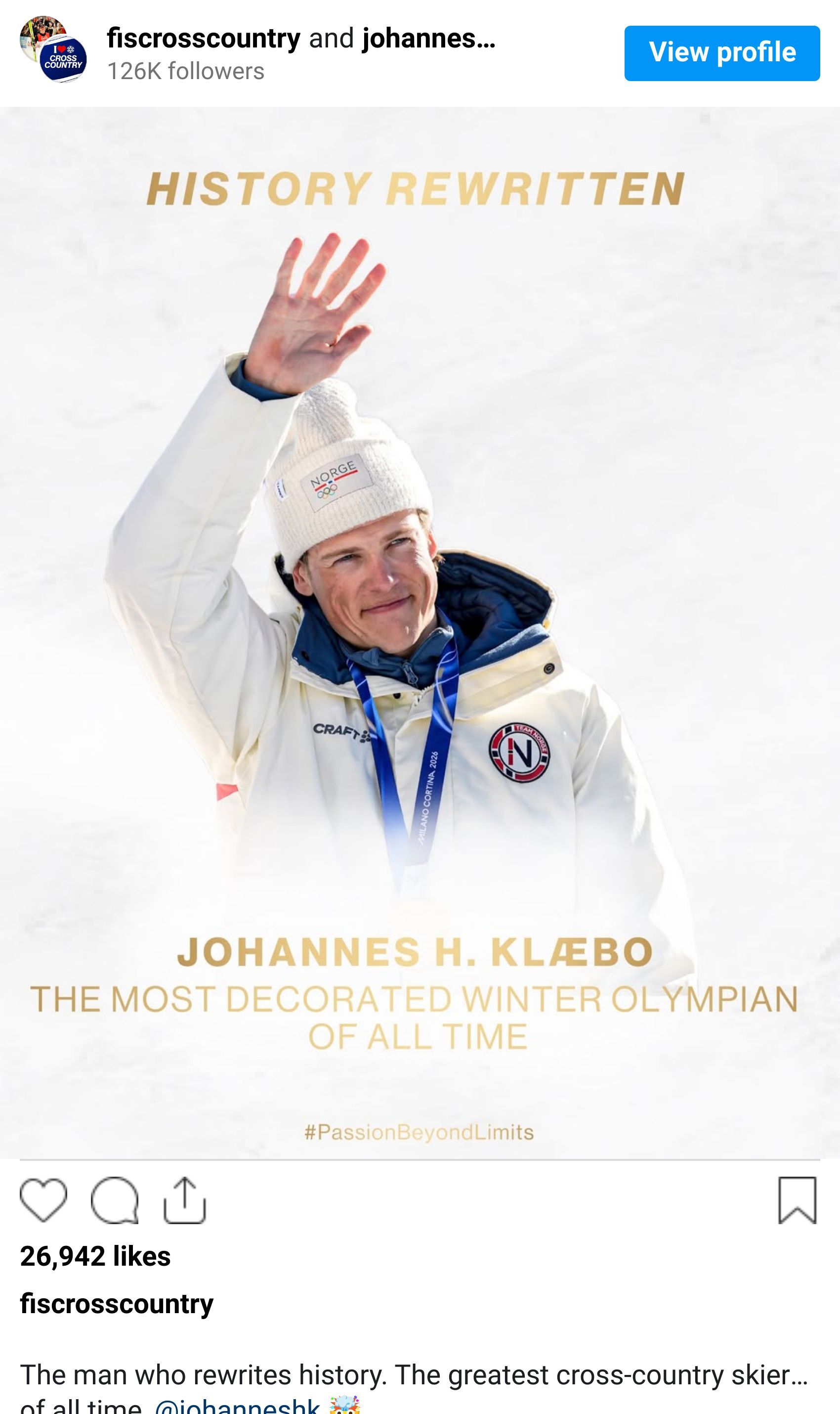
Cross-country skiing G.O.A.T, Johannes Hoesflot Klaebo, raced into the record books as he became the first-ever athlete to win TEN Winter Olympic gold medals across his career. Having secured numbers seven, eight and nine in the 10km+10km skiathlon, sprint and 10km free, he then anchored Norway to victory in the men’s 4×7.5km relay to stretch ahead of three fellow Norwegians, Bjørn Dæhlie, Marit Bjørgen, and Ole Einar Bjørndalen, who had held the previous record of eight golds.
Here’s a quick look at the other news in your Winter Olympics wrap-up.
Biathlon: Quentin Fillon Maillet became France’s most decorated Winter Olympian as he claimed his seventh biathlon medal in the men’s 10km sprint gold. It was his second gold of these Games.
Biathlon: Sweden’s Martin Ponsiluoma took gold in the 12.5km pursuit as his quick, accurate shooting saw him beat Sturla Holm Laegreid of Norway, and France’s Émilien Jacquelin.
Biathlon: Lisa Vittozzi became Italy’s first-ever biathlon gold medal winner as she overhauled Norwegian leader Maren Kirkeeide in the final stages of the 10km pursuit. Finland’s Suvi Minkkinen was third.
For all the latest Winter Olympic news, go to the official website HERE.
🇳🇿 Challenge Wanaka
More than 3000 athletes, including a pro field of 22, are expected to take part in this weekend’s Challenge Wānaka triathlon festival as the event on New Zealand’s South Island marks its 20th year.
The elite line-up for the Wānaka Half – 1.9km swim, 90km bike, and 21.1km run –includes home favourites Mike Phillips and two-time champion Jack Moody, while Frederic Funk (GER) and Britain’s Lucy Byram are among the highest-ranked athletes on show.
The Challenge Wānaka Half takes place on Saturday, February 21. Read more HERE.

Will endurance sports be the next on the radar of the Enhanced Games brand?
🔍 The BIG issue: Enhanced Games eyeing up endurance sports
When Max Martin, the co-founder of sport’s controversial new Enhanced Games, announced he was looking to expand into the endurance arena, you can bet the governing bodies of cycling, triathlon and athletics took note.
Flying against the face of traditional regulations, his Games will permit athletes, under medical supervision, to take performance-enhancing drugs which are currently banned in mainstream sports.
Due to take place in Las Vegas this May, 50 athletes from track, swimming and weightlifting will, as the official website puts it, ‘celebrate human potential through safe, transparent enhancement, offering fair play, record pay, and unmatched athlete care’.
A three-month training camp has also been organised in the United Arab Emirates, where 39 athletes will be offered substances such as steroids, growth hormone and testosterone to measure the impact they have on performance.
Unsurprisingly, the move has created great controversy, with critics arguing it is unethical, that it will ‘normalise’ the act of doping, and could cause severe health issues for the athletes.
But Martin is shrugging off such comments, and in an interview with BBC Sport last weekend, suggested he was already plotting his next move, with the endurance world very much in his sights.
Explaining how he was “very excited about expanding beyond the three sports that we’re currently offering”, he added: “We’re speaking to athletes already outside of the core three sports. What else can we do in long-distance triathlons? What can we do in cycling? What can we do in marathon running?”
Keen to test the limits and break new world records, what is to stop them from signing up a marathon runner or two in a bid to break the two-hour threshold, or bring in a couple of cyclists in an attempt to break the world record of 5:25:58 for the 260km route of the Paris-Roubaix?
Such definitive outcomes are trickier in triathlon, a sport where its world records are not standardised, with courses varying in difficulty and conditions differing from one country to another – but that does not necessarily mean it won’t be targeted.
With a prize pot in the region of $25m, and athletes promised handsome rewards for achieving record times and distances, bodies such as World Triathlon and Union Cycliste Internationale (UCI) will, understandably, be watching carefully.
What we know about the Enhanced Games
The Enhanced Games are due to take place at Resorts World, Las Vegas, on May 24 this year, with 50 athletes competing in swimming, track & field and weightlifting.
Athletes are already listed on the official website, including British swimmers Ben Proud and Emily Barclay, as well as track competitors such as Taylor Anderson (USA), Mouhamadou Fall (FRA), Reece Prescod (GBR), Mike Bryan (GER), and Marvin Bracy-Williams (USA).
A prize pot for the Enhanced Games of $25m has been provided by its investors, including US tech billionaire Peter Thiel, with bonuses of up to $1m awarded for athletes who break a world record.
The Enhanced website states they are ‘transforming human potential into superhumanity’.
It also explains: “The Enhanced Games do not endorse the indiscriminate use of restricted substances. We advocate for the safe, responsible, and clinically supervised use of performance enhancements.”
Only performance-enhancing drugs which have been declared legal under the US Food and Drug Administration will be permitted; these could include some anabolic steroids, growth hormones and testosterone.
The World Anti-Doping Agency has described it as a ‘dangerous and irresponsible concept’ and questioned the legality of those athletes taking the drugs or the physicians administering them.
Travis Tygart, CEO of US Anti-Doping Agency, said: “While those behind the Enhanced Games might be looking to make a quick buck, that profit would come at the expense of kids across the world thinking they need to dope to chase their dreams. We desperately wish this investment were being made in the athletes who are currently training and competing in a real and safe way. They are the role models this world so desperately needs, and they are the ones who deserve our support – not some dangerous clown show that puts profit over principle.”
Jane Rumble, CEO of UK Anti-Doping, said: “It is incredibly disappointing that any British athlete would consider competing in an event that flies in the face of the true spirit of sport. Any decision by any athlete to compete in the Enhanced Games risks undermining the values of a sporting landscape that prizes hard work, integrity, pure talent and 100% clean sport.”
Swiss-based World Aquatics has said it will banish athletes who compete in ‘sporting events that embrace the use of scientific advancements or other practices that may include prohibited substances and/or prohibited methods’.
Would you support an 'enhanced' triathlon series if one was launched?
👩💻 Trending in triathlon
Let’s face it, we all accept that as endurance athletes, we are something of a slightly strange breed. The very fact that we take pride and (sometimes) enjoyment out of sports which are forever testing the limits of our fitness, resolve and sanity, makes us unique.
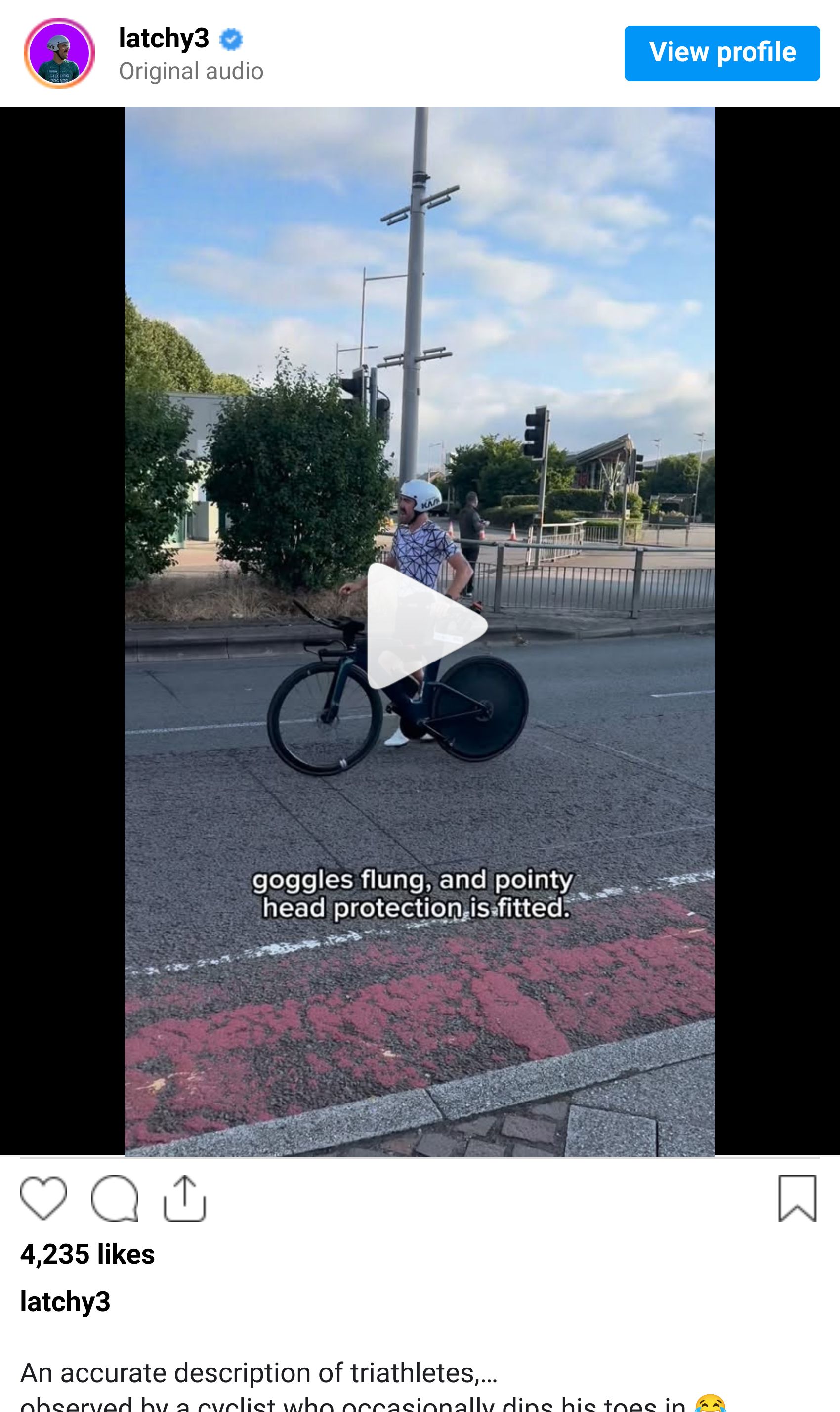
Indeed, when we stumbled across this video below from Andy Latcham, we felt it captured the mentality of an endurance athlete perfectly, even down to the fake David Attenborough commentary introducing us to this ‘fascinating species’ whose main survival tactic is to ‘urinate on themselves while swimming to keep warm’.
Brilliant, Andy… 👏👏

Cold water swimming has seen a surge in popularity in recent years. But avoiding the chlorine and lane ropes of the pool to take your invigorating dip into icy waters does come with inherent risks – particularly when temperatures plummet.
There are, however, some golden rules to follow that can help reduce those dangers. Here are some top tips from high-level masters swimmer Helen Gorman and Swim England-accredited cold water coach and ice swimmer Fenwick Ridley, which will go a long way to ensuring you enjoy your experience to the fullest.
🚨 The risks
🥶 Cold water shock: This can happen to any swimmer, regardless of ability, and is the body’s physiological response to sudden immersion in cold water – defined by the Royal National Lifeboat Institution as water under 15 degrees Celsius. As blood vessels constrict in order to preserve body heat, both blood pressure and heart rate rise, leading to an increased risk of heart attacks.
🥶 Hypothermia: Hypothermia occurs when the body’s core temperature drops below 35C. Setting in gradually, it can take around 20-30 minutes for symptoms to start showing, making it a real danger to swimmers. Alongside the physical symptoms, such as uncontrollable shivering, loss of muscle function, impaired coordination and claw-like hands, hypothermia also has an impact on your mental function, reducing reaction time, making it difficult to speak, and reducing your ability to assess your own condition.
🥶 Muscle cramps: Cramp is every swimmer’s foe at one time or another. And while the precise cause of cramp is unknown – with hypotheses ranging from muscular fatigue to electrolyte imbalances – anecdotal evidence suggests that cold temperatures can increase the prevalence of muscle cramps. Not only is cramp excruciatingly painful – it’s also dangerous if you’re in the water because it can make it very difficult to swim.

Follow our top tips on how to swim safely in cold water.
🛟 How to swim safely
🏊♀️ Swim with a group: A coached or group session is the safest environment. If you visit a ‘wild swimming’ location, ideally choose one that you’re already familiar with and ensure that you have at least one buddy with you. A mobile phone with a good signal is essential. Also, make sure everyone in your group knows the signs of cold water shock, swim failure and hypothermia so you can all look out for each other.
🏊♀️ Don’t just dive in: Resist the temptation to dive headfirst into cold water swimming. Your body will gradually acclimatise, allowing you to swim in colder temperatures with less discomfort. But this adaptation takes time. Start your cold water swimming early in the winter season before temperatures drop too low, so you’ve got time to adapt gradually as the water gets colder. It’s about a staged introduction.
🏊♀️ Reduce your time in the water: Check the water temperature before you get in, and adjust your session accordingly. The colder the water temperature gets, the faster your body will fatigue because it’s having to work harder to keep your core temperature up.
🏊♀️ Get the right gear: It’s OK to wear a wetsuit. That added layer of neoprene will help to keep you warmer – especially if you treat yourself to a thermal one – and it’ll give you some extra buoyancy, which is ideal from a safety perspective. Other key purchases should include swimming gloves and boots, a bobble hat under a brightly coloured swim cap, a tow-float with a dry bag… and make sure you have some warm clothes and a flask of hot chocolate waiting for you when you return to land.
🏊♀️ Finally… check the weather: Avoid swimming in high winds and during or soon after heavy rainfall – the water quality might be compromised, which may cause sickness. If you’re planning to swim in the sea/ocean, check the local tide times so you don’t get caught out by a rapidly changing tide.
💪 Outside edge of endurance
Russ Cook, aka The Hardest Geezer, is never one to shy away from a challenge, especially when completing it also helps him prove some of his doubters wrong.
This week, the man who made his name by running the length of Africa used his Instagram account to highlight some of the ‘hate comments’ posted in response to his self-imposed target of running a sub-2:30 at this year’s London Marathon.
Among the comments, one follower claims he is ‘just chatting rubbish’, while another suggests ‘it would be like a Sunday league footballer trying to convince the internet they are going to play for Manchester United’.
Laughing and smiling as he reads through them, he finishes by actually getting scientifically tested to see whether a 2:30 is possible in his current state of fitness… with interesting results!!! 🏃🏼

What did you think of today's email?
That’s your Split. Until Next Time
Together, we go the distance. — @247_endurance 🏃♂️🚴♀️🏊♂️