

👋 Welcome back
Morning endurance fans… and Happy New Season 🎉🥳
March is finally here, the IRONMAN Pro Series kicks off this weekend, and you can almost hear the collective click of cleats, the zip of wetsuits and the rattle of race wheels coming out of hibernation.
Your winter miles are banked. Turbo sessions are (mostly) survived. Long, dark runs have toughened the mind. And now? Now the season begins.
Here’s what we have in store for you today…
PREVIEW: Who is lining up in New Zealand this weekend?
FARCE: Runners go the wrong way in US Half Marathon.
RULES: Deep dive into the new IRONMAN rules for 2026
TIPS: What is running cadence, and how do you measure it?
🏃🏼 Quick splits

Croc-alert!!! More reaction after the swim leg of IRONMAN 70.3 Colombo was scrapped. [IRONMAN]
🤩 Sanders talks retirement: Canadian triathlete Lionel Sanders says he is not ready to hang up his trisuit just yet and is throwing everything he has got into a bid for glory at the World Championships in Kona this summer. Read HERE.
🏊♀️ LCB back with a win: Lucy Charles-Barclay proved her all-round sporting skills by winning the Women’s 18 Years & Over Essex County Championships at the London Aquatics Centre, taking the 1500m freestyle in 17:29.40. Read HERE.
🥇 Wilde off to a flier: Kiwi superstar Hayden Wilde kicked off his 2026 season just as he finished 2025, dominating the field in the Oceania Sprint Championships & Continental Cup in the art deco New Zealand town of Napier. Read HERE.
🐊 Beware the crocs: There was widespread support for IRONMAN organisers in Colombo who decided to scrap the swim section of the 70.3 race due to ‘wildlife’ being spotted in the water – wildlife thought to be crocodiles. Read HERE.
🎽 Just having fun: Ultra running great, Chris Myers, talks to RUN247 reporter Jonathan Turner about his career, ethos and how a 20-miler in the desert resulted in him changing course and pitting his skills against longer distances. Read HERE.
🏁 Race news

Tadese Takele took the tape in the men’s Tokyo Marathon at the weekend. [Tokyo Marathon]]
🎽 Tokyo Marathon
Kenya’s Brigid Kosgei turned back the clock with a course-record display to win the women’s race in Tokyo while Ethiopia’s Tadese Takele (ETH) won a three-way thriller in the men’s event.
Kosgei had shown she was in good form with victory in last November’s Shanghai Marathon, and she broke away at the 30km mark with reigning champion, Sutume Kebede (ETH), before then making a break on her own and finishing in 2:14:29.
Four men, Takele and three Kenyans – Geoffrey Toroitich, Alex Mutiso and Daniel Mateiko – were in the leading group after 40km, but Mateiko was the first to be dropped, before Takele kicked on to edge Toroitich in a thrilling finish.
Women’s Tokyo Marathon results:
🥇 Brigid Kosgei (KEN) 2:14:29
🥈 Bertukan Welde (ETH) 2:16:36
🥉 Hawi Feysa (ETH) 2:17:39
Men’s Tokyo Marathon results:
🥇 Tadese Takele (ETH) 2:03:37
🥈 Geoffrey Toroitich (KEN) 2:03:37
🥉 Alex Mutiso (KEN) 2:03:38
💪 IRONMAN New Zealand
The IRONMAN season gets underway in earnest this weekend with the opening race of the Pro Series playing host to a quality field of athletes in Taupō, New Zealand.
Last year’s champions, Mike Phillips (NZL) and Regan Hollioake (AUS), return to defend their titles, while the winners of the 2025 Pro Series, Kat Matthews (GBR) and Kristian Blummenfelt (NOR), are also confirmed to start.
Other names in the women’s field include Jocelyn McCauley (USA), Nina Derron (SUI), Tamara Jewett (CAN) and Gabrielle Lumkes (USA), while Kiwi Kyle Smith and Frenchman Pierre Le Corre will no doubt interest spectators as they tackle a full-distance IRONMAN for the very first time.
⏱️ When to watch: The men’s elite athletes start at 7.45am local NZDT time, which is 10.30am PST, 12.30pm CST, 1.30pm EST, 6.45pm in the UK, and 7.45pm in central Europe on the previous Friday, March 6. The women’s elite race then starts five minutes later.
📺 How to watch: The races can be streamed live via IRONMAN.com/proseries, the IRONMAN YouTube channel, and DAZN. Live coverage, including Pro Series action, is available for free, alongside the IRONMAN Tracker app for tracking age-group athletes.
🤦♀️ US Half Marathon
There was huge controversy at the women’s US Half Marathon Championship race in Atlanta over the weekend when an official pace car led the three leading runners the wrong way, causing them all to miss out on the chance of a podium finish.
Jess McClain was running comfortably at the front of the pack, closely pursued by Ednah Kurgat and Emma Hurley with only one and a half miles remaining. However, they were then guided off course as they wrongly followed the vehicle, and by the time they realised what had happened, it was too late.
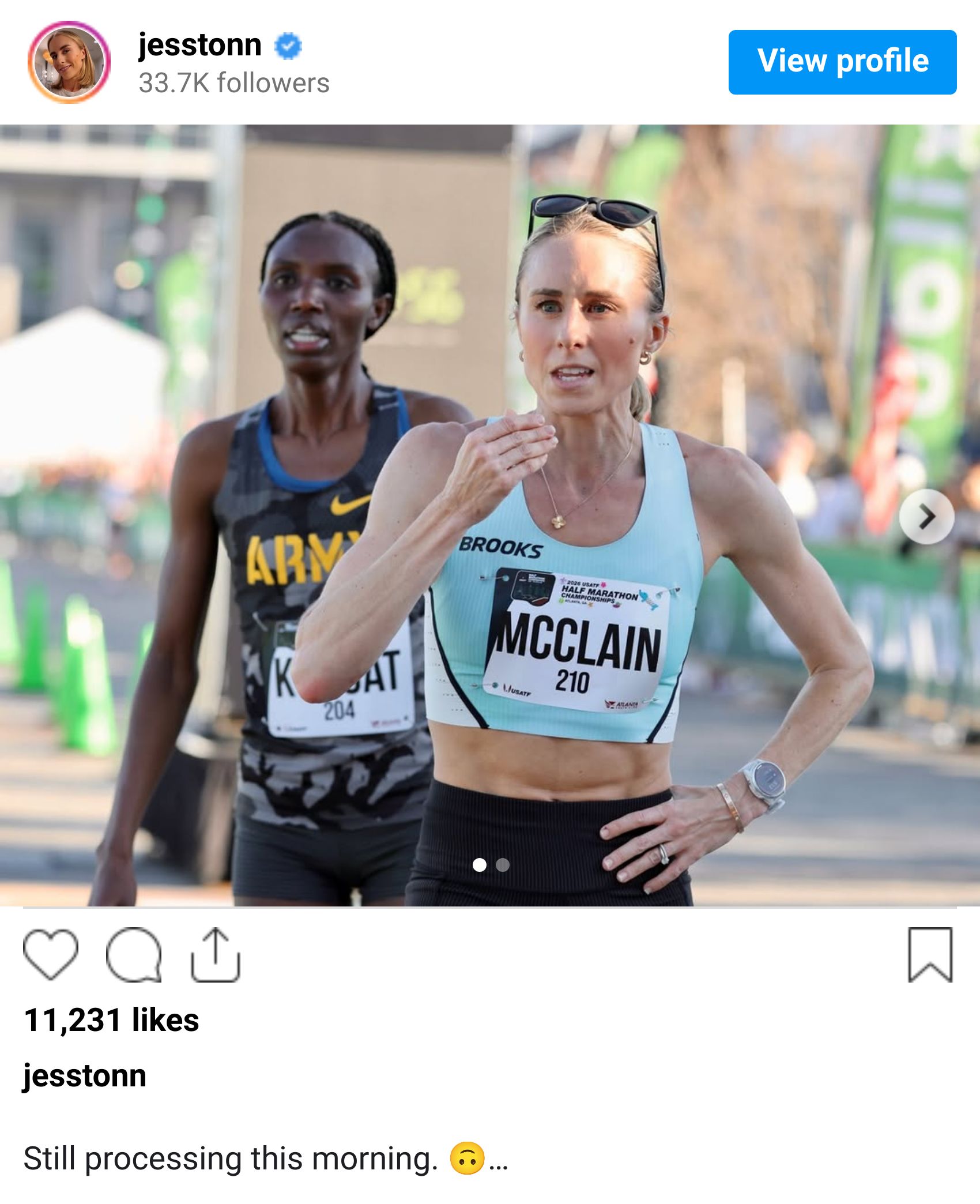
Instead, a puzzled-looking Molly Born crossed the line in a time of 1:09:42, ahead of Carrie Ellwood and Annie Rodenfels. McClain, Hurley and Kurgat, clearly frustrated by the incident, came in 11th, 12th and 13th, respectively.
As well as acting as a qualifier for the USA team at the World Road Running Championships in September, the winner also claimed a cheque for $20,000.
USA Track and Field (USATF) have confirmed that a protest was lodged by the athletes who had clearly been the victims of a terrible error by the race official, but it added that the jury of appeals found that while ‘the course was not adequately marked at the point of misdirection’ there was ‘no recourse within the USATF rulebook to alter the results order of finish’.
McClain, posting on her Instagram account in the aftermath of the race, said: “This truly sucks for everyone involved. No one wants this outcome, ever. Mistakes happen & I am sure those who were leading us feel terrible about the outcome. I just hate that the athletes are ALWAYS the ones who pay the price (literally $$$)… time & time again.”
🚴♀️ News from the saddle
Dutchman Mathieu van der Poel is looking to become the first man to win both the Omloop Nieuwsblad and the Tour of Flanders after claiming a dominant victory in Belgium at the weekend.
Key to his win was a stunning attack on the Muur van Geraardsbergen – one of the most famous climbs in road cycling – as he beat compatriot Tim van Dijke and Florian Vermeersch (BEL) into second and third respectively.
He will now set his focus on completing a Belgian double with the 271km Tour of Flanders taking place on Sunday, April 5, between Antwerp and Oudenaarde.
There was also a Dutch winner in the women’s Omloop Nieuwsblad, where Demi Vollering and Kasia Niewiadoma-Phinney (POL) broke away from the pack, before Vollering dominated the final sprint. It was her first win in the race. Lorena Wiebes, also from the Netherlands, came third. Read More at Cycling Weekly.
Men’s Omloop Het Nieuwsblad results:
🥇 Mathieu van der Poel (NED) Alpecin-Premier Tech: 04:53:55
🥈 Tim van Dijke (NED) Red Bull-Bora-Hansgrohe: +22s
🥉 Florian Vermeersch (BEL) UAE Team Emirates-XRG: +24s
Women’s Omloop Het Nieuwsblad results:
🥇 Demi Vollering (NED) FDJ United-SUEZ: 03:35:51
🥈 Kasia Niewiadoma-Phinney (POL) Canyon-SRAM-zondacrypto: SAME TIME
🥉 Lorena Wiebes (NED) SD Worx-ProTime: +21S
Would you be interested in reading an edition of the Daily Split solely focused on cycling?

IRONMAN has announced a ban on athletes filming during their races via hi-tech glasses.
🔍 The BIG issue: IRONMAN rule changes
IRONMAN New Zealand will not only herald the start of a new Pro Season campaign this weekend, but it will also be the first race of 2026 where the new rules and regulations for all athletes will be implemented.
The M-Dot brand has released its updated 2026 Global Competition Rules, with key updates on bike draft zones for professional athletes, equipment specifications, and terminology around the PC/ID Open Division.
Of course, the drafting move from 12 to 20 metres for the pros was announced earlier this year after a testing and consultation period, and was widely welcomed as IRONMAN came into line with both the T100 Triathlon World Tour and Challenge Family races.
The draft zone for age-group athletes will remain at 12 metres, and the new rules for 2026 offer clarification around that, especially where age-groupers could impact the pro race – on multiple lap courses, for example.
We have pulled together all of the key aspects from the report below in our in-depth briefing, but in terms of headline changes, there are a couple that are certainly catching the eye… literally.
Most notably, the fact that athletes are now explicitly banned from taking photos or video footage in-race, a ruling which is clearly aimed at influencers who wish to relay coverage of their efforts, either live or recorded, to their army of social media followers.
Interestingly, a 2017 rule had made it clear that while mobile phones could be carried, they could not be used for filming of any kind, and it now seems that it is the arrival of Meta/smart glasses that has, no doubt, prompted the update. Anyone who doesn’t abide by the ruling will face disqualification.
Other rulings range from tri-suit zipper clarifications to PC/ID classifications… and all of the new rules are effective from March 2nd, so they will be in force this weekend.

Among the new rules announced for the IRONMAN season is the new 20-metre draft zone. [IRONMAN]
From drafting to tri-suit zippers… the rules explained
As previously announced, IRONMAN will be moving to a 20-metre bicycle draft zone for all professional races. The draft zone is measured from the leading edge of the front wheel of each bike, and extending 20 metres backwards.
The trailing cyclist must ensure that their front wheel remains outside of this draft zone. With the update to 20 metres, professional athletes will now have a maximum of 45 seconds to complete the pass of an athlete.
The draft zone for age-group athletes will remain at 12 metres, however the updated draft zone for professionals could impact age-group athletes depending on race flow and type of course. Age-group athletes who may interact with professional athletes during the bike segment are bound to the stated age-group drafting rules but may not slot in between two or more professional athletes who are legally spaced.
Age-group athletes must either remain behind at 12 metres of the trailing professional athlete or pass all professional athletes in a legally spaced group. In this situation, age-group athletes will have 45 seconds to pass each athlete in the group. Additionally, while initiating a pass, age-group athletes may not slipstream the trailing professional athlete in a legally spaced group.
The PC/ID Open race division has been renamed as the Para Open division, with the term Para referring to Parallel. The Para Open division will remain inclusive and non-competitive in 2026, with IRONMAN aiming to develop additional sub-Para classifications in the coming years.
This approach reflects an effort to better align with global standards and the broader international movement towards consistent and inclusive classification structures. This amendment was made with input from and in collaboration with a working group of Para athletes, guides and coaches from around the world.
Any items that are attached to the top tube of the bike may be a maximum of 10cm high, measured from the top edge of the tube, and may not be attached to, or cover, the headset. Additionally, no part of the athlete’s body may rest on items attached to the top tube.
Regarding tri-suits, an amendment has been made to reduce the penalty for the front zipper of an athlete’s uniform not being connected at the bottom, or their top not covering their shoulders. Violations will no longer result in a potential disqualification and will instead result in a warning and amendment, to be followed by a 30 or 60-second time penalty.
Using any device (eg, including without limitation, cameras, phone cameras, video cameras, glasses, etc.) to capture photographs, video, or other visual images during the Race is prohibited. Athletes using any device in this manner will be disqualified.
Headsets, headphones, audio-capable eyewear (including AI glasses) or audio-capable cycling helmets are prohibited during the bike segment of the race.
(30 or 60 Second Time Penalty (as applicable), DSQ if not remedied promptly).
👩💻 Trending in triathlon
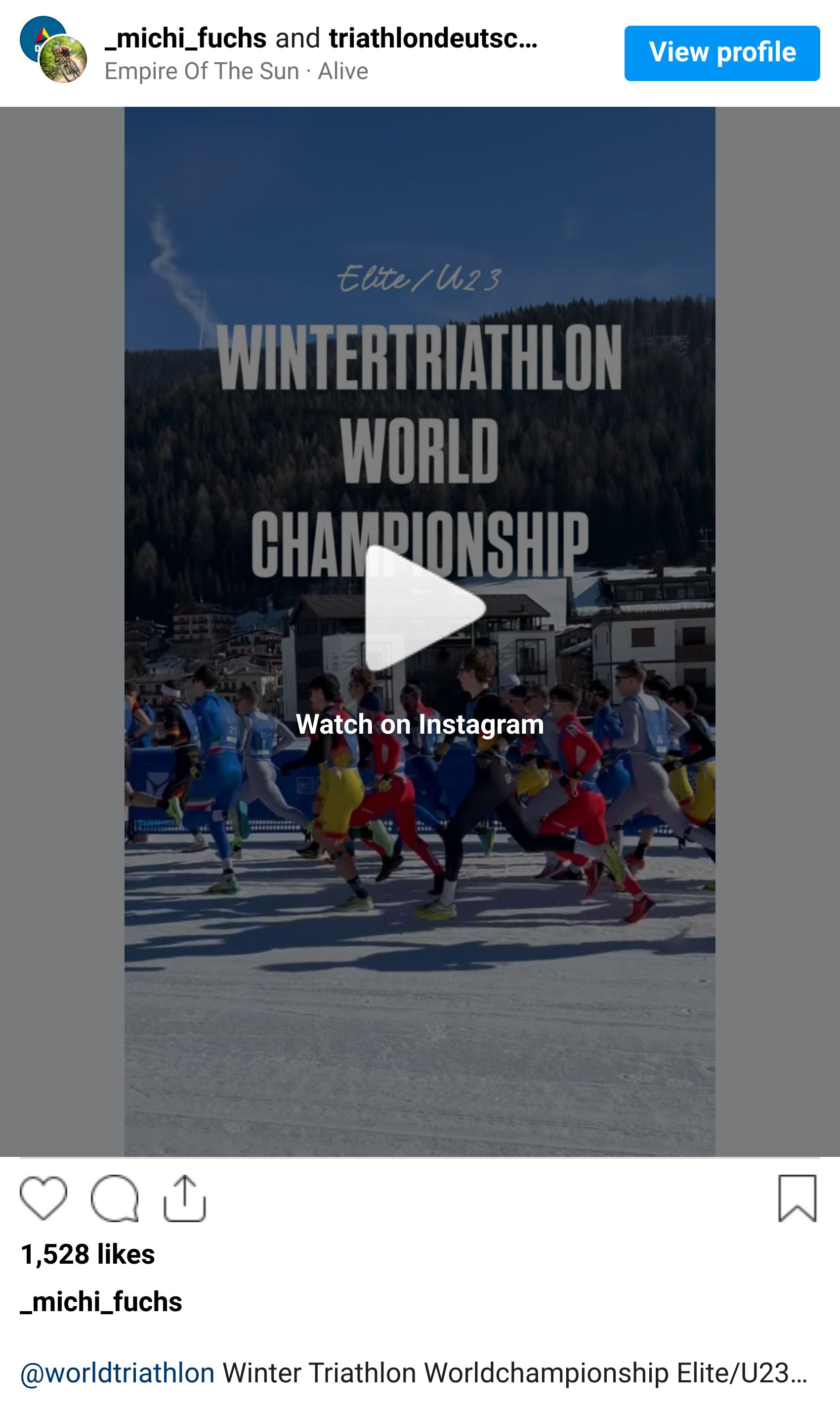
The Winter Triathlon World Championships took place in Padola, Italy, over the weekend, where there was late drama in the men’s elite race as Dmitrii Kondrashov (AIN) edged a mighty three-way sprint for the line. Daria Rogozina (AIN) faced significantly less pressure as she pulled clear to secure her fifth world title.
The video below, which was posted on Instagram over the weekend, shows the event in all its glory under clear blue skies as swim-bike-run was replaced with run-bike-ski.
You can read more about the event on the World Triathlon website HERE.
⏱️ Coaches corner: Checking your running form
Running form and economy can often be the key ingredient to unlocking your running potential. Helping you to run further and faster, with less risk of injury. But what does ‘improving your form’ actually mean, and how can you do it?
🏃🏼 Cadence
Cadence in running is essentially how quickly you’re moving from one foot to another – ie, how fast your foot turnover is. We measure running cadence in strides per minute. It’s an important part of your run form, because your cadence has an impact on factors such as your stride length – where your foot strikes the ground relative to your hips.
⬇️ Low cadence: If you have a low cadence, you’ve likely got a longer stride. But if you’re overstriding, you’ll be striking the ground hard with your heel way out in front of your hip. This slows you down, as you’re essentially putting the brakes on with each step. And it may also correlate with an increased risk of injury, as the angle created at your ankle joint when you overstride puts more impact through the lower limbs.
A low running cadence can also indicate that you’re running with a more ‘bouncy’ form. This means you’re bouncing up, rather than propelling forward. By speeding up your cadence, you should naturally find that you have to shorten your stride. This can help you unlock extra speed and efficiency as you find more forward propulsion.
📐 How to measure cadence: You can measure your running cadence the old-fashioned way – by running for 60 seconds and counting how many times your feet hit the ground – but there’s a risk you’ll lose count. Most running watches these days can calculate your cadence and give you an average strides per minute (SPM) value for each run.
👍 The ideal cadence: We all have different biomechanics, so the optimal running cadence will vary between individuals. For example, a taller, long-limbed runner is naturally going to have a lower cadence than a more petite runner. It used to be said that 180spm was the holy grail of running cadence, but in truth, it is more about finding the right cadence for you. On average, recreational runners are said to have a cadence somewhere between 150 and 180spm, with anything under 160spm indicating overstriding.

🤔 Running form improvement
Once you know your cadence, you can use other running metrics, such as ground contact time and vertical oscillation, to build up a picture of your running efficiency.
👟 Ground contact: Ground contact time is the amount of time your foot spends in contact with the ground during each run stride. The lower the amount of time, the faster you’ll run, and when used in tandem with your cadence score, you can check running efficiency. If you’re getting good propulsion and you’re not spending too much time sinking into the ground, your cadence might already be optimal for your biomechanics.
However, if you notice that your ground contact time is high, the good news is that speeding up your cadence (focusing on faster foot turnover) will naturally help to improve your contact time. You can incorporate plyometric conditioning into your gym routine, such as hops and drop jumps, to improve your explosive power.
⬆️ Vertical oscillation: In running, this refers to how far up in the air you travel with each running stride. If you’re bouncing upwards, your vertical oscillation will be high, which actually means you’re wasting energy going ‘up’ instead of pushing forward. Try to think about darting forwards with every run stride, rather than hopping upwards. You should find that you can go faster for the same effort.
5️⃣ Our top 5 training tips
Improving your running form can be an easy enough fix, as the things you need to make such improvements are probably already part of your training. With a mindful focus on cadence, ground contact time and vertical oscillation while you’re running – plus some specific speed work and conditioning – you should soon start to reap the running rewards.
⏩ Focus forward: Interval training and tempo runs will help you improve your run form – focus on forward propulsion, shorter strides and faster foot turnover.
⛰️ Hill starts: Short hill repeats of up to 2 minutes can build strength and power – most of us will adopt the most efficient form when running up hill to overcome the forces of gravity.
🏃♂️ Stride drills: Incorporate stride drills at the end of your warm-ups, involving short bursts where you progressively increase your pace and exaggerate your run style – this will help you to focus on propelling forward.
📔 Plan ahead: Incorporating one or two speed/hill sessions a week will help to ingrain better form into your running at the slower paces.
🏋️♂️ Strength matters: Building up your strength with leg press, squats and deadlifts will help to develop resilience against injury, while it is also worth working on the upper body with reverse flies, tricep extensions and hammer curls, and exercises which train your core to stabilise your pelvis, such as slow-motion planks, spiderman planks and prone dead bugs.
💪 Outside edge of endurance
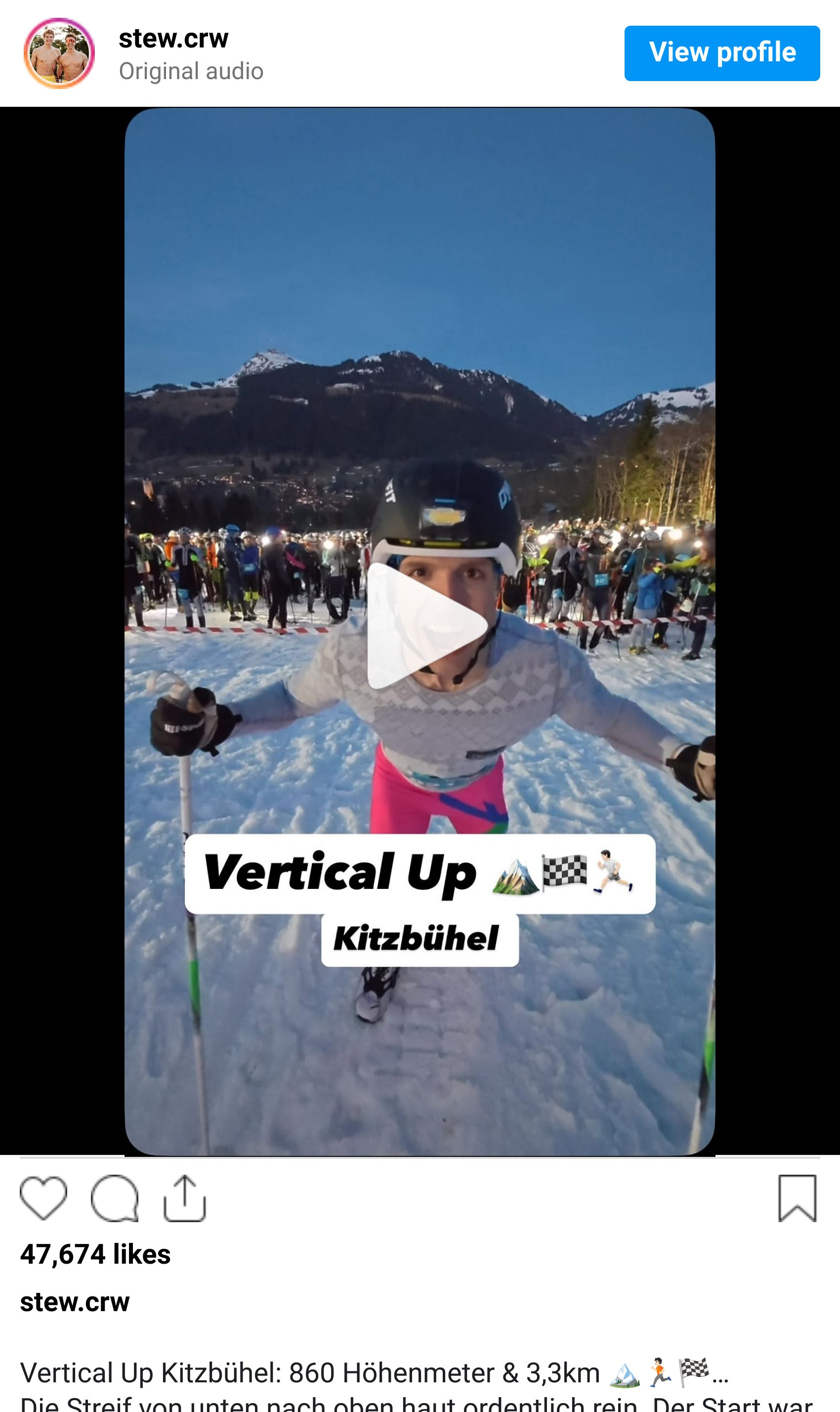
Coming down one of the most dangerous ski slopes in the world must be hard enough, but what about trying to run UP it? That’s what a thousand people did at the weekend when they took part in the annual Vertical Up at the world-famous Austrian ski resort of Kitzbühel, where the goal is to conquer the legendary Streif course – which is 3,312km long and has an elevation gain of 860 metres – as quickly as possible.
Christof Hochenwarter (AUS) was the overall winner in a time of 31:14, while Vicky Kreuzer (SWI) was the first woman across the line in 39:04. The video below was posted by Austrian influencers, the Stew Crew, and we all agree in the Daily Split office that this looks utterly MAD!!!! ❄ 🏔️ 🎿
Are you ready to take your endurance journey to the next level? We have teamed up with Holly Wilson, Challenge Family, and some of the industry’s leading performance brands to give one lucky winner the Ultimate Triathlon Experience.
We are giving away a prize package designed for those of you who live for the finish line. Whether you are a seasoned pro or preparing for your first middle-distance event, this bundle provides the access and equipment you will need to perform at your peak.
What did you think of today's email?
That’s your Split. Until Next Time
Together, we go the distance. — @247_endurance 🏃♂️🚴♀️🏊♂️