


👋 Welcome back
Morning endurance fans… and happy weekend!!!!
Welcome to Saturday’s endurance round-up — where the new season is truly starting to stretch its legs. From triathlon start lines and ultramarathon adventures to the relentless world of cycling and the icy brilliance of winter sport, the engine room of endurance is very much rumbling along.
So, go and grab a coffee, loosen the hamstrings and settle in for the latest news, results and stories from the wonderfully relentless world of endurance sport. 🏊♂️🚴♂️🏃♂️❄️
Here’s what we have lined up for you today…
LATEST: The endurance news headlines.
REPORT: IRONMAN Pro Series gets underway in New Zealand.
CYCLING: Can anyone stop Tadej Pogačar at Strade Bianche?
BLISTERS: How to avoid them when you clock up the miles.
🏃🏼 Quick splits

Sam Laidlow has added his name to the Challenge Roth roster this year. [Challenge Family]
🤯 Roth excitement: Challenge Roth has always been one of the highlights of the triathlon season, but this year’s races are shaping up to be two of the very best in its history as Sam Laidlow adds his name to the stellar start lists. Read HERE.
🤰 Baby joy: The triathlon family came together this week to congratulate Aussie athlete Ashleigh Gentle as she announced she was pregnant, just a matter of months after suffering the heartbreak of a miscarriage. Read HERE.
⏱️ Funk’s future: Coach Dan Lorang explains to TRI247 why Fred Funk is making the switch to full distance after spending last season on the T100 tour – starting with this weekend’s IRONMAN opener in New Zealand. Read HERE.
💵 Paid up: The athletes who were denied a podium finish at the US Half Marathon in Atlanta last weekend, when they were led off the course by a pace car, have been compensated with the equivalent prize money. Read HERE.
⏰ Made in marathon: Fresh from his recent triathlon world record feat, ‘Made in Chelsea’ star Spencer Matthews smashed the three-hour barrier at the Tokyo Marathon last weekend by coming home in 2:57:42. Read HERE.
🏁 Race news

The brilliant Kat Matthews started her season off with a win in New Zealand. [IRONMAN]
🇳🇿 IRONMAN New Zealand
Kat Matthews made the perfect start to the new Pro Series season as she claimed an emphatic victory at IRONMAN New Zealand in Taupō earlier today.
The British athlete stormed away in the run to open up a huge gap on the remainder of the field, crossing the line in 8:28:55, and setting a new course record in the process – her time beating the previous best by more than 10 minutes.
However, while it was very much a day for the favourite in the women’s race, the men’s event caused something of a surprise as Norwegian powerhouse Kristian Blummenfelt struggled with mechanical issues on the bike and then had nutrition problems on the run.
As Big Blu faded from contention, it was American Trevor Foley who took full advantage, storming past Kiwi and long-time leader Kyle Smith midway through the run and then holding off the challenge from Pierre Le Corre (FRA) and Matt Hanson (USA) for the win.
IRONMAN New Zealand women’s results
🥇 Katt Matthews (GBR) - 8:28:55
🥈 Hannah Berry (NZL) - 8:35:43
🥉 Lotte Wilms (NED) - 8:39:57
For more on the women’s race, read the TRI247 report HERE.
IRONMAN New Zealand men’s results
🥇 Trevor Foley (USA) - 7:46:44
🥈 Pierre Le Corre (FRA) - 7:48:26
🥉 Matt Hanson (USA) - 7:50:39
For more on the women’s race, read the TRI247 report HERE.
🚴♂️ News from the saddle
The full start list for the men’s Strade Bianche today has been confirmed, with a mixture of headline riders, past winners and debutants. Among those expected to light up the race are the defending champion Tadej Pogačar (UAE Team Emirates-XRG), last year’s runner-up Tom Pidcock (Q36.5 Pro Cycling), and 19-year-old Paul Seixas (Decathlon CMA CGM), who is widely touted as French cycling's emerging hope.
Strade Bianche is the latest of the season’s Classics, with the white gravel roads of Tuscany and the stunning finale into Siena set to decide one of the calendar’s most thrilling races.
You can read a preview of the race on Cycling News, HERE.

It is unlikely that the WTCS event in Abu Dhabi will take place this month. [World Triathlon]
🔍 The BIG issue: How will the Middle East war impact endurance sports?
As the world watches the missiles firing both into and out of Iran, those responsible for organising the many sporting events planned for the Middle East region in 2026 are all no doubt thinking the same thing… ‘What does that mean for us?’.
Talking about sporting issues when there is a war raging, and people are suffering, always seems trivial, and there is no question that athletic pursuits of any kind should, and indeed will, take a very distant seat in the order of importance over the coming weeks and months.
However, this is now a region of the world which has worked hard on creating a place for itself at the top table of sporting events, and whether that is in triathlon, marathon, athletics, cycling, or even golf, tennis and Formula 1, a great deal of money has been invested in delivering some of this year’s major events.
Qatar, Saudi Arabia and Bahrain’s capital Manama have been targeted by Iranian missiles and drones, with a hotel hit in the latter city, after the US and Israel launched attacks on Iran. Major airports in the region, significant hubs for international travellers, remain closed, making it difficult for athletes to get to this week’s Paralympic Winter Games in Milano-Cortina.
Already, we have seen the World Endurance Championship postpone its season-opening race, which was scheduled for March 28 in Doha; a new date for the Qatar 1,812km will be finalised and announced once the picture becomes clearer.
The ATP Challenger event in Fujairah, UAE, was cancelled due to safety concerns, while the US men’s hockey team withdrew from a World Cup 2026 qualifier in Ismailia, Egypt, after an official advisory from the State Department urged all US citizens to ‘leave nations within or close to’ conflict zones.
And in motorsport, Mohammed Ben Sulayem, who heads the global governing body FIA, said safety will be their main concern when deciding on next month’s Formula One races in Bahrain and Saudi Arabia. Indeed, it is now likely that both events will be scrapped from the 2026 schedule and the 24-race calendar simply reduced to a 22-race season.
So what of triathlon, running, and cycling?
Cycling’s first round of the 2026 UCI Mountain Bike Eliminator World Cup, originally scheduled to take place in Dushanbe (Tajikistan) on 5 April, has been postponed.
The Organising Committee and the Tajikistan Cycling Federation have stated that they are ‘unable to guarantee the smooth running of the round as scheduled due to the current situation in the Middle East’.
In terms of triathlon and running, nothing has been officially cancelled; however, a very large ‘but’ must be added here, as World Triathlon decides on what to do ahead of this month’s World Triathlon Championship Series race in Abu Dhabi.
An announcement is expected imminently, but it seems conversations are ongoing as race organisers and those on the ground decide a course of action likely to provide a blueprint for others to follow should events drag on.
Indeed, time is a crucial factor, and for triathlon in particular, with the WTCS event the only one this side of the summer likely to be impacted by the knock-on effects of the war.
While the US has already insisted it does not want this offensive to be a long-running battle, should missiles still be falling as we approach the closing months of 2026, then the likes of IRONMAN and the PTO will also be forced into making some big decisions.
IRONMAN are due to host the Dhofar 70.3 in October and the Oman full-distance race in December, while the T100 season is expected to finish off with races in Dubai, Saudi Arabia and Qatar through November and December.
And it is not only questions regarding the safety of host nations which need to be answered, as there will no doubt also be serious deliberations over worldwide travel and racecourse security, particularly when athletes are competing in the US.
With the priority in all cases focused on athlete and viewer safety, organisers understand there can be no doubts or indecision; safety first will be the right play, and while the bombs are dropping, sports must and will sit back and wait.

The WTCS in Abu Dhabi is due to take place on March 28. [World Triathlon]
The impact of war in the Middle East
While no sporting events are planned to take place in Iran, since the US and Israel launched strikes on the country last week, it has carried out retaliatory missile and drone attacks across Israel, Saudi Arabia, Bahrain, Qatar, Kuwait, the United Arab Emirates (including Dubai), and Azerbaijan.
Many of these nations situated in the Persian Gulf are due to host major sporting events of some kind during 2026, as organisers and governing bodies take advantage of the warmer weather either side of the European summer.
Some sporting events have already been cancelled due to fears over safety, with the opening round of cycling’s UCI Mountain Bike Eliminator World Cup, originally scheduled to take place in Dushanbe (Tajikistan) on 5 April, and the World Endurance Championship, scheduled for March 28 in Doha, no longer taking place.
Mohammed Ben Sulayem, President, Fédération Internationale de l’Automobile (FIA), said: “The safety and well-being of our community will always be the FIA’s first priority. As the opening event of the FIA World Endurance Championship, the Qatar 1812km holds a special place for many fans, drivers and teams alike, and we will work closely with all involved to reschedule the race for later in the 2026 season. The FIA continues to monitor developments across the region, and our thoughts remain with all those affected by these recent events as we hope for calm, safety and a return to stability.”
One of the biggest and most expensive sports is also expected to make the call and scrap events in the region, with the Formula 1 calendar likely to lose its weekends at Bahrain and Saudi Arabia. Mercedes chief Toto Wolff said yesterday: “Formula One, in a way, becomes the second priority. I would very much hope we race. Is it realistic that we race there at the moment? I’m not quite sure.”
As well as the Abu Dhabi WTCS event later this month, the World Triathlon Multisport Championships are planned to take place on Hudayriyat Island in the UAE between the 13th and 22nd of November.
World Triathlon will also be concerned about any potential escalation of the conflict as the second event of the WTCS season is due to be held in Uzbekistan, which borders the Middle East, and this week, saw its government express concerns over the ongoing situation.
The World Triathlon Women’s World Cup weekend is also set to take place in the region, with the Dubai event lined up for the opening week in December.
Additional security is expected at the Oceanside 70.3 later this month, as part of the running course will take the athletes through the Marine Corps Base at Camp Pendleton.
Travel is also a major consideration for athletes, with thousands of flights grounded in a situation that has been described as the most serious disruption to global travel since the Covid-19 pandemic.
👩💻 Trending in triathlon
Just when we didn’t think Challenge Roth could get any better, the legend that is Sam Laidlow pops up with a video on Instagram, which not only confirms his attendance, but also ramps up the excitement 100-fold… if that were even possible!!!!! 🤯
His ‘I’m coming for the Roth record, and I’m coming for you, Kristian Blummenfelt’ post (which is embedded below) certainly got the pulses racing… and arguably makes Roth THE race to watch in 2026. We can’t wait… 🤩

⏱️ Coaches corner: How to avoid blisters?
Blisters are something every runner will have encountered at one time or another. And while for the most part they’re a minor – but painful – inconvenience. For runners putting in the big miles or taking on multi-day trail races. Blisters can quite quickly become a race-ruining disaster.
🩹 What causes blisters?
In runners, blisters are typically caused by friction, which damages the upper layer of skin and causes a small ‘bubble’ of fluid between the top layer of your skin and the deeper layers. The blister forms to prevent further damage, but they’re also pretty painful. Ill-fitting running shoes, socks that rub or conditions that leave you with wet feet for a sustained period of your run are usually the culprit for blisters.
❌ How to prevent blisters
Coming home from a race with the soles of your feet resembling the surface of the moon doesn’t have to be the rule of thumb. And there are plenty of measures you can take to avoid getting blisters while running – or at the very least, reduce their severity.
👟 Get shoes that fit: It doesn’t matter how great the energy return feels or how beautifully grippy they are. If your running shoes don’t quite suit the shape of your feet or your gait, they’re going to cause you trouble. If your shoes are too tight, they’ll create pressure points and hot spots. Making it more likely that your socks will rub or your toes will be crammed together. This is an issue not only on the blister front but can also lead to painful bruising. But if you size up a touch too far, then shoes which are too loose will cause your foot to shift around inside your shoe. That’ll create friction as your foot moves, particularly on the downhills, which can lead to blisters.
🐻 The Goldilocks effect: So you’re looking for the Goldilocks effect when it comes to how your running shoes fit.
🔒 Your foot should feel securely locked down in the shoe, without pressure around the ankle or top of the foot.
🦶 There should be enough wiggle room in the toe box for you to slightly spread your toes.
👌 And a small amount of space between the ends of your toes and the front of the shoe to allow for a little movement without slipping back and forth or feeling like you’re running in clown shoes.
🪢 How to tie your shoes
Once you’ve found a pair of shoes that work for the shape of your feet (and for the terrain/weather conditions you’ll be tackling), it’s also worth considering how you tie your laces. Getting your lacing right can really help to lock your foot down into your shoe without causing pressure points or hot spots.
Heel lock/runner’s loop: Heel slippage can cause painful chafing and blisters on the backs of your heels, and it might mean your foot is slipping forward in your running shoe, causing your toes to bump up against the toe box. If your shoes fit well otherwise, then the solution might come in the form of a runner’s loop lacing.
Start by lacing your shoes as normal until you reach the second-to-last eyelet.
Pull the lace through the second-to-last eyelet, and then instead of crossing it over to the opposite side of the shoe, insert it back into the top eyelet on the same side of the shoe – creating a loop.
Repeat the step on the other side, so you have two small loops on either side of the shoe.
Take the lace end on the right side of the shoe, and pull it across to feed through the loop on the left side of the shoe. Repeat with the left lace, pulling it through the right loop.
Window lacing: If your shoes fit too tightly across the top of your foot, this can put pressure on the tendons and nerves in front of your ankle. Creating uncomfortable numbness and tingling, as well as hot spots and blisters. Window lacing can help to alleviate this pressure without compromising on how locked down your foot feels.
Start by lacing your shoes as normal until you get to the area where you’re experiencing pressure on top of your foot.
Instead of crossing over as usual at the pressure point, feed the lace through the next eyelet on the same side. Repeat on the other side.
Then resume crossing over as usual – you should have a ‘window’ where the laces don’t cross over in the middle of the shoe.
🧦 Choose your socks wisely
Getting the right shoes and dialling in the fit is just one part of the blister-avoidance equation. Your socks can also impact your comfort. Experiment with different socks in training. Some runners prefer toe socks, while others tape their toes and opt for regular socks instead. It comes down to personal preference and what works best for your unique biomechanics. Try a range of options in training so you know what your best is before race day.
Wet feet – due to sweat or puddles – can be a major contributor to getting blisters. For summer racing, you’ll want breathable socks, quick-wicking and fast-drying, so you’re minimising how sweaty your feet get. Meanwhile, for winter racing, waterproof options may be your best bet where cooling is less of a priority but keeping the elements at bay is vital.
🏥 Take care of your feet
🧴 Use lubricants: Even with the best shoes and socks in the world, if you’re putting in the big miles, you’re likely to experience at least some level of chafing and friction. Using lubricants or barrier creams can be a great way to pre-empt this to prevent maceration and blisters during long runs and ultra marathons.
Again, you’ll need to try a few options to find out what works best for you. But products such as trench foot cream, petroleum jelly, or even Sudocrem (which top-level ultra-runner Kim Cavill uses to avoid blisters during a 100-mile race) are good places to start. During training, regularly inspect your feet and note any areas which tend to get hot spots or chafe. You can use products such as K-tape or Mole Skin to tape up any areas where you know you’re likely to experience blisters.
⛔️ Stop and deal with it immediately: When you’re in the zone and ticking off the miles, particularly during a race, it can be tempting to ignore any discomfort and power through. But taking a minute or two to stop and sort out any hot spots or rubbing before a blister forms is likely to save you time overall because you’ll be able to maintain better form in the later stages of the race if you’re not dealing with unnecessary blister-related pain.
If you feel a hot spot, try changing your socks, applying more of your barrier cream or lubricant of choice and taping up if necessary – and adjust your shoelaces to ensure your foot is dialled into your shoe.
💪 Outside edge of endurance
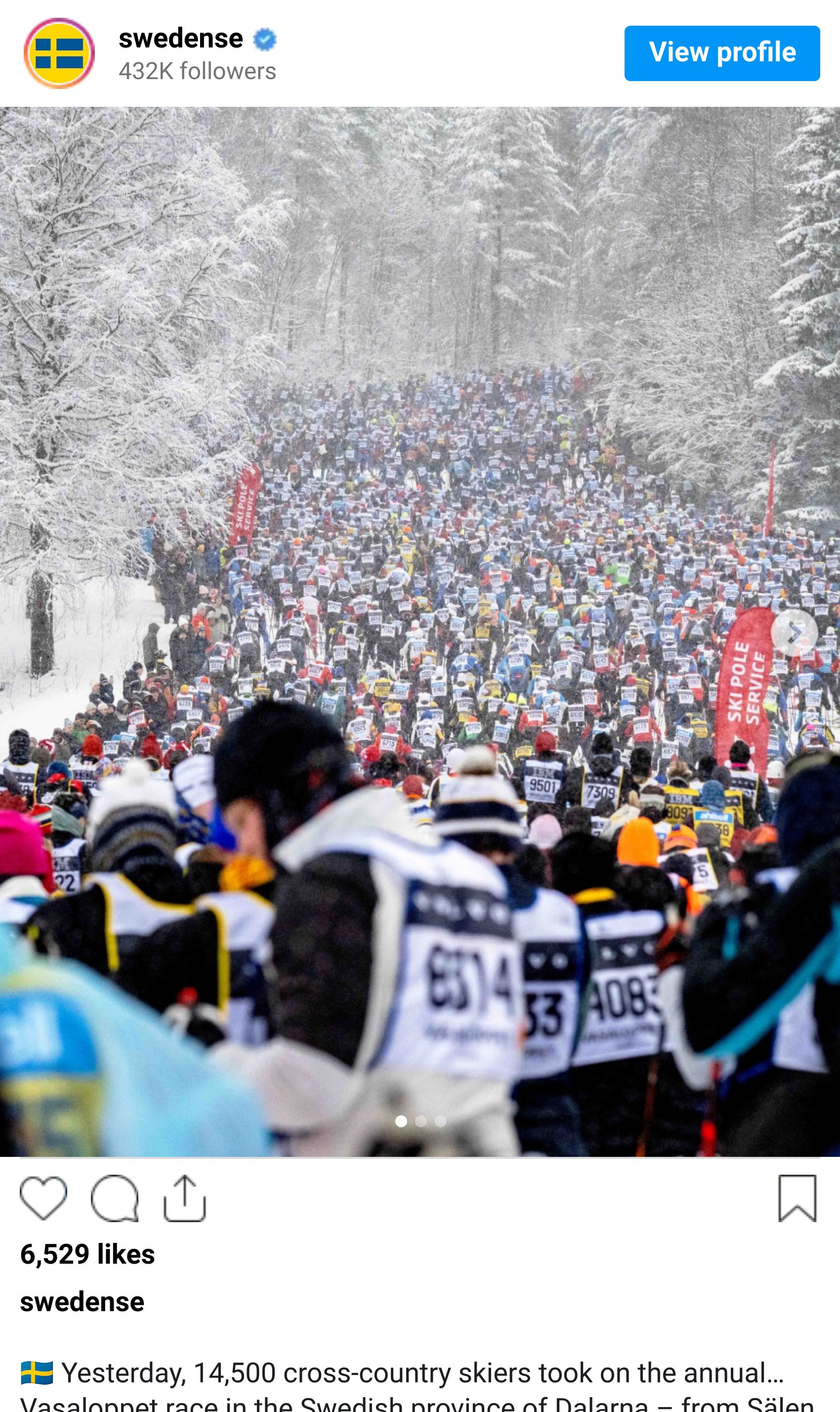
What a sight this is – 14,500 skiers taking part in the gut-busting, leg-aching, 90km cross-country Vasaloppet race from Sälen to Mora in the Swedish province of Dalarna.
More than 63,000 athletes, aged 16 to 90, attended multiple events throughout the week leading up to the big race, with Oskar Kardin and Emilie Fleten crossing the line first to take the Vasaloppet honours. ❄️❄️👏👏
What did you think of today's email?
That’s your Split. Until Next Time
Together, we go the distance. — @247_endurance 🏃♂️🚴♀️🏊♂️