


👋 Welcome back
Phew… what a weekend of endurance sport 🤯.
From dramatic finishes to record-breaking performances, and incredible comebacks, the season is already throwing up plenty of thrills, spills and talking points — and on top of all that, Lionel Sanders is BACK after his RED-S horrors… and reminding everyone exactly what he is capable of.
There is a lot to get through, so saddle up, grab your Loaded Water and settle in for another healthy helping of the Daily Split.
Here’s what we have lined up for you today…
LATEST: The endurance news headlines
RACE REPORTS: From Barcelona to Dallas, and World Cup to 70.3
COMEBACK: Special report on Lionel Sanders and his RED-S recovery
SOCIAL IMPACT: Olympian bemoans impact of ‘comparison culture’
TIPS: How to get the most from your Brick Workouts

🏃🏼 Quick splits

Fotyen Tesfay celebrates her course record in Barcelona. [Zurich Marató Barcelona]
💨 RECORD: Ethiopian Fotyen Tesfay clocked the second-fastest time in women’s marathon history on her debut over the distance in Barcelona on Sunday as she sets her sights on the world record. Read HERE.
👟 GEARING UP: Ultra-running star Kilian Jornet has added an extra race to his mouthwatering calendar, with the GOAT set to tackle Zegama-Aizkorri in May as well as Western States and UTMB in 2026. Read HERE.
👏 SHE’S BACK: Sophie Evans – the athlete formerly known as Coldwell – was delighted to be back in competitive action at the weekend as she finished fifth in her first race since giving birth last year. Read HERE.
🎽 STRUGGLES: Former triathlon world champion Sam Laidlow was forced to give up on his marathon quest at the weekend as the Frenchman only managed to complete 14km in Barcelona after suffering cramps. Read HERE.
❌ GONE: Ourea Events, who have created and organised some of the UK’s most iconic ultrarunning races, including the Dragon’s Back, have announced they have ceased trading with immediate effect. Read HERE.
🏁 Race news

Nina Eim takes the World Cup win in Lanzarote on Saturday. [World Triathlon]
🏆 World Cup Lanzarote
Germany’s Nina Eim topped a classy podium ahead of Georgia Taylor-Brown (GBR) and Laura Lindemann (GER) in the opening women’s World Cup race of the season in a breezy Lanzarote. The three served up a superb battle, with Eim’s late kick just proving decisive as she crossed the line five seconds clear of GTB, with Lindemann a close-up third in her first race for nearly a year.
The men’s race saw Tim Hellwig briefly look like he could make it a German double; however, Lindemann’s gold medal-winning teammate in the Paris Olympics mixed team relay faded, and it was home favourite David Cantero (ESP) who proved a fantastic winner despite having to serve a 10-second penalty midway through the run.
RESULTS: Women
🥇 Nina Eim (GER) – 01:02:14
🥈 Georgia Taylor-Brown (GBR) – 01:02:19
🥉 Laura Lindemann (GER) – 01:22:22
RESULTS: Men
🥇 David Cantero Del Campo (SPA) – 00:54:45
🥈 Tim Hellwig (GER) – 00:54:48
🥉 Jawad Abdelmoula (MAR) – 00:55:01
🤠 IRONMAN Dallas Little-Elm 70.3
Lionel Sanders (CAN) made a winning start to 2026 as he claimed an emphatic win in the men’s race at the inaugural IRONMAN 70.3 Dallas–Little Elm, while Jackie Hering (USA) took the women’s title despite a two-minute penalty on the bike.
Organisers were forced to modify the format due to adverse weather and strong currents linked to an incoming cold front. While the professional field still completed a shortened 350-metre time-trial swim, the age-group swim was cancelled entirely, with those athletes instead starting the race via a bike time-trial.
Sanders was 40+ seconds off the leader in 46th place coming out of the water, but had nudged his way inside the top ten within ten miles of the bike lap and then up to second by the time they had reached 23 miles. As he left T2, Sanders was out in front and a full 19 seconds ahead of German Leonard Arnold.
An impressive 1:11:53 half-marathon then saw him claim a comfortable victory, 2:27 ahead of American Ben Kanute, and Andrea Salvisberg (SUI) rounding out the podium a further six seconds back.
Hering’s dramatic victory came after she was handed a two-minute penalty on the bike, and despite her being 22 seconds behind leader Anna Buettner (GER) with 3km of the race remaining and then 11 seconds back with only 1.5km left to run.
Hering powered her way into the lead with a late burst of power and took the tape in 3:49:57, just 18 seconds ahead of her rival Buettner.
RESULTS: Men
🥇 Lionel Sanders (CAN) – 03:17:12
🥈 Ben Kanute (USA) – 03:19:40
🥉 Andrea Salvisberg (SUI) – 03:19:45
RESULTS: Women
🥇 Jackie Hering (USA) – 03:49:56
🥈 Anna Buettner (GER) – 03:50:14
🥉 Annamarie Strehlow (USA) – 03:53:00
🎽 Barcelona Marathon
Fotyen Tesfay clocked the second-fastest time in women’s marathon history on her debut over the distance in Barcelona at the weekend. The 28-year-old Ethiopian already holds the third-fastest half-marathon time and has made no secret of her desire to pursue the world record for 26.2 miles, which is 2:09:56, set by Ruth Chepngetich at Chicago in 2024.
This was certainly a sensational first attempt at taking the record as she blazed a trail through the Catalan capital, opening with a 31:01 first 10km and passing the halfway point in 1:05:01. However, she just slowed fractionally in the second half in what were breezy conditions, crossing the line in 2:10:53 – breaking the course record by an incredible 8 minutes and 40 seconds.
Meanwhile, Uganda’s Abel Chelangat was the winner of the men’s race in a personal best 2:04:57. He was put under pressure throughout by Kenyan duo Patrick Mosin and Jonathan Korir, but just had enough in the tank to claim the win.
RESULTS: Women
🥇 Fotyen Tesfay (ETH) – 2:10:53
🥈 Jepkosgei Kiplimo (KEN) – 2:18:42
🥉 Zeineba Yimer (ETH) – 2:18:49
RESULTS: Men
🥇 Abel Chelangat (UGA) – 2:04:57
🥈 Patrick Mosin (KEN) – 2:05:01
🥉 Jonathan Korir (KEN) – 2:05:29
☀️ T100 Gold Coast
Swiss athlete Julie Derron is the latest to have announced she is no longer going to be competing at this weekend’s T100 Triathlon World Tour race on the Gold Coast.
She announced the decision on her Instagram page, writing: “After a long and intense 2025 season, I was hoping to recover and build back up quickly to be ready for @t100triathlon Gold Coast. However, if 2025 has taught me anything, it‘s that things cannot be rushed. And so I’m giving myself a bit more time to build up for another long, intense and hopefully successful year of chasing my dreams and goals 😇
“I am excited to watch the @t100triathlon get started and will be back for the next one 🤗.”
The news will come as another blow to the T100 organisers after already seeing the likes of Kate Waugh, Lucy Charles-Barclay, Ashleigh Gentle, and Lucy Byram all ruled out.

SAIL Challenge Québec powered by Argon18 is a race unlike any other, where world-class competition meets raw Quebéc beauty. Athletes race through the historic streets of Québec City, along the St Lawrence River, and into a vibrant, passionate atmosphere that rivals Europe’s best events. It’s an experience every athlete should have at least once.
🚴♂️ News from the saddle
Jonas Vingegaard took the General Classification victory on the final day of the eight-stage Paric-Nice road race, despite the Danish rider being pipped on the line at Allianz Riviera by Frenchman Lenny Martinez.
Martinez (Bahrain Victorius) took Stage 8 in 03:06:43, just ahead of Vingegaard (Visma-Lease a Bike), and with Colombian Harold Tejada (XDS Astana Team) seven seconds further back.
Wind, rain and snow resulted in a shortened Saturday ride as Frenchman Dorian Godon took Stage Seven for his Ineos Grenadiers team. The route had to be shortened to just 47km because a blizzard hit the finish at Auron ski resort, and torrential downpours and dangerous crosswinds then battered riders.
The General Classification saw Vingegaard take the overall honours by +4:23 from Colombian Dani Martinez (Red Bull-Bora-hansgrohe) and by +6:07 from Germany’s Georg Steinhauser (EF Education-EasyPost).
For a full report from the weekend’s Paris-Nice action, read Cycling Weekly HERE.

Lionel Sanders, one of the world’s leading triathletes, has battled with RED-S. [IRONMAN]
🔍 The BIG issue: Lionel Sanders battles back from RED-S scare
The look on Lionel Sanders’ face as he crossed the finishing line to take victory at IRONMAN’s Dallas Little-Elm 70.3 on Sunday pretty much said it all.
There was little in the way of fanfare; indeed, celebrations were somewhat limited, as the popular Canadian threw the broken tape to the floor as if to say, ‘I’m back… now what’s next?’.
He could certainly have been forgiven for swapping the usual race-winning feelings of exaltation for those more akin to vindication as his long road back from injury and illness was seemingly consigned to the past.
Victory in Texas took his tally of IRONMAN wins to 35 across a trophy-laden 12-year professional career. And while this new Dallas 70.3 would usually be classed as small fry compared to some of his grander and more important races of the past, it’s the path that he took to get there that quite possibly makes this one of his most meaningful.
For those among his 207,000 YouTube subscribers, the last ten months have been fascinating viewing as he dealt first with a fractured sacrum, and then, following specialist advice, realised he was struggling with RED-S, or Relative Energy Deficiency, to give it its full name.
RED-S is a condition relatively common among athletes where their calorie intake is not sufficient to balance out the demands of their heavy training and racing. It can lead to poor post-workout recovery and increased risk of fractures at specific weak points.
As well as suffering the sacrum injury, Sanders was also worried that he had recently fractured a rib, and was also struggling with sleepless nights and feeling unwell – both classic symptoms of RED-S.
His enforced lay-off was met with typical gusto as he took the prognosis on the chin and set about finding a long-term answer to the dietary-related puzzle, which he felt had blighted his health over the last year or so.
It was last August when he set out his plans for a happy and healthier return to professional competition, when he said: “As an athlete, this is an absolute fundamental piece of the puzzle here. I have every symptom of RED-S, every single symptom. I have quite low testosterone, quite low iron, quite low thyroid hormones and low estrogen. I have the blood work to back that up, including metabolic distress. I sleep like s**t, feel like s**t. You know, those are all symptoms that are more rooted in nutrition.
“This has been a blessing getting injured from the standpoint of it’s allowing me to cultivate new habits that will be integral to me training well when I do get back to full tilt training. I’m developing habits that will allow me to eventually consume 7,000 calories a day. This is now the path toward being able to do that consistently.”
With a menu of high-protein meals, snacks and drinks consumed regularly from 7.30am through to 7.30pm, Sanders – renowned for his extremely intense training regimes in the past and given the moniker ‘No Limits’ – has also dialled down his preparations with a more targeted approach that focuses on quality and recovery.
The road back has been long, difficult and uncertain. He admitted in the build-up to Dallas that he was feeling ‘peak insecurity’ over competing again as his new-look regime was put to the test.
However, victory will not only have given him a timely boost, but it will also serve as a reminder to the likes of Kristian Blummenfelt, Sam Laidlow, Casper Stornes and Jelle Geens that Lionel Sanders is back… and he clearly means business.
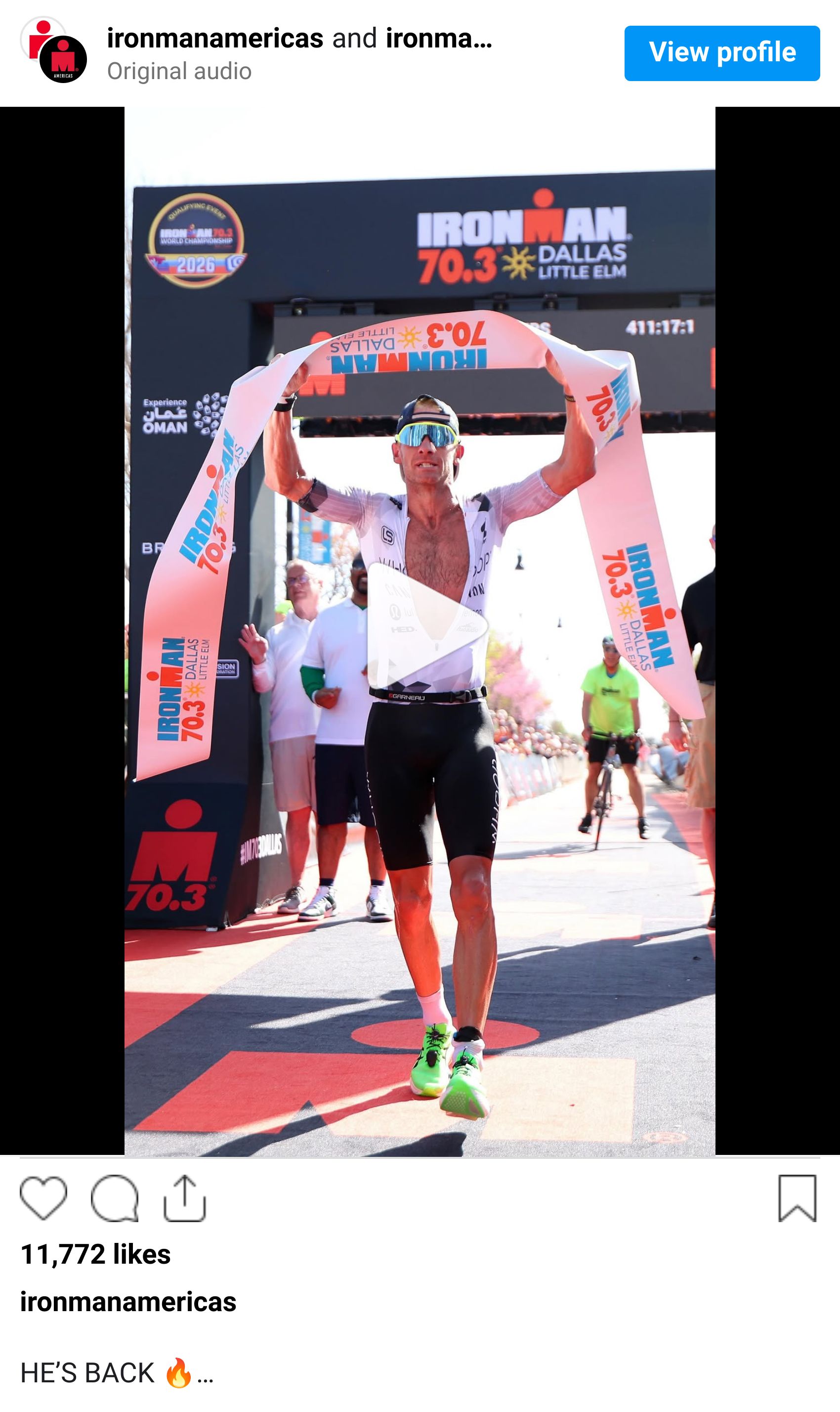
What is RED-S, and how can you spot it?
RED-S occurs when athletes consistently burn more energy than they consume, leaving the body without enough fuel to maintain the demands of its normal physical functions.
For endurance athletes such as triathletes, cyclists and runners, it can affect: hormone production, bone density, immune system, recovery, mood, cognitive function, and performance.
Symptoms of RED-S can include: Persistent fatigue, loss of power or endurance, increased illness or injury, low testosterone (in men), and difficulty recovering from training.
Because endurance sports tend to ‘reward’ lean body composition and huge training volumes, RED-S can develop gradually and go unnoticed for years.
Athletes who embark on massively intense training programmes, yet struggle to produce the expected improvements, are likely not taking in sufficient calories to meet the body’s needs, meaning energy is being diverted away from recovery and long-term health.
Sanders made immediate changes to his diet, focusing on a high-protein mix of meals, snacks and drinks, which would eventually take his daily calorie intake up to 7,000. Better fueling during rides and runs was also integrated into his overall plan as he focused training on quality and recovery, not just volume.
The idea that ‘lighter is faster’ has been blamed by some experts for the rise in RED-S cases, particularly in triathlon, where the requirements on the body are extreme in all three disciplines.
Through speaking out about his experiences, Sanders has helped shed more light on a condition which was initially thought to impact only female athletes, but which is now scientifically recognised in men as well.
The key symptoms to watch out for in women are the loss of menstrual cycle, stress fractures and hormonal disruption.
Through its work with leading RED-S researcher, Dr Margo Mountjoy, World Triathlon and the International Olympic Committee have increased education around RED-S, with Dr Mountjoy saying: “RED-S is common in both male and female athletes in many sports, and although we understand a lot more about its causes, awareness of the syndrome, and its consequences for health and performance, it is still low on the agendas of athletes, their medical and performance support teams, and the general public.”
I’ve had ups and downs, I’ve had stress fractures, I’ve had injuries, I’ve had bad training periods, good training periods, I’ve had bad races, really good races. And with certainty, there is a correlation between my eating quantity (how many calories) and those ups and downs. Professional triathlete, Lionel Sanders, on his RED-S battle.
👩💻 Trending in triathlon
Whether it is the neighbours posting about their new car, family friends sharing images of their stunning holiday, or simply pals uploading pictures from that weekend away that you couldn’t make, it is a fair bet that many of us have, at some point, experienced the modern phenomenon of ‘comparison culture’.
Feelings of envy, marrying up with questions over your own performances and life skills, often ferment into a caustic mix of self-doubt, uncertainty and anxiety. It is certainly something that Olympic triathlete Emma Jeffcoat has experienced, as she spoke of the ‘toxic’ nature of social media’s impact on athletics during a recent episode of the excellent ‘The Female Athlete Project podcast’.
“I feel like it’s really tough in today’s society when you have Instagram and things like Strava,” she says. “It feels to me that everyone is a triathlete; everyone is an endurance athlete at the minute, and I’m thinking, ‘I do 30 hours a week, and I don’t feel like I am doing enough.
“The people who are juggling families and full-time jobs with training for a marathon or a half-marathon… how are they supposed to ever think they are ever doing ‘enough’ because of this comparison culture and all the highlight reels continually online?”
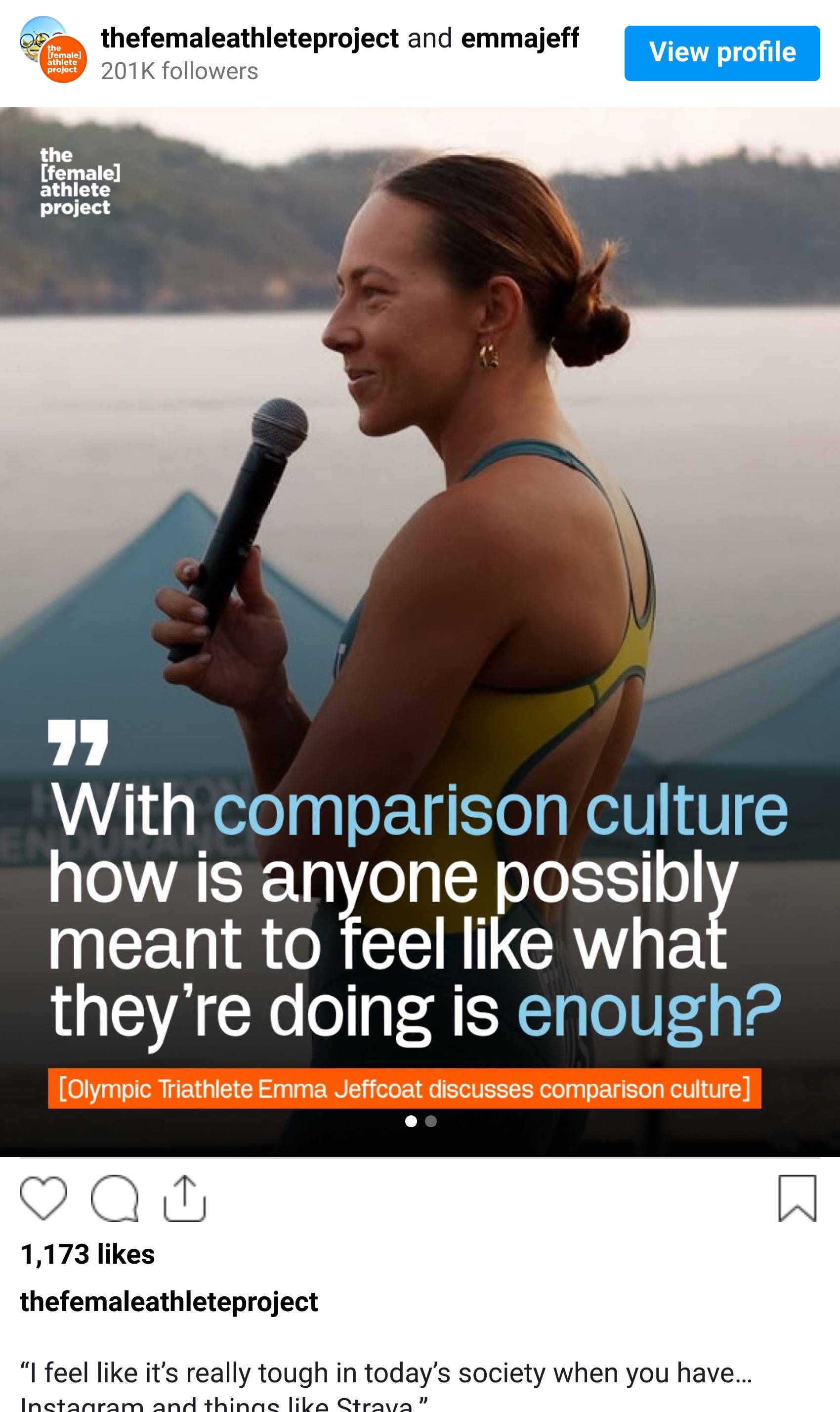
Has social media turned into a toxic home for 'comparison culture'?

A Brick Workout is designed to help with an athlete’s transition from one discipline to another.
⏱️ Coaches corner: What is a Brick Workout?
A brick workout in triathlon means performing two disciplines back-to-back with little or no rest between them. The most common example is a bike ride immediately followed by a run. These sessions help athletes prepare for the unique challenge of transitioning between disciplines on race day, when their legs often feel heavy and awkward after cycling. Brick sessions train your body to adapt to the switch.
❓ Why they are important: Brick workouts prepare athletes for race-day conditions. When you start running after cycling, your muscles must suddenly change movement patterns. This often creates the familiar ‘jelly legs’ feeling that many triathletes experience in the first few minutes of the run. Practising brick workouts regularly helps your body adapt and improves coordination, pacing, and overall race performance.
📈 Structuring a workout: For beginners, brick sessions should be simple and controlled. An example of a beginner brick session would be taking on a 45-60 minute bike ride and then, with little rest in between, setting off on a 10-15 minute easy run. The goal is not intensity but adaptation. Over time, you can increase the duration or intensity of the run as your body starts to adapt.
🙋♀️ When to include brick workouts: Most triathletes include brick sessions once per week during their training cycle, especially when following a structured sprint triathlon training plan. They are especially useful in the weeks leading up to a race, when athletes want to simulate race conditions and improve transition efficiency. For sprint-distance triathlons, shorter brick sessions are usually enough to prepare your body for the bike-to-run transition.
🤦♂️ Common brick workout mistakes: Some athletes make the mistake of turning every brick session into a high-intensity workout. Common mistakes include:
Running too fast after the bike.
Making brick sessions too long.
Skipping recovery afterwards.
Performing them too frequently.
Forgetting that a controlled approach is usually more effective.
🧱 Types of brick workouts: Not all brick workouts are the same. Athletes use different variations depending on their experience level and training goals.
🚴♂️ 🏃♂️Classic bike → run brick
The most common brick session involves finishing a bike ride and immediately starting a short run. This mimics the transition you’ll experience during a triathlon race.🏊♀️ 🚴♂️ Swim → bike brick
Less common but still useful, this variation helps athletes practice the swim-to-bike transition and the feeling of getting onto the bike with an elevated heart rate.🏁 Race simulation brick
More experienced athletes sometimes combine all three disciplines – swim, bike, and run – to simulate race conditions. These sessions should be used carefully, as they can be physically demanding.
⚠️ If you’re new to triathlon, it’s best to start with short sessions and gradually increase duration as your fitness improves.
📋 Quick brick workout checklist
Start with short bike-to-run sessions.
Focus on smooth transitions.
Keep the first minutes of the run easy
Practice pacing and fuelling.
Use brick sessions to simulate race conditions
💪 Outside edge of endurance
This one is certainly not for anyone afraid of the dark!!! 🦇
The Tunnels Ultra 200 took place earlier this month in Somerset, England. A mind-bending test of extreme endurance and sensory deprivation, this challenge is a 200 mile ultramarathon through the darkness of the UK’s longest foot tunnel. Running on flat terrain, but completely in the pitch black between the hours of 11pm and 5am, athletes have 55 hours to complete 100 'out-n-backs', or 200 times through the Combe Down tunnel… possibly the greatest mileage ultramarathon ever run 99% underground.
The average DNF rate for this nerve-splitting, knee-knocking challenge is 86%. Indeed, only eight of the 46 starters completed it this year, with Christian Mauduit – winner in 2021 and runner-up in 2024 – winning with a time of 49 hours and five minutes.
If you want to know more about The Tunnel, click HERE.

What did you think of today's email?
That’s your Split. Until Next Time
Together, we go the distance. — @247_endurance 🏃♂️🚴♀️🏊♂️