

👋 Welcome back
Morning endurance fans…
Have you got your breath back yet? Because that was one thriller of a weekend!!!
From big-name showdowns to statement wins and brilliant debut performances, the swim-bike-run world was firing on all cylinders… while the Ultra Trail Chianti Castles by UTMB produced its own set of thrills and spills.
And the best part? We go again this week... and we can’t wait!!!
Here’s what we have lined up for you today…
LATEST: The endurance news headlines
GEELONG: Incredible Blummenfelt stuns Wilde and Geens.
TUE ROW: Sam Laidlow argues that TUEs should no longer be anonymous.
TIPS: What to look for when buying your first tri suit.
ENDURANCE: Alistair Brownlee has a go at a skimarathon.
🏃🏼 Quick splits

Jess Fullagar was in impressive form on her T100 debut at the weekend. [PTO]
🌟 IMPACT: Jess Fullagar made an instant impression at the weekend as the British athlete starred on her T100 Triathlon World Tour debut on the Gold Coast by coming in a close second to American winner Taylor Knibb. Read HERE.
👊 TITANS: Hayden Wilde admitted he simply ‘wasn’t good enough’ to compete with the likes of Kristian Blummenfelt and Jelle Geens as the trio went into battle at the IRONMAN 70.3 in Geelong at the weekend. Read HERE.
🏆 EYECATCHING: World U23 champion Ollie Conway (GBR) made a statement start to the year as he powered to victory in the Triathlon World Cup event in Haikou. Diana Isakova (AIN) won the women’s race. Read HERE.
🎽 LEGEND: Courtney Dauwalter‘s late pivot to Tuscany from snow-hit Tenerife paid off in spectacular style as the ultrarunning GOAT swooped late to take the women’s title in the feature 120km Chianti Castles race. Read HERE.
🏃♀️ INJURED: Reigning Olympic champion Sifan Hassan has withdrawn from what promises to be a race for the ages at this year’s TCS London Marathon on 26 April, after confirming that she is struggling with an Achilles issue. Read HERE.
🏁 Race news

The big three of Jelle Geens, Kristian Blummenfelt and Hayden Wilde at Geelong. [IRONMAN]
💪 IRONMAN 70.3 Geelong
Pro men: An incredible run by Norway’s Kristian Blummenfelt ripped victory from the grasp of Hayden Wilde and Jelle Geens as the much-anticipated battle of three triathlon champions did not disappoint at the Geelong 70.3 on Sunday.
T100 winner Wilde (NZL) set a new course bike record as he led into the final transition, and was more than a minute and a half ahead of Big Blu as the 2025 Pro Series winner recovered from a seemingly slow bike section to give himself hope going into the final discipline.
Belgian Geens had been steady throughout and was tagging in just behind Wilde as they set off on the run. However, neither of them could have predicted the blistering pace with which Blummenfelt would deliver as he started to hunt them down.
With both time and distance hungrily gobbled up by every one of his giant strides, Big Blu stormed past the reigning 70.3 world champion Geens, and then, with 10km to run, caught up with long-time leader Wilde.
They jostled shoulder-to-shoulder for a short while before the pace simply got too much for the Kiwi, and Blummenfelt turned on the after-burners to steam away and take the win with an incredible 1:06:39 half-marathon.
A measure of how fast he was going could be seen in the Norwegian’s run splits, with his first three 5ks timed at 15:30, 15:43 and 15:36. 🏃♂️💨
Geelong 70.3 – Men’s Results (Swim/Bike/Run)
🥇 Kristian Blummenfelt (NOR) – 22:18/ 01:57:29/ 01:06:39 = 03:30:25
🥈 Jelle Geens (BEL) – 22:13/ 01:57:03/ 01:08:30 = 03:31:24
🥉 Hayden Wilde (NZL) – 22:15/ 01:56:03/01:09:04 = 03:31:51
Pro women: Kat Matthews secured her second win of the Pro Series as the reigning champion of 2025 once again demolished all before her to cross the tape in impressive style.
Having already won at IRONMAN New Zealand two weeks previously, she was looking for more early-season points on the Queensland coastline.
For a while, it looked as though she might have a real battle on her hands to secure the win, as fellow Briton Sophia Green led with a strong swim and powerful opening to her bike.
However, Matthews was never too far out of the picture, and when she finally caught her compatriot on the bike, there was a sense of inevitability about the proceedings.
Matthews had moved into a position of dominance by T2 and was never going to be caught, despite the best efforts of Grace Thek (USA), who reduced the gap between the two from a yawning three minutes-plus to only 36 seconds by the finish.
Canadian Tamara Jewett took an unlikely third place despite finishing the bike more than ten minutes back from Matthews. She produced the second-best run of the day, however, to blast her way through the flagging field.
Geelong 70.3 – Women’s Results (Swim/Bike/Run)
🥇 Kat Matthews (GBR) – 24:43/ 02:14:09/ 1:22:29 = 04:06:15
🥈 Grace Thek (USA) – 24:48/ 02:18:17/ 01:19:01 = 04:06:51
🥉 Tamara Jewett (CAN) – 26:12/ 2:24:22/ 1:19:55 = 04:15:27
🏛️ Rome Marathon
The Rome Marathon very nearly saw two new course records set on Sunday as Kenyan athletes once again reigned supreme in the Eternal City.
For a third consecutive year, both races were won by Kenyans as Pascaline Kibiwot Jelagat dominated to take the women’s crown, and Asbel Rutto secured the men’s event.
Jelagat also set a new best Rome Marathon time of 2:22:44, which just edged the previous record of 2:22:52 set by Ethiopia’s Kebede Megertu Alemu in 2019.
She was the fifth Kenyan to win the women’s race in the last six years, and her record-breaking feats were almost matched by Rutto, but he eventually missed out by just eight seconds, crossing the line in 2:06:32.
Rome Marathon – Women’s Results
🥇 Asbel Rutto (KEN) – 2:06:32
🥈 Tukor Kichana (KEN) – 2:06:36
🥉 Lencho Tesfaye Anbesa (ETH) – 2:07:44
Rome Marathon – Men’s Results
🥇 Pascaline Kibiwot Jelagat (KEN) – 2:22:44
🥈 Genet Tadesse Robi (ETH) – 2:24:55
🥉 Aberash Fayesa Robi (ETH) – 2:25:43
🚴♂️ News from the saddle
World champion Tadej Pogačar out-sprinted Tom Pidcock to take victory in the Milan-San Remo at the weekend – one of the few major races that had previously eluded the dominant Slovenian.
After he and Briton Pidcock had dropped last year’s winner, Mathieu van der Poel, they battled for the line in an epic tussle that was made all the more incredible by the fact that Pogačar had earlier suffered a crash which left him with road rash, shredded kit and a huge battle to get back into the race with only 33km to go.
You can read a full report from the Milan-San Remo on Cycling Weekly, HERE.

Sam Laidlow has called on his fellow professionals to call for an end to anonymous TUEs. [Challenge Family]
🔍 The BIG issue: Laidlow’s attack on TUEs
Sam Laidlow issued a plea to his fellow professionals this week, urging all those ‘that believe in a clean sport’ to join his crusade against anonymous TUEs.
Writing on his Instagram story, the former IRONMAN World Champion expressed ‘sadness, anger, and confusion’ after reviewing the latest number of TUEs accepted by the International Testing Agency.
TUEs – Therapeutic Use Exemptions – are approved if an athlete has a genuine medical condition for which they require the use of a substance or substances that would otherwise be banned under World Anti-Doping Agency rules.
Set up with the belief that athletes should never be forced to choose between their health and their career, it means those with asthma, diabetes, ADHD, or even such conditions as severe allergies or bowel disease can safely use banned medication without fear of breaking regulations.
There are strict criteria for the awarding of a TUE, which can only be approved if all of the boxes are ticked; they include:
The need for a diagnosed medical condition.
There is no reasonable alternative.
There is no significant performance enhancement.
They are not required as a consequence of a prior doping issue.
Since 2019, the ITA has received 3,528 TUE applications from across a wide range of sports, including aquatics, tug of war, cycling, equestrian, athletics, boxing, weightlifting and biathlon.
Of those applications, 2,361 have been approved, 903 were withdrawn or no longer required, and 75 were denied.
Triathlon specifically has seen 78 applications between 2019 and 2025, with 54 approved, 17 not needed/withdrawn, six still pending, and one denied. The trend is increasing, with one application made in 2023, 34 in 2024, and 43 last year.
World Triathlon handed its management of the process over to the ITA in 2024, and while many agree that TUEs are a fair and safe way to regulate the need for medical support to those athletes who need it, there remains something of a trust gap.
Because these are medical records, they remain anonymous, and it is this secrecy which upsets those who believe the system could be ‘played’ by less scrupulous athletes looking for an illegal advantage.
Laidlow’s post on Monday morning read: “Recently, the ITA posted a file showing how many TUEs had been accepted in each sport. It made me sad, angry and confused as to why so many athletes feel the need for these medical ‘exceptions’.
“To my fellow pros that believe in a clean sport, let’s get together and MAKE TUE’s PUBLIC. DM me so we can start this charge.”
He followed it shortly after with another image of his inbox, complete with messages from pro athletes such as Kilian Jornet, Richie Porte, Josh Amberger, Jake Birtwhistle and Jelle Geens.
He wrote: “Kind of flexing my inbox right now, but in all seriousness, if you are a pro and keen to make a change… let’s get together and sign something.”
Health protection is essential in life, competitive integrity is everything in sport… the fine line in between can so often be the cause of discussion, frustration and doubt.

The question of whether TUEs should remain anonymous has once again surfaced.
Triathlon’s shifting landscape explained
The World Anti-Doping Code International Standard for Therapeutic Use
Exemptions is a mandatory International Standard developed as part of the World Anti-Doping Program.An Athlete who needs to use a Prohibited Substance or Prohibited Method for Therapeutic reasons must apply for and obtain a TUE prior to using or possessing the substance or method in question.
A retroactive TUE may be granted in exceptional circumstances, for example, if there was an emergency and urgent treatment was required.
WADA states that each TUE will have a specified duration, at the end of which the TUE will expire automatically. If the Athlete needs to continue using the prohibited substance or method, they must submit another application well in advance of the expiry date.
WADA also states that any TUE application ‘shall be dealt with in accordance with the principles of strict medical confidentiality’. Any consulted independent experts and relevant staff of the Anti-Doping Organisation ‘shall conduct all of their activities relating to the process in strict confidence and shall sign appropriate confidentiality agreements’.
The ITA says: “Only a small proportion of athletes (around 1-3%) require a TUE, and no evidence shows that having one provides a performance advantage. Nonetheless, the system is sometimes the subject of public debate and media scrutiny, occasionally portrayed as a potential loophole. In reality, TUEs are based on clear regulatory principles, robust medical assessment, and rigorous implementation.”
Between 2019 and 2025, the number of applications made to the ITA for a TUE has steadily risen: 167 in 2020, 267 in 2021, 505 in 2022, 631 in 2023, 777 in 2024, and 852 in 2025.
The sport with the most TUE applications made to the ITA is Equestrian, with 379 between 2019 and 2025, while cycling comes second with 332. Of cycling’s applications, 272 were approved, 33 withdraw/not needed, 13 are pending, and five were denied. The applications were mainly for stimulants such as methylphenidate to treat ADHD, and glucocorticoids used to treat asthma.
Of the 78 applications made from triathletes to the ITA between 2019 and 2025, 24 were for stimulants and 18 for glucocorticoids.
In a study undertaken by WADA at summer and winter Olympics between 2010 and 2018, Medical Director, Dr Alan Vernec said: “The data showed that the number of athletes competing with valid TUEs at the selected Games was less than 1%. Furthermore, the analysis suggests that there is no meaningful association between competing with a TUE and the likelihood of winning a medal.”
Should athletes who are approved TUEs be named?
👩💻 Trending in triathlon
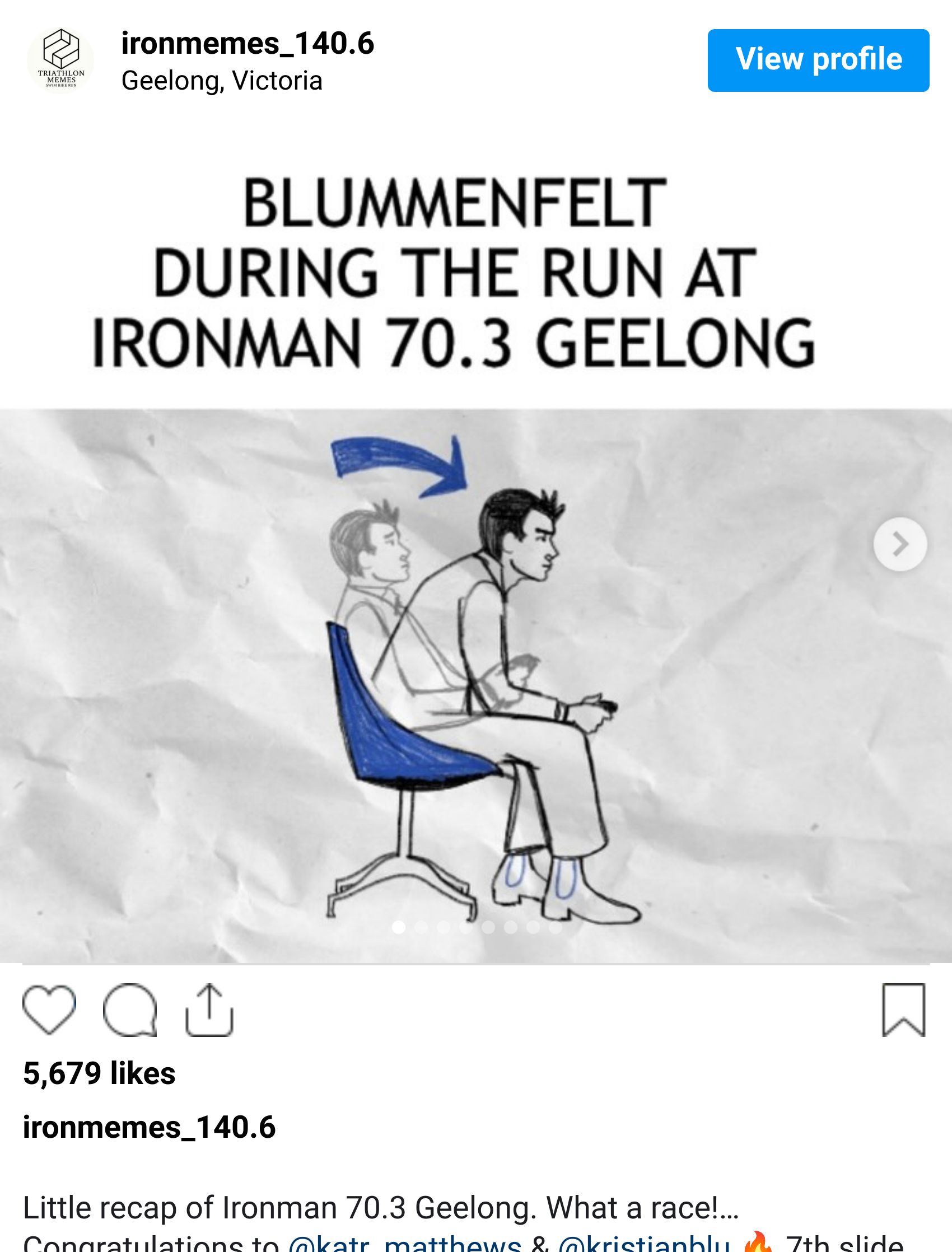
You can always trust ironmemes_140.6 to hit the nail bang-centre on the head when it comes to posting about the world of triathlon. And this weekend saw them on top form.
We could try and talk you through their take on the events at Geelong, but we don’t want to ruin the impact of you seeing them yourselves… our particular favourite, however, was that of Hayden Wilde pouring beer over his own head.

The TRI-FIT GEO women’s tri suit was rated 90% in a TRI247 review.
⏱️ Coaches corner: Tri suit buying guide
Whether you are a beginner or a seasoned swim-bike-run veteran, a great tri suit can be a game-changer when it comes to both speed and comfort on race day. But with so many options out there, deciding which is right for you can be a bit of a head-scratcher.
This tri suit buying guide will talk you through everything you need to know in the hunt to find the best tri suit for YOU.
❓Do I really need a tri suit?
You can absolutely participate in triathlon races without having to wear a tri suit. But changing between each discipline will cause you to lose a lot of time in transition. That might not be so much of a concern if you’re racing the longer-distance events where ‘complete’ is more of a priority than ‘compete’. But in short-course racing, it’ll mean you’re putting yourself way behind the rest of the field before you’ve even started.
Tri suits are designed to be efficient, comfortable and ultra-fast. You won’t have to get changed multiple times during your race. So your finish times will be an accurate reflection of your fitness – not your costume-changing skills. The best tri suits are loaded with all sorts of aerodynamic and cooling technology, meaning they can help you to ride faster and perform better out on the race course.
Put all of that together, and you’re immediately taking time off your triathlon personal best. A tri suit is an easy win to improve your race times.
Time to embrace the superhero look. 🦸♂️🦸♀️
🩱 Tri suits for beginners
Newcomers to the sport might not want to invest in a premium suit right away. The good news is that there are plenty of really great entry-level tri suits out there for beginners. You just need to know what to look out for.
Fabric: Choose a tri suit made from lightweight material which dries quickly after the swim so you can stay comfortable. Suits described as ‘quick-wicking’ as well as lightweight are also a great choice. The material will be designed to draw moisture away from your body for evaporation, so you’re less likely to overheat.
Fit: A tri suit should have a ‘second skin’ fit. That means it’s tight, but it doesn’t restrict your movements. When you first try your tri suit on, make sure that you can easily lift your arms above your head and you have a full range of motion with your legs. Ensure that none of the seams or the leg grippers are digging in – race day is tough enough without chafing getting in your way!
Protection: Make sure the suit you’re looking at has a tri-specific chamois pad. This will mean that it’s comfortable on the bike, without absorbing too much water after the swim or chafing uncomfortably during the run. Check the product description to determine if the tri suit has been designed for a specific distance. The chamois pad in a short-course-specific suit might not be substantial enough for longer distances.
Sleeves: Many top middle- and long-distance triathletes favour a short-sleeved suit. A lot of that comes down to aerodynamics, as research suggests that fabric is faster than skin at cutting through the air. The other consideration is UV protection. Some sleeved tri suits use UV protective material, protecting your back, shoulders and upper arms from the sun. That’s particularly important for long-course racing, where you can expect to be out on the bike for several hours before you can top up the sunscreen in T2.
Women: Choosing a tri suit for women with a female-specific fit is important to ensure you’re as comfortable as possible. A female-specific chamois pad is a key feature to look for in a women’s tri suit – designed to offer enhanced comfort by placing padding where it’s required for female anatomy. A chamois pad which is too wide or doesn’t offer the appropriate level of support can make for a very uncomfortable bike leg.
💰 When to upgrade
The main difference with the higher-end tri suits is the level of aerodynamic tuning and performance features they’ll have packed in. Some feature specific material profiles – such as raised bumps on the upper body – to reduce drag. Other premium tri suits have also incorporated additional features to promote better cooling while you race.
If you’re still fairly new to triathlon, or if racing is more about enjoyment than chasing every ounce of performance, then an entry-level or mid-range suit will absolutely do the trick to keep you comfortable. But if you’re looking for that extra 1% to race as fast as possible, then treating yourself to a premium suit is worth the extra investment to really maximise your performance.
💪 Outside edge of endurance
Is there nothing that double Olympic gold medallist Alistair Brownlee can’t do?
The now-retired star of triathlon is currently embarking on a self-imposed series of worldwide tests of endurance, which has so far included racing up the Empire State Building in New York, gravel cycling in South Africa, and taking on the brutal Patagonman Xtri in the Chilean mountains.
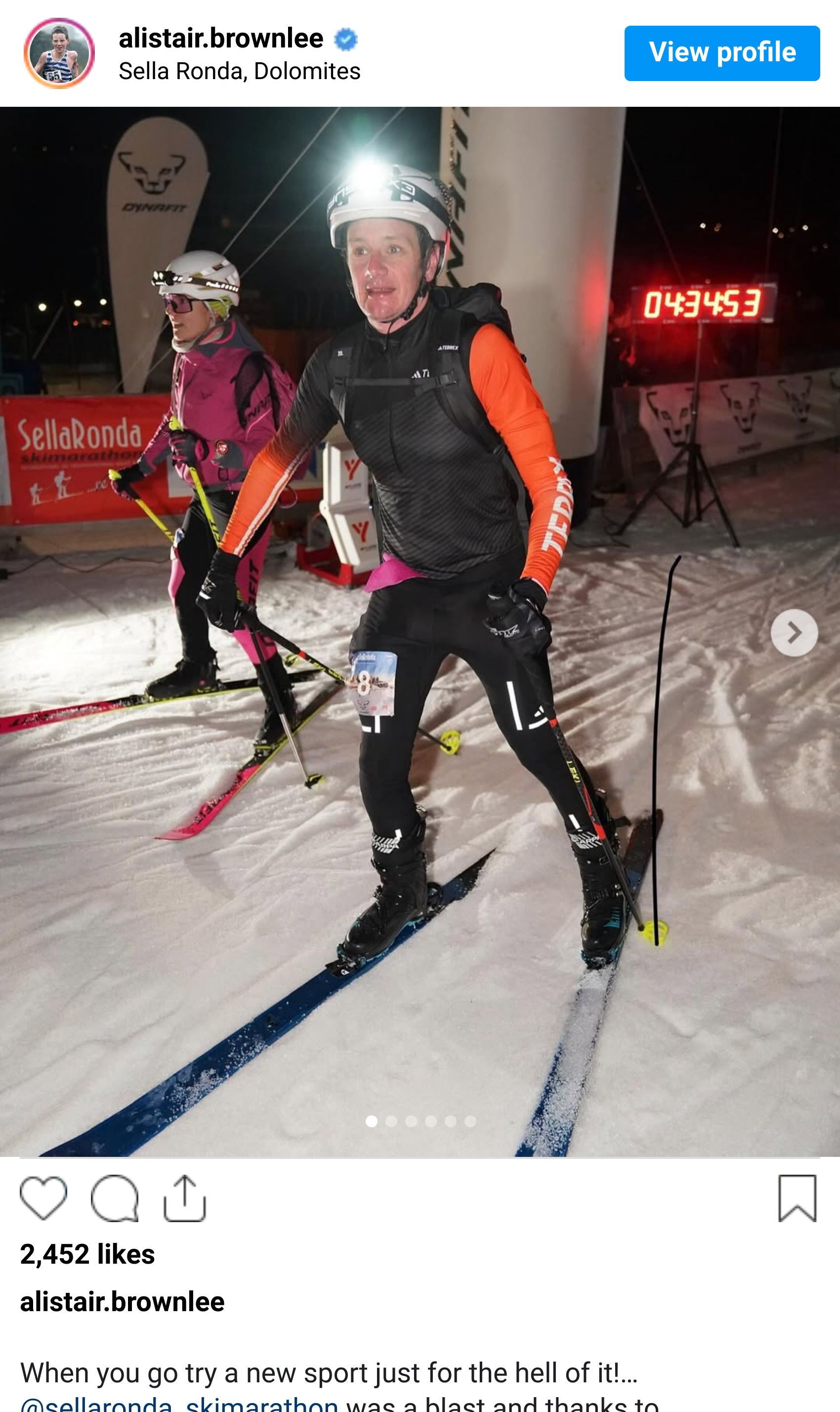
His latest challenge came at the weekend when he took part in the Sellaronda Skimarathon – a classic nighttime ski mountaineering race in the Italian Dolomites, which sees 550 pairs of athletes racing 42km with an elevation of 2,700 metres.
After competing alongside former Polish mountain biker Maja Wloszczowska, he wrote on his Instagram page: “When you go try a new sport just for the hell of it! @sellaronda_skimarathon was a blast, and thanks to @maja.wloszczowska for going along with my crazy, last-minute idea.
“42km, 4 climbs/descents and about 2800m of climbing. Mostly enjoyed being a complete novice at something; only crashed once, and it’s truly inspiring to see how amazing the Ski Mo athletes are.
“Going down a ski run, trying to follow a slightly crazy ex-MTB rider in the dark, with light only coming from a head torch and the occasional fire stick, is one way to feel very alive!”
What did you think of today's email?
That’s your Split. Until Next Time
Together, we go the distance. — @247_endurance 🏃♂️🚴♀️🏊♂️