


👋 Welcome back
Good morning and welcome back to the engine room of endurance sport.
After a weekend that delivered drama by the bucketload – from lung-busting triathlon battles and blistering marathon performances to the relentless dominance of a certain Slovenian cyclist — Tuesday morning feels like the perfect time for us all to catch our breath and take stock.
Records rattled, rivalries reignited, and somewhere, in every corner of the endurance world, athletes discovered just how deep they were prepared to dig.
So pour a strong coffee, loosen the legs and settle in. Here’s everything you need to know from a thrilling few days across swim, bike and run. 🚴♂️🏃♂️🏊♂️
LATEST: The endurance news headlines
WRONG WAY: Thrilling finish in LA as leader goes the wrong way.
WINNER: Tadej Pogačar secures third-straight Strade Bianche title
GETTING IN: Why is it so hard to get signed up for a top marathon?
TIPS: What is ‘bonking’ and what can you do to avoid it?
Presented By:

The T100 lands in Pamplona for the Spain T100 Triathlon – a must-do event for any triathlete and the perfect way to embrace the rich history, vibrant culture and delicious food of this famous provincial capital. Test yourself against the 100km distance – 2km swim, 80km bike, 18km run – or feel the festival vibes with the 10km run. Spanish Triathlon members can compete within the Spanish National Championships as part of the race weekend.
🏃🏼 Quick splits

Jacob Kiplimo regained his half-marathon world record in Lisbon this weekend. [eDreams]
🥇 Setting the tone: Defending Pro Series champion Kat Matthews believes her opening race victory in New Zealand at the weekend can form a ‘really good benchmark’ for further success in 2026. Read HERE.
🐮 Get moo-ving: Former triathlon star Braden Currie has broken his leg after an attempt to help put a cow back on its feet went horribly wrong, and he ended up being chased across a field. Read HERE.
⛔️ WTCS make Abu Dhabi call: The opening World Triathlon Championship Series event in Abu Dhabi, due to take place on March 27, has been postponed as a result of the ongoing conflict in the Middle East. Read HERE.
🎽 Like lightning: Jacob Kiplimo has reclaimed the half-marathon world record on the same course in Lisbon where he first made history in 2021. The Ugandan star clocked an incredible 57:20. Read HERE.
🏃♂️ Marathon medals: A new continent-wide race series has been launched, bringing together eight of Europe’s most iconic marathons and creating an exciting new challenge for endurance athletes. Read HERE.
🏁 Race news

Jon and Henriette Albon won their respective races at the Transgrancanaria. [UTMB]
🥾 North Face Transgrancanaria Classic
There was an incredible family double in the flagship Classic race at The North Face Transgrancanaria as Heniette and Jon Albon took the respective titles. Henriette was repeating her victory from 12 months earlier, while her husband Jon went one better than his second place in 2025. The third event in the World Trail Majors covers 125km with 6,700m of elevation gain, and it saw seriously challenging conditions early on – and among those to DNF was reigning UTMB champion, Tom Evans.
RESULTS – MEN
🥇 Jon Albon (GBR) – 12:58:08
🥈 Hannes Namberger (GER) – 13:03:10
🥉 Josh Wade (GBR) – 13:07:54
RESULTS – WOMEN
🥇 Henriette Albon (NOR) – 15:16:33
🥈 Claudia Tremps (ESP) and Mélanie Delasoie (SUI) – 16:49:20
🎽 Marathon
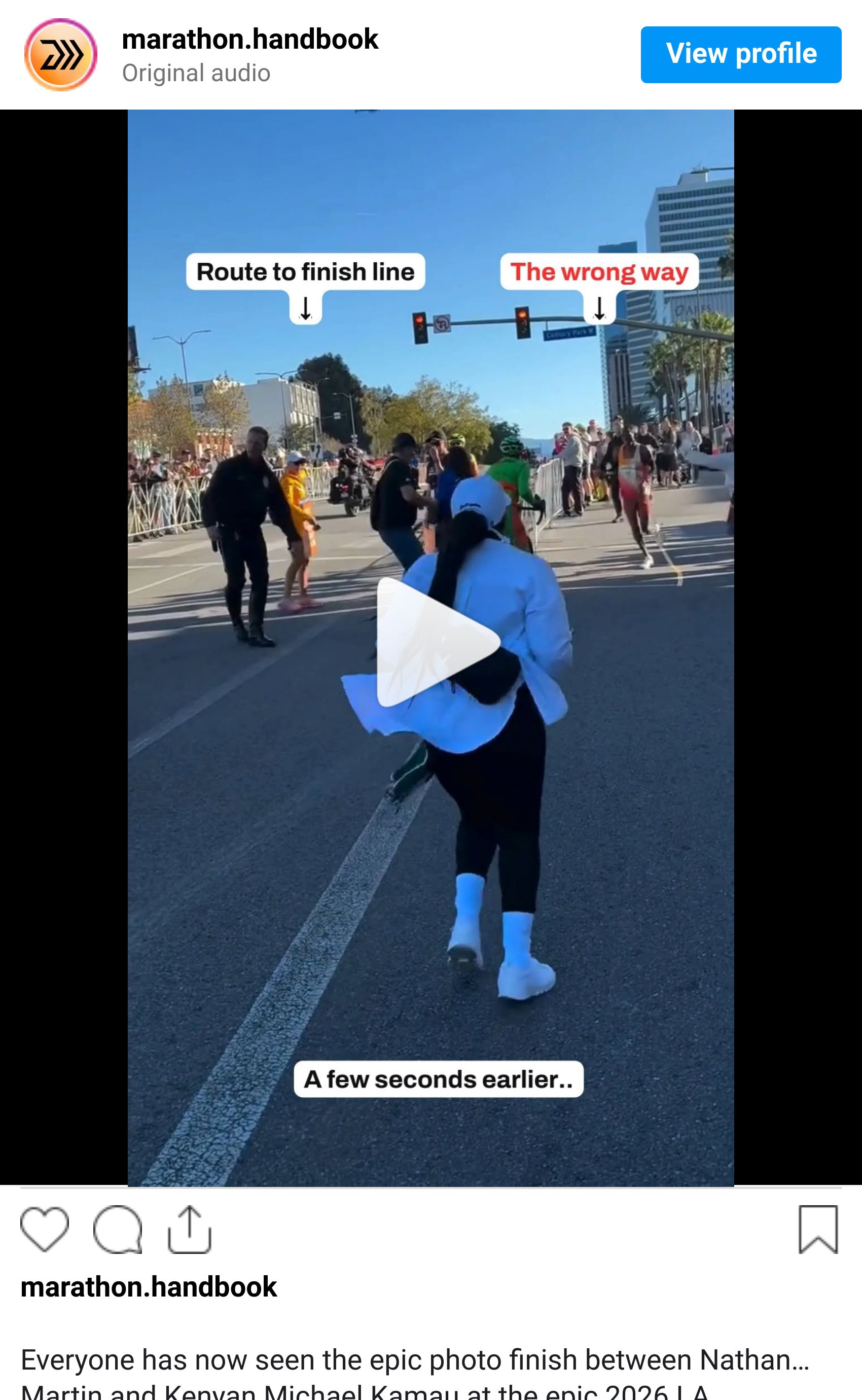
Los Angeles: American athlete Nathan Martin stormed to an incredible LA Marathon ‘photo finish’ victory after chasing down Kenyan Michael Kamau to win by just 0:01 seconds – after the leader had lost valuable time by going the wrong way.
Long-time leader Kamau had looked set to break the tape until high school coach Martin powered past him to complete what has been described by organisers as ‘the closest finish in the race’s history’.
However, while clips of the dramatic final few metres were widely shown on social media, it was later revealed that Kamau had lost precious seconds when he took a wrong turn while heading down the home straight.
Video footage, shared by the Marathon Handbook on Instagram, shows the Kenyan being momentarily distracted by two members of the crowd who had run onto the course in celebration of what looked to be his inevitable victory.
Instead of carrying on down toward the finish line, he follows one of the lead vehicles and veers off course. It is only when marshals shouted for him to come back that he realised his error and did a U-turn – costing him precious seconds in the process.
As Martin found his late burst of speed, Kamau seemed to be struggling, and with the pair lunging for the line, it was Martin who got there first, pipping his rival by the smallest of margins as the Kenyan went crashing to the floor.
A similar issue over course directions was also highlighted last week, when the three lead runners in the women’s US Half Marathon in Atlanta were led away from the course after following a pace car and eventually finished down in ninth, 12th and 13th positions.
Olympian Priscah Cherono (KEN) was the first to cross the line in the women’s category, beating her competition with a time of 2:25:19.
Men’s results:
🥇 Nathan Martin (USA) – 2:11:17
🥈 Michael Kamau (KEN) – 2:11:17
🥉 Enyew Nigat (ETH) – 2:14:23
Women’s results:
🥇 Priscah Cherono (KEN) – 2:25:19
🥈Kellyn Taylor (USA) – 2:27:36
🥉 Antonina Kwambai (KEN) – 2:28:50
Paris Half Marathon: British triathlete Emma Pallant-Browne demonstrated why she is widely regarded as one of the strongest runners in women’s triathlon as she completed the Paris Half Marathon in seventh place, with an impressive time of 1:12:34.
The race itself was dominated by East African athletes. Ethiopia’s Ftaw Zeray claimed victory in 1:05:12, while Kenya’s Mercy Chepwogen finished second in 1:06:29. Uganda’s Sarah Chelangat completed the podium in 1:06:31.
Another triathlete, the GOAT himself, Jan Frodeno, also showed his class by finishing the men’s race in a time of 1:11:45. Kenyan Kennedy Kimutai won the men’s race with a time of 1:00:11, ahead of Timothy Misoi (KEN) 1:00:39, and Thabang Mosiako (SAF) 1:00:42.
👀 You can read more on this story at TRI247, HERE.
🏙️ IRONMAN Dallas Little-Elm 70.3
IRONMAN will get a taste of some Big Texas energy this weekend as the inaugural Dallas Little-Elm 70.3 hosts the long-awaited return to triathlon of superstar Lionel Sanders, who has been out with various injury issues since the middle of last season.
Also joining the field for this much-anticipated event, which takes in views of the city’s iconic skyline and offers the natural beauty of Lewisville Lake, are the likes of Sam Appleton and Ben Kanute, while Jackie Hering is the lead name among the women.
🚨 Check out Saturday’s Daily Split for a more in-depth preview of this race.
🚴♂️ News from the saddle
Four-time Tour de France winner Tadej Pogačar eased to victory as he won Strade Bianche for a record fourth time – soloing for the final 78km to secure his third-straight title in the Italian one-day classic.
It was also the sixth-straight year that the 27-year-old Slovenian had won his opening race of the season, crossing the line exactly one minute before 19-year-old French rider Paul Seixas, and with Pogačar’s UAE Emirates-XRG team-mate Isaac del Toro in third.
Earlier, Swiss champion Elise Chabbey won the women's race for the first time following a thrilling finish.
👀 You can read a full report from Strade Bianche on Cycling Weekly, HERE.

More than a million people applied through the London Marathon ballot. [London Marathon]
🔍 The BIG issue: Getting your marathon place
Securing your bib for one of the world’s leading marathons is now so difficult that it could be argued the actual running of 42.2km is the easiest part of the entire process.
Demand for places at the sport’s most iconic races has never been higher, with the running boom seeing London receive more than a million applicants in its ballot this year, New York announcing it had only accepted 1% of its 240,000+ entries, and Tokyo reporting more than 300,000 requests for just 30,000 spaces.
The facts of the matter are that if you harbour dreams of taking part in one of the seven Abbott World Marathon Majors – Tokyo, Boston, London, Berlin, Chicago, New York and Sydney – then you need a great many things to go your way.
Of course, there are many other marathons around the world worthy of your consideration, such as Paris, Amsterdam, Walt Disney World, Toronto, LA, and even Honolulu, but chances are the demand for those is also way beyond availability.
Indeed, an indication of the worldwide thirst for marathon places can be gauged when looking at last year’s Honolulu Marathon, which saw more than 43,000 participants take part in Hawaii, an increase of 62% from two years prior.
Marathons are big business, with major city events in the US, such as New York, Boston and Chicago, now listed among the most powerful economic events in sports, generating hundreds of millions of dollars and even surpassing the Super Bowl in terms of financial impact.
Boosted by social media influence, bucket-list ‘marathon tourism’, and a surge of influencers encouraging people to take on new challenges, the boom of 2025 shows no sign of slowing down.
If they could get away with it, most organisers would undoubtedly jump at the opportunity to increase their financial margins by adding a further 15,000 runners to their race fields, but alas, it is not quite that simple.
Even the largest events are capped at around 60,000 participants (London and New York being the biggest), with safety, transport logistics, and regulations over environmental impact meaning any further increase would make these already large-scale events simply too difficult to manage.
So, with very little room for growth in terms of numbers, and a running community that continues to increase beyond pre-COVID pandemic levels, there is little that can be done, other than to ensure there is a fair process in place, which gives hopefuls an equal opportunity of gaining entry.
And this is where things start to get tricky.
Not all races are the same, and therefore not all application processes are identical. While Amsterdam operates a first-come, first-served policy, most will set up a ballot process much like a lottery, where you must throw your name into a hat in the hope you win your bib.
The criteria are also getting tougher, with qualification times faster; Boston, for example, has set a 2:55:00 minimum requirement for men aged 18-34 and 3:25:00 for women of the same age, with all age groups from 18-59 expected to hit qualifying times that are five minutes faster than the year before.
Even if you hit the criteria, there is a very high likelihood that the number of places available still won’t match the demand, with more than 8,000 runners missing out in Boston last year despite meeting the criteria.
Places are, of course, limited in part due to the large number of charity runners who are accepted, with major charitable organisations granted a tranche of bibs which they can in turn hand out to applicants, with a proviso they hit a specific fundraising target – last year London set a new world record as its runners raised a staggering £87.3m.
Running a marathon is, without doubt, one of the most incredible achievements in sport… It’s just a shame that actually registering for one is also becoming something of an endurance challenge.

The Boston Marathon is among the most popular events worldwide. [Boston Marathon]
Marathons and running boom explained?
The world is experiencing a running boom, with figures registered in 2025 revealing how participation figures had not only returned to pre-COVID pandemic levels, but had in fact surpassed them.
An increase in the number of social media influencers and celebrity runners, coupled with a spike in interest for new and improved kit which makes it easier to run longer distances have been put forward as reasons for the boom.
The London Marathon was the first event ever to receive in excess of one million ballot applicants, as 1,133,813 runners tried to get one of the 20,000 places available for the 2026 race.
Of that figure, 869,803 applicants came from the UK, while 264,010 were from international applicants.
More than 240,000 people from 160 countries applied for places at the New York marathon, but only 1% were selected, making this the lowest acceptance rate in the race’s history. The applications represented a near-20% increase in entries for 2025.
Outside of London and New York, Tokyo is regarded as the next toughest to secure a place, with more than 300,000 people applying for the 2026 race. With only 38,500 taking part in the full marathon, it meant a lottery success rate of around 2%.
Unconfirmed numbers for this year’s Berlin Marathon suggest they have also received more than a million applicants for the race, which is due to take place on September 27. With under 20,000 spots available in the ballot, the odds of success are extremely low.
As a World Marathon Major with a very tough entry standard, the charity window is regarded as the best option for runners to get into the Boston event, with more than 3,000 bibs available.
Runners who gain their places through charity bibs must reach the minimum level of fundraising required by the charity providing the spot, which can range from as little as $2,000 right up to $10,000, depending on the organisation.
Among the most popular marathons in the world, outside of the seven majors, are Paris, Shanghai, Athens, Amsterdam, Cape Town, Mumbai and LA.
“The sport of marathoning is gaining momentum world-wide, and we recognize the dedication it takes to qualify and earn a spot on the starting line for the Boston Marathon. Unfortunately, we are unable to accept all applicants into the event, but we do want to applaud all who train and aspire to participate”.
Jack Fleming, President and CEO of Boston Athletic Association.
👩💻 Trending in triathlon
We’ve all been there… You are approaching the end of a race or a particularly tough workout, and your sole focus is on reaching that finish line. Everything else is secondary; outside noises are muted as you drive on to achieve your goal.
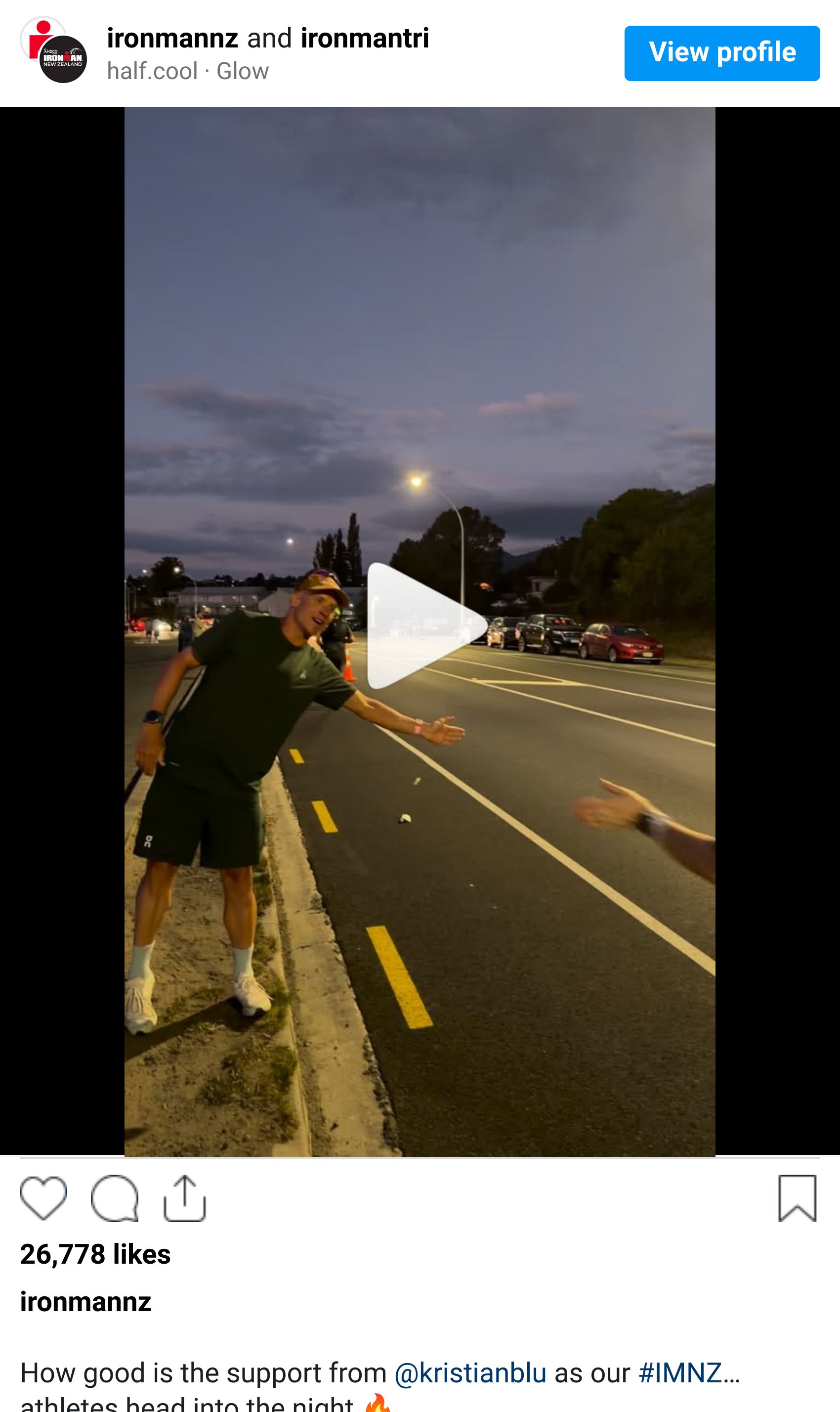
That was clearly the case for Auckland-based science teacher and triathlete, Rob Eyre, who was so engrossed in trying to complete last weekend’s IRONMAN New Zealand that when a guy offered him a ‘high-five’ to keep the spirits up, he took very little notice of who it was and kept his mind on the road ahead.
With a nagging feeling in the back of his mind that the guy looked familiar, it was only later that he spotted himself on an Instagram video being encouraged by none other than Norwegian superstar Kristian Blummenfelt.
Big Blu had put his frustrations of a tricky Pro Series opener aside to nip back out to the course and show some encouragement to the age-groupers still pounding the tarmac, not that Rob had much of a clue who his cheerleader was until much later.
“I didn't realise it was him until after I high-fived him (I’m the third person in green). Even then doubted it was, awesome to see this! 😍? 🤔’
It must also be said that Kat Matthews, winner of the women’s pro race, also returned to the course later in the day to present medals to the finishers. Two quality moments from two wonderful athletes and ambassadors for the sport. 👏👏👏
⏱️ Coaches corner: What is ‘bonking’ and how can you avoid it?
Bonking is one of the most common and unpleasant experiences in endurance sports – a sudden loss of energy that can stop you in your tracks. In this guide, we explain what bonking is, why it happens, the warning signs to look for, and how to avoid it with simple nutrition and pacing strategies.
🧱 Hitting the wall
Bonking happens when your body runs out of readily available carbohydrates (glycogen), which are your primary fuel source during moderate to high-intensity exercise. When glycogen stores are depleted, your body is forced to rely more heavily on fat for energy, and while it can be a useful fuel source, it cannot be converted into energy quickly enough to sustain performance – leading to a sudden drop in power, pace, and mental clarity. Also described as ‘hitting the wall’.
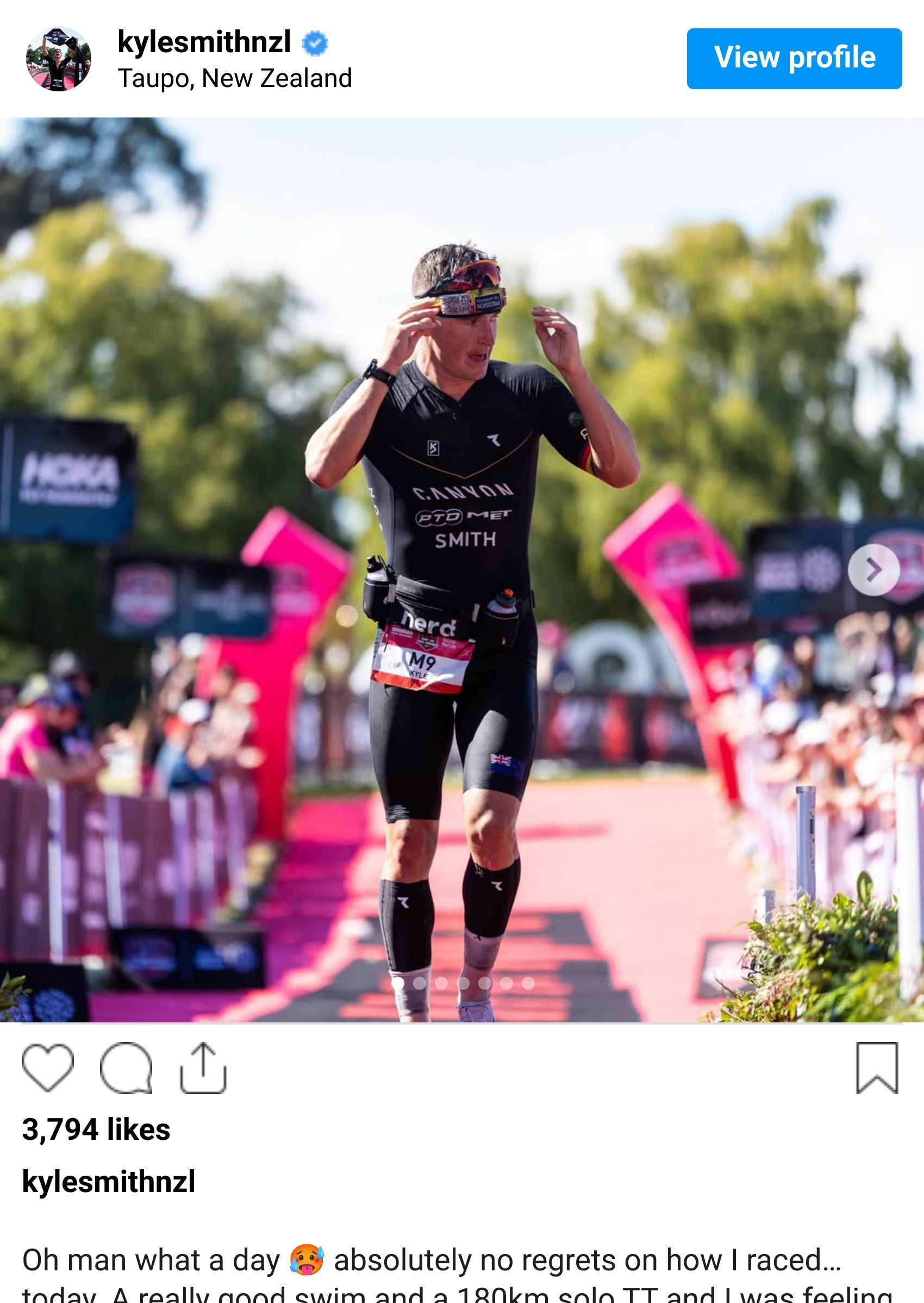
What causes it? Even the most experienced of athletes can get their race prep wrong; indeed, only this weekend, Kyle Smith admitted that he suffered from the ‘dreaded bonk’ midway through the marathon stage of the IRONMAN New Zealand. And his issues were likely caused by a combination of the following.
🍌 Not eating enough before or during a race.
😰 Competing at too high an intensity for too long.
💨 Poor pacing strategy – especially when starting too hard.
🚱 Inadequate hydration.
⌛️ Long durations without carbohydrate intake.
The tell-tale signs of ‘bonking’: The signs of bonking can come on quickly and feel overwhelming. In severe cases, you may need to stop completely.
Sudden fatigue and heavy legs.
😵💫 Dizziness or light-headedness.
🤔 Loss of concentration.
🤬 Irritability or mood swings.
😩 Inability to maintain pace or power.
🥶 Feeling cold or shaky.
What you can do to avoid it: Preventing bonking is mostly about fueling and pacing correctly, so here are our key tips on making sure you don’t bonk… and what action you can take, if you do.
🍜 Eat before you go: Start with sufficient glycogen stores by eating a carbohydrate-rich meal 2-3 hours before training.
☄️ Fueling up: For rides longer than 60-90 minutes, aim for 30-60g carbs per hour if you are a beginner; or 60-90g carbs per hour if you are more advanced. Start fueling up early; don’t wait until you feel tired.
🚰 Stay hydrated: Dehydration can accelerate fatigue and make bonking worse. Make sure you are drinking regularly, not just when you are thirsty.
⌚️ Pace properly: Avoid going too hard early – steady effort is key.
🏥 Recovery: This depends on how severe the bonk is, but once it happens, performance will usually be compromised for the remainder of the session. Consuming fast-absorbing carbohydrates (like energy gels or sugary drinks) can help restore some energy within 10-20 minutes, but full recovery may take longer.
🚴♂️ Bonking on the bike: Bonking can happen in any endurance sport, including triathlon and running. However, it often feels more severe in cycling because: Rides are typically longer, fueling is easier to neglect, and intensity can fluctuate more.
⚠️ Is bonking dangerous? Bonking is not usually dangerous, but it can lead to extreme fatigue, poor decision-making, and in some cases dizziness – so it’s best avoided.
💪 Outside edge of endurance
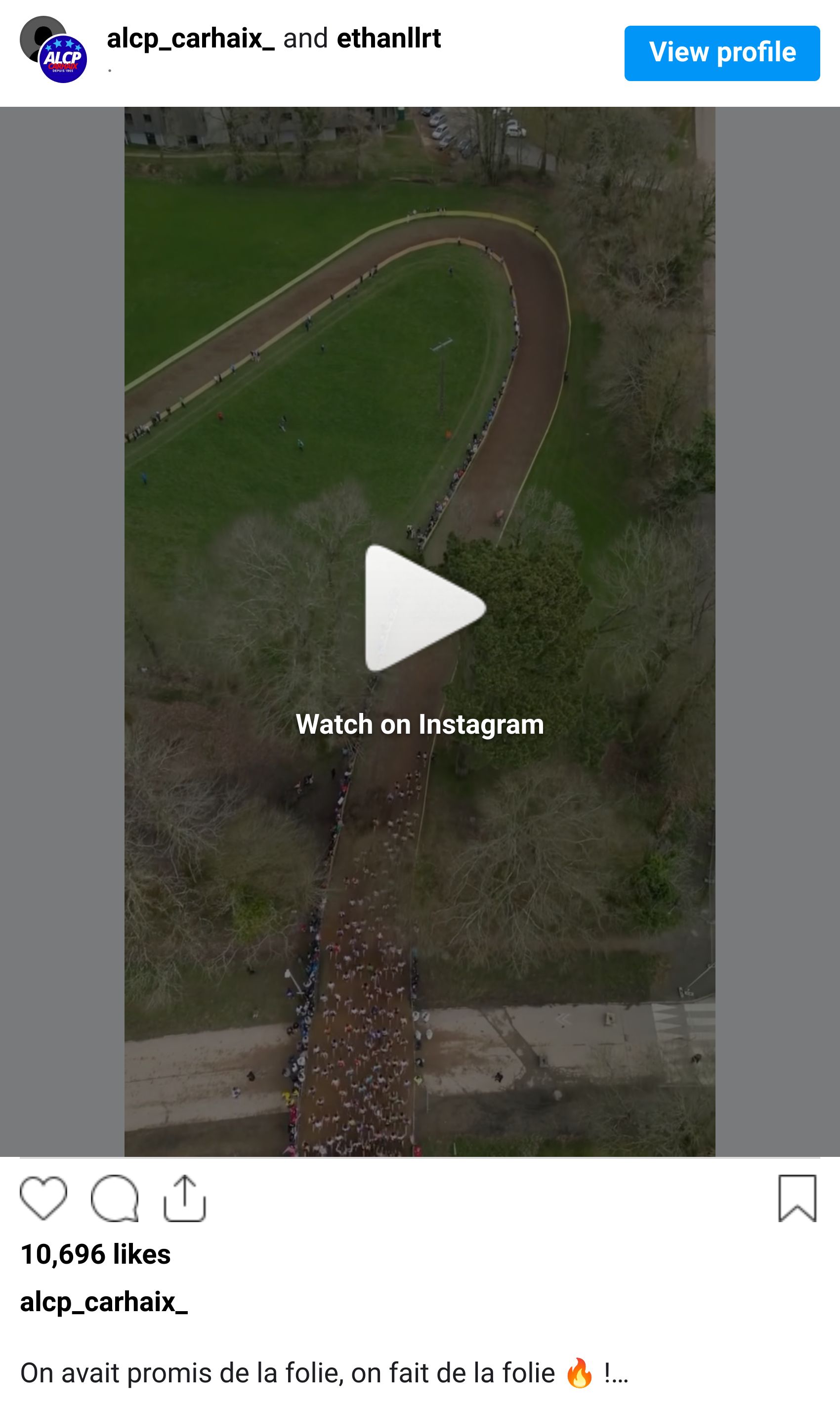
This incredible drone footage was taken during last weekend’s France Cross-Country Championships, which were held in Carhaix, Brittany. The heading alongside it states: ‘We promised madness, and we’re delivering madness 🔥!’… which is pretty spot on when you clock the (very) early pace setter who didn’t last too long at the front!!!
Félix Bour secured his second consecutive French Cross-Country title, while in the women’s race, Margot Dajoux caused an upset by denying Léonie Périault in the final straight. You can read a full report from the weekend on the Fédération Française d'Athlétisme website HERE.

World of Triathlon LIVE is a new triathlon exhibition taking place at Excel London 28-29 March 2026. Whether you're a pro-competitor, an age-grouper, an avid racer, a novice, or just curious about all things swim, bike, run, World of Triathlon LIVE, powered by TriDot, has something for everyone.
What did you think of today's email?
That’s your Split. Until Next Time
Together, we go the distance. — @247_endurance 🏃♂️🚴♀️🏊♂️