


👋 Welcome back
Morning endurance fans…
Strap in – because endurance sport isn’t just racing forward, it’s evolving fast.
From record-breaking performances and season-defining showdowns to a rapidly shifting tech landscape, the past few days have delivered action on every front. And it’s not just the athletes making moves – off the course, the game is changing too, with Zwift snapping up Rouvy in a major shake-up of the indoor training world.
The two platforms will continue to run separately – for now – but the move signals a clear trend towards consolidation and a new era for how endurance athletes train, race and connect.
On the roads, trails and start lines, though, it’s business as usual: big performances, bold tactics and plenty of talking points across swim, bike and run.
Let’s dive in…
Here’s what we have lined up for you today…
LATEST: The endurance news headlines
PREVIEW: IRONMAN 70.3 Western Sydney
CYCLING: Tour de Romandie bubbling up to thriller
TAKEOVER: What does the Zwift purchase of Rouvy really mean?
TIPS: The key mistakes you could be making when you run
🏃🏼 Quick splits

Reigning T100 champion Kate Waugh looks set for a tour return after injury. [PTO]
💪 RETURN: Reigning champion Kate Waugh looks set for a return to T100 later this month after recovering from a calf injury. Read HERE.
🏥 RECOVERING: Former IRONMAN World Champion Laura Philipp has been in hospital this week after suffering from stomach and back pain. Read HERE.
⏱️ RECORD: Legendary triathlete Jonny Brownlee is hoping to set a record for the Weekend Warrior at Supertri’s Blenheim Palace race. Read HERE.
❌ SUFFERING: Ultrarunner Sarah Perry has given up on beating her own world record after 76 laps at the Legends Backyard Ultra. Read HERE.
🎽 RECORDS: Last week’s London Marathon was hailed as ‘the greatest in its history’ after a record 59,830 runners crossed the finish line. Read HERE.
🏁 Race news

Jake Birtwhistle leads the field at IRONMAN 70.3 Western Sydney this weekend. [Korupt Vision]
🐨 IRONMAN 70.3 Western Sydney
A mainly Antipodean pro field will line up in Penrith tomorrow for the IRONMAN 70.3 Western Sydney.
Leading Australians lining up for the race include Jake Birtwhistle, Josh Ferris, Cameron Wurf and Mitch Kibby, while the list of New Zealanders includes Lachlan Haycock, Trent Thorpe and Xander Marsh.
Finland’s Henrik Goesch is also among the favourites for a podium place as they join more than 1,800 age-group athletes at Sydney’s International Regatta Centre.
🚴♂️ News from the saddle
All eyes now turn to the Grand Tours and the spring and summer stage races, with this week’s Tour de Romandie the first of those, serving as an ideal warm-up for the Giro d'Italia next week. Held in Switzerland, the Tour de Romandie is a mountainous race (four of the six stages have big climbs).
Dorian Godon (Ineos Grenadiers) denied Tour de Romandie leader Tadej Pogačar (UAE Team Emirates-XRG) a third stage victory, powering to a reduced bunch sprint win in Orbe.
The prologue winner started winding up his sprint early and was passed by the punchier Finn Fisher-Black (Red Bull-Bora-Hansgrohe). However, once Godon got on top of his gear, he powered past the Kiwi to grab the victory.
Valentin Paret-Peintre (Soudal-Quickstep) sprinted in for third place ahead of Pogačar.
The world champion continues to lead the Tour de Romandie before the mountainous final two stages by 17 seconds over Florian Lipowitz (Red Bull-Bora-Hansgrohe), with Lenny Martinez (Bahrain Victorious) in third at 26 seconds.

Zwift and Rouvy will continue to be run as separate businesses.
🔍 The BIG issue: Major indoor cycling shake-up as Zwift buys Rouvy
As the news broke this week regarding Zwift’s purchase of long-time rival Rouvy, the question among those who rely on these two giants of indoor cycling was no doubt the same worldwide: ‘What does it mean for us?’
Both brands have delivered a reliable and crucial service for endurance athletes down the years, and news of their impending ‘merger’ was always going to set the cat among the pigeons.
The move brings together two of the most prominent players in indoor cycling at a moment when the category is once again gaining serious momentum… but what does it really mean for those who rely on these services to remain fit, mainly through the winter months?
A move that unites two contrasting approaches to the same space. Zwift has built its position on a gamified virtual world and a strong global community, while ROUVY has grown through its use of real-world video routes, offering riders a more realistic and outdoor-driven experience indoors.
The deal, announced this week, is aimed at accelerating growth across the indoor cycling market, with both platforms set to continue operating as independent bodies… their own product roadmaps and subscriptions remaining separate.
“This is a major moment for both Zwift and ROUVY,” said Zwift CEO Eric Min. “ROUVY has built a fantastic product and proven there is strong demand for real video experiences. Together, we can push the category forward and get more people active, more often.”
Zwift confirmed that its ecosystem, including smart trainers and frames, will now integrate with ROUVY, lowering the barrier for new users and expanding the range of experiences available across both platforms.
Beyond the consumer market, both brands have built strong ties within the professional peloton. Zwift has become a key commercial player in cycling, serving as title sponsor of the Tour de France Femmes and partnering with teams such as Alpecin-Premier Tech, with Mathieu van der Poel as one of the brand’s most prominent ambassadors.
The brand is also well known for its Zwift Academy.
ROUVY, meanwhile, has aligned itself with performance-focused teams, including Team Visma/ Lease a Bike and Lidl-Trek. Riders from these teams are regularly featured in so-called group rides on the platform, where fans can ride alongside them while they are interviewed in real time.
For example, Wout van Aert recently joined a ROUVY group ride following his victory in Paris-Roubaix, sharing insights into how he experienced his landmark win.
No announcements have been made regarding the potential impact of this development on the sponsorship portfolios of either brand.
Min added: “We have a huge amount of respect for what Rouvy has achieved, developing a fantastic product. Experience is proof we can be stronger together, and I’m excited to see how this deal will accelerate our mission to make more people, more active, more often.”
Zwift Ready smart trainers and the Zwift Ride smart bike will now work with Rouvy, with further updates to be revealed over the coming months. Min said Zwift had at one point hit “45,000 simultaneous users, but hundreds of thousands of customers are using Zwift on a daily basis”.
Rouvy was founded after Zwift in 2017 by the brothers Petr and Jiri Samek in the Czech Republic as an augmented reality app for indoor training.
As opposed to the gamified experiences of Zwift and MyWhoosh, Rouvy blends real-world video routes with virtual racing and training.
The platform received $6 million of investment in 2021. At the time, the investors and developers said they intended to "redraw the popularity rankings of cycling applications, currently dominated by Zwift”.
In March 2026, Rouvy’s UK marketing agency told BikeRadar that the platform had more than 300,000 subscribers and had seen more than 50% year-on-year growth.
Commenting on Zwift’s acquisition, Rouvy CEO, Petr Samek, said: “This is a strong validation of what we’ve built with our team and community, connecting indoor and outdoor training through real routes.
“Now, supported by Zwift and the Zwift hardware ecosystem, we have an opportunity to create even more experiences in the world of indoor cycling reality!”

Rouvy has been purchased by rival indoor cycling expert Zwift.
The key information you need to know
A firm favourite with pro and amateur triathletes alike, Zwift is a virtual training app which uses gamification and interactivity to make indoor cycling fun.
Gone are the days of sitting on the turbo trainer with nothing but a blank wall and your own thoughts to keep you entertained. Riding on Zwift means you can explore virtual roads, complete structured workouts, join group rides or races with cyclists from across the globe… and even ride shoulder to shoulder with some of the top pro triathletes.
Rouvy is an indoor cycling app that merges real-world video footage with augmented reality to create a highly realistic training experience. By connecting to a smart trainer, the app automatically adjusts resistance to match the terrain and allows users to explore thousands of real-world routes, including iconic climbs and race courses from around the world.
Zwift requires you to have the following kit: A turbo trainer or a smart bike with Bluetooth or ANT+ connectivity so you can pair it with the Zwift app. There are plenty of turbo trainers out there, suitable for a range of budgets.
The Wahoo KICKR Core Zwift One comes loaded with a Zwift Cog, which gives versatile compatibility with 8-12 speed bikes.
The Zwift Ride smart bike (available to purchase with a Wahoo KICKR Core Zwift One turbo trainer or just as a frame) is an always-ready option that gives you everything you need to make the most of all the features on the platform, without the hassle of having to take your outdoor bike on and off the trainer all the time.
You need a WiFi/Internet connection for both systems, as well as a device to run and display the apps. The Zwift app can run on PC, Mac, tablets, iPhones, Android and Apple TV.
It is also a good idea to purchase a fan, because Indoor training can get pretty steamy, and a fan is essential to keep you cool!
You can seamlessly integrate ROUVY and the leading fitness-tracking platforms, allowing you to track your outdoor and indoor efforts in one place and import customised workouts. ROUVY syncs with Strava, GARMIN Connect, TrainingPeaks, TriDot and many others.
According to a press release in the immediate aftermath of the acquisition, the two platforms – long seen as direct competitors, despite the very different user experience they offer – will continue to operate independently, with separate road maps and subscription packages.
Just last year, ROUVY hoovered up two other 'real-world' style training platforms, first acquiring FulGaz and all the app's routes from The Ironman Group (in effect becoming the official digital sports platform of the global Ironman and Ironman 70.3 series through a partnership), and then buying Bkool.
👩💻 Trending in triathlon
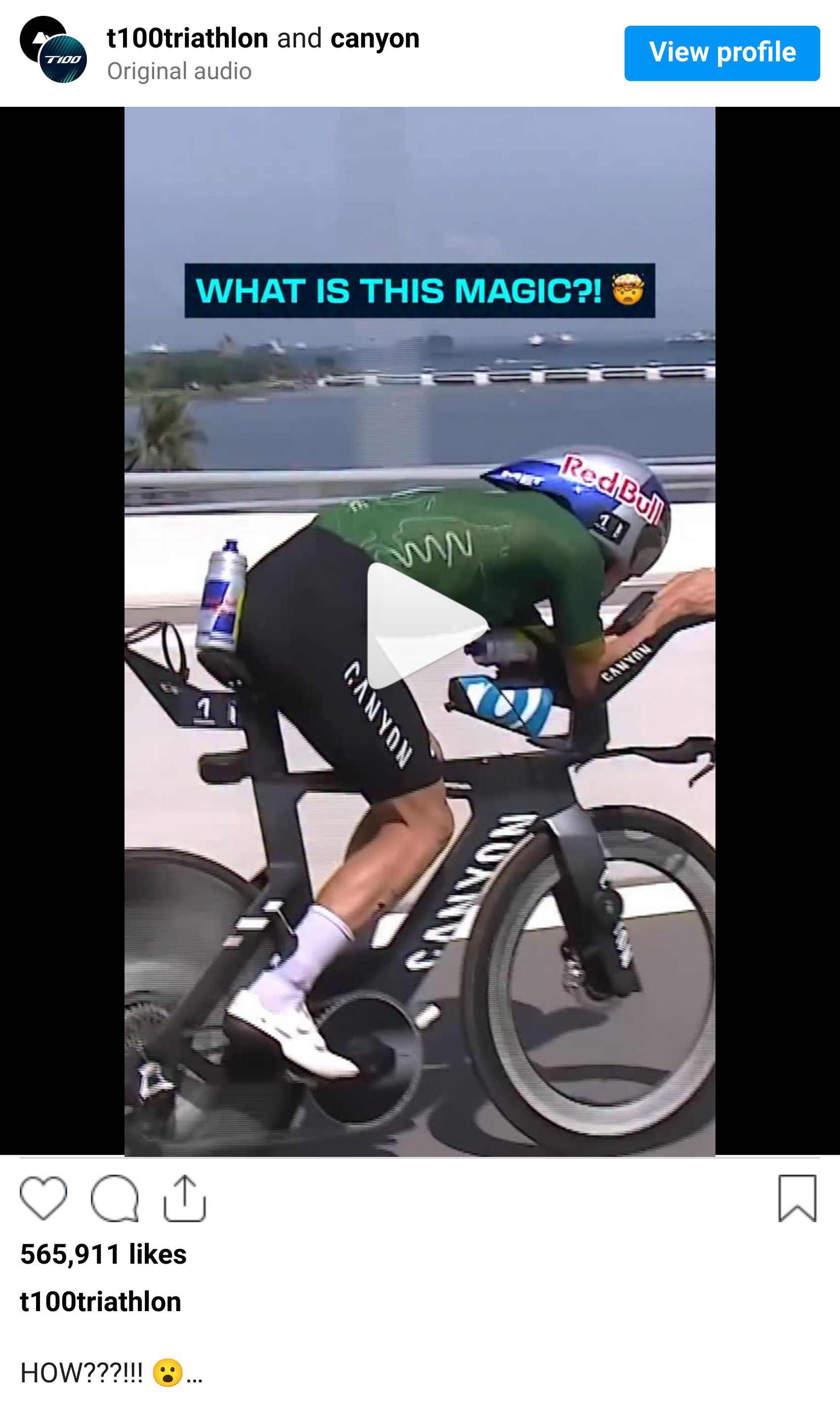
Hayden Wilde’s stunning performance at the T100 in Singapore last weekend was so dominant that the Kiwi superstar even had time to perform a magic trick during the bike section.
Footage from the ride-along crews clearly shows how his rear-mounted drinks bottle bounces out of its holder when he hits a particularly rough piece of the road.
However, instead of the bottle crashing to the tarmac, it somehow balances upright on his saddle, balancing up against his backside, enabling him to reach back and casually take a sip.
The best bit is the reaction, however, as Wilde turns to the camera and gives a knowing nod… ‘see that? How cool was that?’
⏱️ Coaches corner: The mistakes that could be ruining your running development
Improving as a runner is not just about doing more training; it is about doing the right training consistently. Many runners plateau not because they lack effort, but because of common mistakes that limit adaptation and increase fatigue. Identifying and correcting these errors is essential for long-term progress and better performance.
❓ Why does your progress suffer?
Running progress depends on the balance between training stress and recovery. When this balance is disrupted, improvement stalls. Too much stress leads to fatigue, while too little prevents adaptation. Consistent, structured training is what drives progress forward. Understanding common mistakes helps you stay on the right path.
😮💨 Running too hard, too often:
One of the most common mistakes is training at high intensity too frequently. Many runners push hard in most sessions, thinking it leads to faster improvement. However, excessive intensity increases fatigue and reduces recovery. Most runs should be at a controlled, lower intensity. This allows your body to adapt and build endurance effectively.
🫤 Lack of consistency:
Inconsistent training limits progress more than any other factor.
Skipping sessions or training irregularly prevents adaptation.
Fitness is built through repeated, consistent effort over time.
Even short, regular runs are more effective than occasional long sessions.
Consistency creates momentum and steady improvement.
📈 Increasing mileage too quickly:
Sudden increases in training volume place excessive stress on the body.
This often leads to fatigue or injury.
Progression should be gradual to allow adaptation.
A controlled increase in mileage builds resilience and endurance.
Patience is essential for sustainable progress.
Ignoring recovery:
Recovery is where improvement actually happens.
Without proper rest, the body cannot adapt to training stress.
Fatigue accumulates, leading to reduced performance.
Sleep, easy runs, and rest days are all part of recovery.
Balancing training and recovery is essential for long-term improvement.
🏃♂️ Poor running form:
Inefficient movement wastes energy and increases strain. Poor posture, over-striding, and excessive tension reduce efficiency. Improving running mechanics helps you use energy more effectively.
Better form reduces fatigue and supports performance.

Avoiding common training errors is key to consistent running improvement.
😑 Neglecting strength and mobility:
Running alone is not enough to build a resilient body. Weak muscles and limited mobility increase injury risk.
Strength training improves stability and power. Mobility allows smoother, more efficient movement.
Together, they support better performance and reduce setbacks.
📋 Lack of structured training:
Training without a clear plan leads to inconsistent effort.
Random sessions do not provide the progression needed for improvement.
Structured training ensures the right balance of intensity and recovery.
It helps you track progress and stay focused on goals.
A plan provides direction and consistency.
🏁 Not practising in race conditions:
Training should prepare you for real race scenarios.
Ignoring pacing, fueling, or conditions can affect performance.
Practising these elements builds confidence and readiness.
Preparation reduces uncertainty on race day.
This improves both performance and consistency.
💨 Focusing only on speed:
Speed is only one part of running performance.
Without endurance and efficiency, speed cannot be sustained.
Balanced training includes easy runs, long runs, and structured sessions.
Focusing only on speed limits overall development.
A complete approach leads to better results.
🤔 Mental approach and expectations:
Unrealistic expectations can slow progress.
Expecting rapid improvement leads to frustration.
Running progress is gradual and requires patience.
Staying focused on consistency helps maintain motivation.
A positive mindset supports long-term development.
‼️ What you need to do next
Start by identifying which mistakes apply to your training.
Make small, consistent adjustments rather than drastic changes.
Focus on building a routine that balances effort and recovery.
Track your progress and stay patient with improvement.
Running progress comes from doing the basics well over time.
Avoiding common errors allows your training to deliver results.
💪 Outside edge of endurance
As predicted in Tuesday’s Daily Split, the new Adizero Adios Pro Evo 3 – the shoe worn by both men who broke the two-hour barrier at the London Marathon last Sunday – proved somewhat popular with runners around the world, despite its $500+ price tag.
In fact, the supershoe proved so popular that some news outlets were reporting it had completely sold out within a matter of minutes, and that some were put on resale sites for as much as $5,000.
There were plenty of reviews online by those who did manage to get a pair, so below is a link to one that we think you will enjoy. In this case, it is definitely cheaper to window shop, rather than buy!!!

What did you think of today's email?
That’s your Split. Until Next Time
Together, we go the distance. — @247_endurance 🏃♂️🚴♀️🏊♂️