

👋 Welcome back
Morning endurance fans…
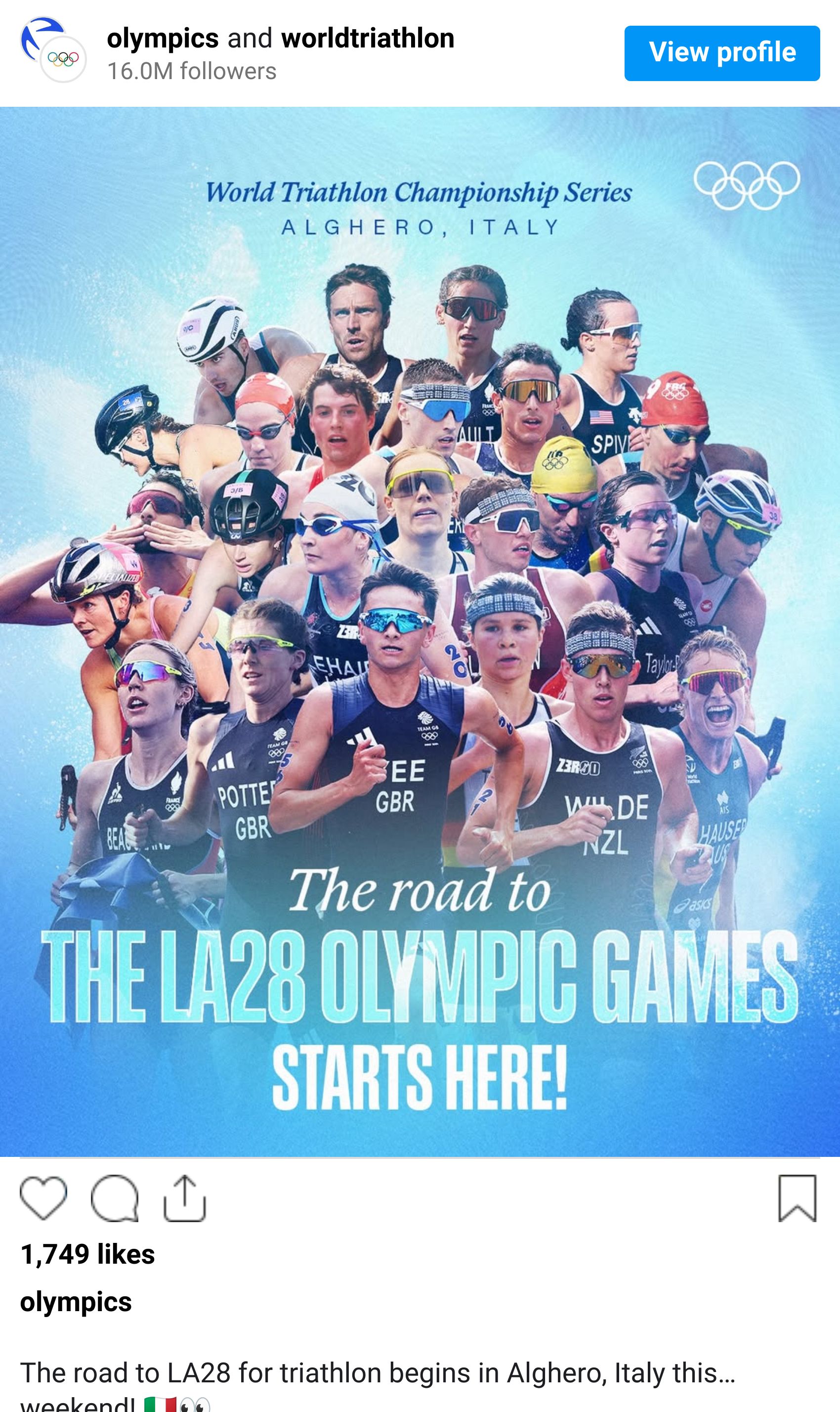
The road to the Olympics starts here.
After years of preparation, thousands of training hours and countless races around the world, the battle for places at LA28 officially begins today when the world’s best triathletes descend on Alghero for the latest WTCS showdown.
And if you're wondering exactly how athletes qualify for the Games, don't worry – you're not alone. The Olympic qualification process is famously one of the most complicated puzzles in sport, combining rankings, quota spots, relay places, continental berths and federation selections into one giant headache.
That's why we've put together a complete guide to who needs what… so pay attention, we will be asking questions later!!!
Elsewhere, there’s another packed weekend of endurance action to enjoy, with big races, big names and plenty of storylines to keep an eye on.
Here’s what we have lined up for you today…
LATEST: The endurance news headlines.
PREVIEWS: Your guide to this weekend’s big races.
OLYMPICS: The complicated qualifying process in TEN key facts.
TIPS: The key tips to improving your swim-to-bike transition.
COMPLETED: The boys who ran an incredible 33 marathons in 33 days.
🏃🏼 Quick splits

Cameron Main is facing a race to be fit for IRONMAN Frankfurt due to hip and back issues. [IRONMAN]
🤕 RETHINK: Cameron Main has been forced into a training re-think ahead of his next event at IRONMAN Frankfurt due to injury. Read HERE.
🚴♂️ RIDING: Top triathlete Maya Kingma will today line up for one of the most prestigious bike races in women’s cycling – the Giro d’Italia. Read HERE.
💰 STREAMING: Olympic champion Alex Yee believes WTCS triathlon events should be free for viewers to stream worldwide. Read HERE.
🎽 STRUGGLE: The ‘Hardest Geezer', Russ Cook, insists his goal of a 2:35 marathon is still possible, despite London troubles. Read HERE.
👟 LEGACY: Eliud Kipchoge has backed the future success of the Cape Town Marathon as it waits on its bid to become a ‘Major’. Read HERE.
🏁 Race news

An incredible field of athletes will line up in Alghero for the WTCS races this weekend.
[World Triathlon]
IRONMAN Brazil
Dutchman Youri Keulen will race at IRONMAN Brazil tomorrow as he chases down one of the six Kona slots available – three per gender – in what will be his first-ever full-distance race.
With time running out for athletes to secure their place on the Big Island come October 10, he is hoping the stunning surroundings of Florianópolis will inspire him to an all-important podium finish and a first experience of the World Championships.
Keulen spent time training with Marten Van Riel (BEL) and Vincent Luis (FRA) in the build-up to their impressive performances at IRONMAN Texas, and is now ready to jump in at the deep end himself and see if he can step up from his middle-distance roots.
Posting on Instagram this week, he said: “Arrived in Florianópolis last night and getting ready for my very first Ironman! After a smooth block of prep in the Sierra Nevada, I am amazed how beautiful Brazil is.
“Being here feels special. This feels like a massive milestone in my athletic career, and I’m just excited to be at the start line with a fit body and a healthy, focused mind. Let’s do this! 🏊♂️🚴♂️🏃♂️
Challenge St Pölten
With two wins under her belt already this season, in-form German athlete Caroline Pohl will be looking to secure a hat-trick of success this weekend when she lines up in Lower Austria for Challenge St Pölten.
Only a week after securing an emotional victory at ‘The Championship’ in Šamorín, the 30-year-old now has the chance to make it three from three on one of the most scenic yet demanding courses on the circuit.
It is a welcome return to form for Pohl, who won four of her nine races back in 2024, only to then go the whole of last year without recording a single win – the best she could muster was two runner-up finishes at the IRONMAN 70.3s in Kraichgau and Sweden.
German Finn Grossse-Freese will be the man to watch. At 38th in the world, he is the highest-ranked male athlete on course and is coming off a fifth place at Challenge Salou-Costa Daurada a couple of weeks ago.
He shares the spotlight with compatriot Frederic Funk, who crossed the line in seventh place last weekend in Šamorín and will be looking for a better performance this time around.
The BIG race: WTCS Alghero – World Triathlon announces FREE stream
The race to Los Angeles starts on the Italian island of Sardinia this morning, as many of the biggest names in short-course triathlon seek to win their first qualification points for the 2028 Olympic Games.
In what is the most stacked field of the WTCS season to date, both the men’s and women’s fields have a star-studded array of international legends ready to do battle around the port city of Alghero.
And to celebrate the World Triathlon Instagram account reaching 500,000 followers, the race will now be available for FREE on the Triathlonlive.tv website, and signing up for the Alghero Race Pass by using the special promotional code MYRACEPASS.
ELITE WOMEN’S FIELD: French star Cassandre Beaugrand will be looking to complete a hat-trick of Alghero wins as she arrives in Sardinia for what will be her first triathlon of the 2026 season… but she won’t have it all her own way!!!
While very much among the favourites, there are plenty of other strong athletes lining up against her, including from within her own French camp, as Emma Lombardi – who has earned an average placing of third in Sardinia and is also one of three women with multiple WTCS medals on the island – challenges alongside Leonie Periault, who arrives on the back of a silver medal at WTCS Samarkand.
Last week’s T100 Spain winner, Georgia Taylor-Brown, heads up a strong British contingent, which also includes Samarkand winner Beth Potter, Olivia Mathias, Sophie Evans, Jess Fullagar and Tilly Anema.
And the big names don’t stop there…
Reigning WTCS champion Lisa Tertsch (GER) will be looking to finally get on a podium this year after missing out in the opening two events, and America’s very own triathlon version of ‘Tay Tay’, Taylor Spivey and Taylor Knibb, will add some real power in the pack.
Spivey podiumed at the T100 last week, while Knibb has already won a T100 and a 70.3 this year, while also finishing as runner-up at IRONMAN Texas.

Olympic gold and silver medallists Alex Yee and Hayden Wilde were due to race each other at WTCS Alghero, until Wilde pulled out. [World Triathlon]
ELITE MEN’S FIELD: The lure of early Olympic qualification points had brought out the big guns in Alghero as the big three of short-course racing – Alex Yee, Matt Hauser and Hayden Wilde – were due to line up against each other for the first time since 2024.
However, Wilde’s announcement on Friday that he was unwell means that he will be missing, and fans will have to wait a little longer for that particular showdown.
Brazilian Miguel Hidalgo won this race last year as well as finishing in second behind Australian Hauser in Yokohama, and will certainly test the two big names remaining.
Hauser powered his way to victory in Japan last time out – his opening race of the series following his brief sojourn into T100 territory – however, Alghero was one of the few WTCS races that he didn’t win last year, and that will give the chasing field hope.
The winner that day, Hidalgo, has proved he has the skills to challenge the very best, beating Hauser into second last year and finishing ahead of another major threat among this week’s field, Vasco Vilaca (POR), who came in third.
Indeed, Vilaca won the opening race of this season in Samarkand when the likes of Yee, Hauser and Wilde were elsewhere, and he will be looking to prove that he can now follow up that success when the terrific trio are also lining up against him.
Wilde, who finished third in the IRONMAN 70.3 at Geelong before then dominating once again at T100 level when he won in Singapore, chose to miss Yokohama and will now focus his immediate attentions on next week’s T100 race in San Francisco.
Yee certainly enjoys his visits to Sardinia. Every time the Briton has shown up at a WTCS race on the island, he has left with the gold medal. He returned to WTCS action in Yokohama, having spent last season focusing on his marathon running.
START TIMES: The Elite women are scheduled to get proceedings underway on San Giovanni beach at 11:00 local Central European time, while the men will then start later in the day at 14:00.
For the women’s race, this means a 10:00 start in the UK, 02:00 on the West Coast of North America, 04:00 in Central USA, and 05:00 on the East Coast. In Australia, that means the race will start at 17:00 AWST, 18:30 ACST, and 19:00 AEST. In New Zealand, the start time is 21:00.
For the men’s race, this means a 13:00 start in the UK, 05:00 on the West Coast of North America, 07:00 in Central USA, and 08:00 on the East Coast. In Australia, that means the race will start at 20:00 AWST, 21:30 ACST, and 22:00 AEST. In New Zealand, the start time is midnight.

For over 15 years, ZONE3 has been a go-to for triathletes chasing marginal gains. From sustainable B-Prene Yamamoto neoprene to race-day innovations, their wetsuits deliver flexibility, buoyancy, and speed—whether you’re a first-timer or chasing Kona slots. Athlete Approved, Performance Driven
Aspire Wetsuit (£549)
The multi-award-winning flagship just got better. 100% B-Prene Yamamoto neoprene with Aerodome buoyancy (+30%), X-10 Extreme shoulder panel for 360° stretch, and SCS nano-coating for ultra-low drag. Natural swim feel, rapid transitions, and proven endurance for age-group crushers.
Learn More
Vision Wetsuit (£399)
Ranked by some as the Best Triathlon Wetsuit of 2024. Eco-friendly B-Prene delivers pro-level flexibility and buoyancy with tested gains: +3.4% speed, +3.6% efficiency. Ideal for beginners to experienced athletes wanting performance without compromise.
Learn More
Vanquish-X Wetsuit (£699)
Elite flagship worn by IRONMAN World Champion Casper Stornes. Bio-Rubber thighs for fresher legs, Alpha Titanium lining, max buoyancy, and top-tested results: +5.2% speed, +10.3% efficiency. Every detail engineered for race-day marginal gains.
Learn More
Olympic qualification explained
PROCESS: Triathlon Olympic qualification is a two-step process: athletes first secure a quota spot for their country by earning points on the World Triathlon circuit, after which their National Olympic Committee (NOC) selects the individual athletes based on their own specific internal criteria
MEDALS: World Triathlon will contest three medal events at the LA28 Olympic Games: Men’s Individual, Women’s Individual, and the Mixed Relay. The total quota will be 110 athletes (55 per gender). These will be held over the Olympic distance of 1.5km swim, 40km bike ride, and 10km run.
QUALIFYING: The Olympic Qualification Period officially opened on May 18, with all points available from that date, through until May 18 2028, with the period split into two one-year parts. Eligibility can be attained through a variety of pathways. As in the previous edition of the Olympic Games, there will be Mixed Relay events counting towards the qualification.
MIXED RELAY QUALIFICATION: The Host Country (USA) is guaranteed two men and two women (one Mixed Relay team). The winners of the 2026 and 2027 World Triathlon Mixed Relay Championships will each secure two men and two women quota places for their NOCs.
MIXED RELAY RANKINGS: 16 men’s and 16 women’s spots will be allocated via the World Triathlon Mixed Relay Olympic Qualification Ranking. The highest-ranked NOC from each of the five continents (from continents without NOCs already qualified and within the top 15) will receive 2-2 quotas, with the remaining spots filling the quota based on rank.
INDIVIDUAL OLYMPIC QUALIFICATION RANKING: 21 places will be available through the rankings as of May 18, 2028. For NOCs that have already secured 2-2 places via Mixed Relay or Host pathways, their top two, ranked athletes, in both genders will not be considered for these individual spots.
‘NEW FLAG’ OPPORTUNITIES: For the first time, the 'New Flag' pathway has been expanded to include two dedicated spots per continent (one via Continental Games, one via World Triathlon Ranking). This ensures that up to 10 athletes (2 men and 2 women per continent) from countries not otherwise qualified will have a guaranteed pathway to the Games.
UNIVERSITY PLACES: A maximum of two invitations (two men, two women) will be awarded by the Tripartite Commission to eligible under-represented NOCs.
NUMBERS: NOCs with at least three athletes in the top 30 may qualify up to three athletes per gender; all others are limited to two.
INDIVIDUALS: Just because an athlete earns a quota spot for their country does not automatically guarantee they will compete. National federations, such as British Triathlon and USA Triathlon, have their own strict selection policies and may choose athletes based on discretionary selections, such as demonstrating past podium finishes at previous games or WTCS events.
Which nation looks in the best shape for Olympic gold right now?
🚴♂️ News from the saddle
Sepp Kuss conquered the Dolomites on stage 19 of the Giro d'Italia to take a debut stage win at the Italian Grand Tour after a dramatic Friday.
The American outlasted the rest of his breakaway companions to triumph atop the Piani di Pezzè as his Visma-Lease a Bike teammate Jonas Vingegaard all but sealed overall victory at the Giro.
Behind, Derek Gee-West (Lidl-Trek) was second, gaining time on his other general classification rivals, as Giulio Ciccone, also of Lidl-Trek, finished third.
It looked like a time that Ciccone would take the stage win, after he launched a move over the penultimate climb of the Passo Falzarego, having already taken the maximum mountain points over the top of the Passo Giau. Ciccone therefore won the Cima Coppi, the prize for conquering the highest point of the Giro.
With Sunday’s processional final stage through Rome, today’s penultimate stage is the final chance for riders to make their moves in the GC, on a 200km ride from Gemona Del Friuli to Piancavallo.
👩💻 Trending in triathlon
There is nothing like a healthy bit of playful banter between athletes and podcast presenters… especially when the triathlete in question feels he has something of a point to prove.
Harry Palmer secured what he would freely admit was the result of his career last week, when he crossed the line first at Challenge Family’s headline event, ‘The Championship’. And he was rightly delighted with his achievement after a run of some, not-so-good results at the tail end of last year and start of 2026.
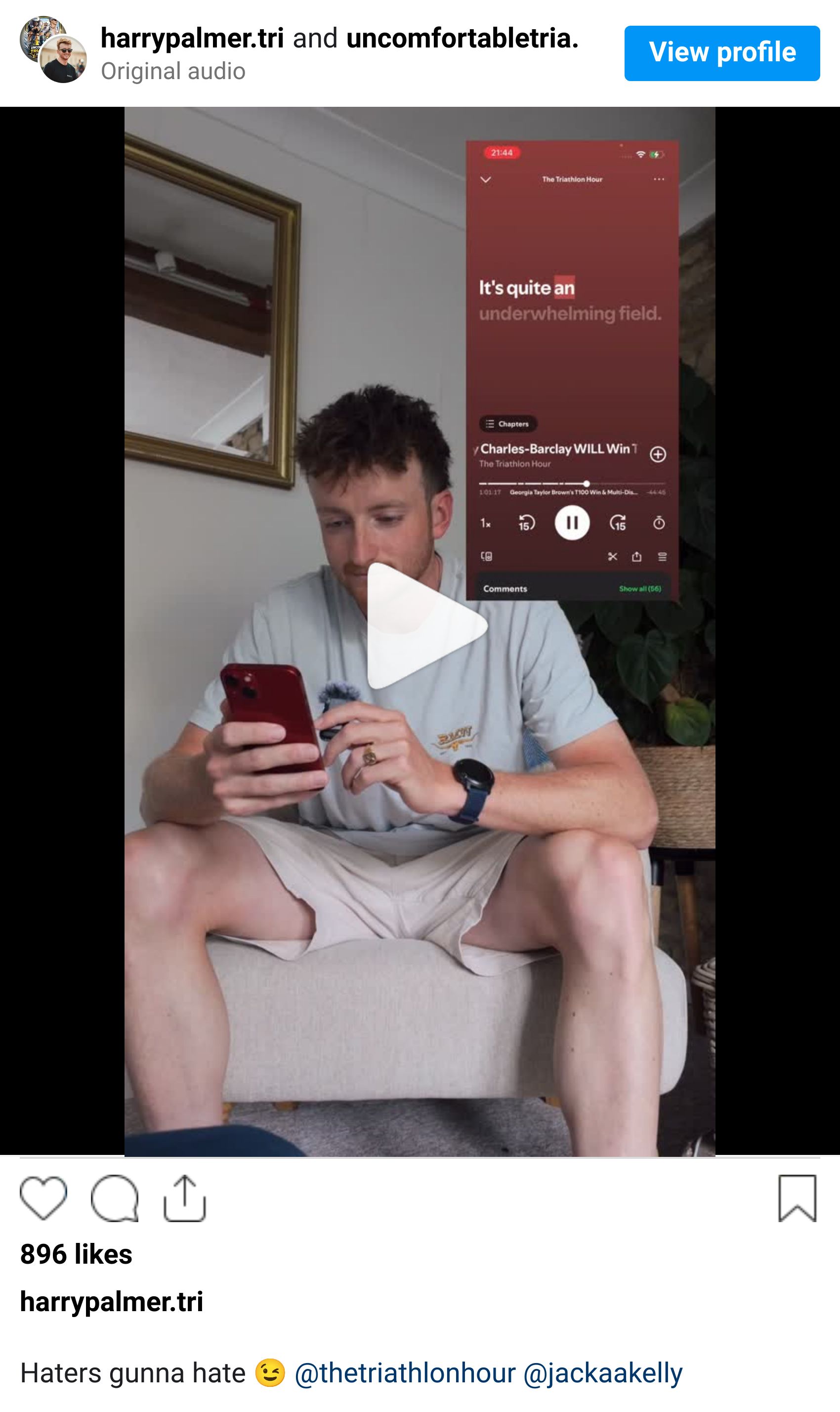
However, a clip from The Triathlon Hour host Jack Kelly, which seemingly questioned the quality of the field on show at the event, left Harry feeling the need to respond… and he did so in real style.
Sitting on a chair, playing the podcast out loud, Harry plays the clip where Kelly states: “It’s quite an underwhelming field. Strength of field 80.97. It’s not what this race, you know, maybe once was in terms of strength of field. So yeah, I don’t know… Challenge not at its strongest when their championship race is being won by Harry Palmer.”
A smiling Harry looks up and, with eyes into the camera, he gives a little chuckle and replies with: “Oh, Jacky-boy… yeah… still got the win though… and I still got paid. So, onto the next one.”
As he stands to leave, there is a red Challenge Family piece of card which says ‘1st Place €15,000’.
The post, which was liked by many of his triathlon colleagues, including former world champion Gustav Iden, also drew a reply from a rather red-faced Kelly, who stated in the comments section: “Haha!! This does sound bad in isolation. I did go on to correct it 3 minutes later and say how you’re very good, and I was probably wrong saying that.
“It was more meant to compare like an Ironman 70.3 world championships or T100 Grand Final compared to the Challenge Champs. Anyway, I feel bad, and Chase Pack for life, it’s only love & support for your career from us, despite that clip sounding a bit nasty 🤣.”
⏱️ Coaches corner: How to complete a smoother T1 and get riding faster
A fast triathlon transition after an open water swim is not just about moving quickly through T1. It is about staying controlled, reducing wasted energy, and preparing the body efficiently for the bike section.
Many triathletes lose valuable time during the swim-to-bike transition because they panic, rush unnecessarily, forget their equipment order, struggle with wetsuits, and simply lose focus after the swim.
A smoother transition often saves more energy than a frantic one. Efficient triathletes stay calm, organised, and deliberate while moving quickly through every step. This becomes especially important during longer races, where transition efficiency affects pacing and energy management across the entire event.
Our top tips on improving your exit from the swim:
Exit the water under control: Many athletes sprint aggressively toward transition immediately after leaving the water. This often causes dizziness, elevated heart rate, poor coordination, heavy breathing, and mental panic. Swimming horizontally for a long period changes blood flow dynamics, so standing suddenly and sprinting immediately can feel disorientating.
Start preparing BEFORE you leave the water: Efficient transitions begin before swimmers even reach shore. During the final minutes of the swim, you should do the following:
Increase kick slightly to improve blood flow to the legs.
Focus on breathing rhythm.
Mentally rehearse transition steps.
Practice removing your wetsuit quickly: Wetsuit removal is one of the biggest sources of unnecessary time loss for athletes. Efficient removal depends on your preparation, ensuring you are lubricated, know your correct technique, and practice repetition. Useful areas for anti-chafing lubricant include the ankles, wrists, neck and calves. Make sure you are standing still, not rushing, or pulling unevenly.

A calm, easy transition from water to bike can seriously improve your race times.
Keep the transition set-up simple: Complicated transition areas create mistakes. Make sure you have everything ready, but remember, too much equipment can lead to mental overload, confusion and unnecessary stress.
Efficient setups usually include the following key rules:
Helmet open and ready.
Sunglasses inside the helmet.
Shoes positioned clearly.
Nutrition is organised simply.
Towel minimal and tidy.
Control your breathing: Open water swimming often elevates heart rate and breathing significantly. Transition becomes smoother when athletes are able to slow their breathing consciously, relax their shoulders and stay mentally calm. Rushing blindly through T1 usually increases mistakes, heart rate and leads to energy waste.
Use landmarks to navigate quickly: Transition areas can become confusing during large races. It is easy to run past your bike, lose orientation and panic under pressure. So some key tips include:
Memorising your row locations.
Identifying visual landmarks.
Counting bike rack positions.
Walking transition before racing.
Practice barefoot running: We know that we can all run, but can you run barefoot? And can you run on wet surfaces, uneven terrain and often on long transitions? Triathletes often underestimate how awkward barefoot running feels after swimming, so practice your coordination and foot placement to give you transition confidence.
Mount line practice: Many athletes lose time at the mount line because they don’t practice enough. Without doing the work in advance, you can stop awkwardly, fumble with shoes, lose balance and end up rushing unnecessarily. Work on your bike handling, mounting technique, and shoe entry to create a smoother, risk-free execution.
💪 Outside edge of endurance
Cast your minds back to the London Marathon weekend, and do you recall the story that we carried here on the Daily Split about the guy who had completed the trek whilst carrying a fridge on his back?
Well, that incredible young man has this week completed the final leg of his incredible marathon challenge, which, having started on the streets of England’s capital, saw him then complete 32 more marathons in just 32 days across Ireland.
Jordan Adams (31) lugged the 25kg fridge for the 42kms around London to raise awareness and funds for Alzheimer’s Research UK in memory of his mum, Geraldine, who died aged 52 after being diagnosed with the condition frontotemporal dementia, or FTD.
The family has seen 12 family members die from the hereditary condition, and both Jordan and his brother Cian (26) have been told they are 99% likely to also contract it – meaning they will be symptomatic in their mid-40s.
Speaking at the finish line, Jordan said he walked out of hospital the day he found out that he carried the gene, knowing he ‘wanted to make an impact on the world’.
The pair, known as the FTD brothers, completed the runs together and arrived in Dublin on Thursday, having raised an incredible £1.8m for the charity.
You can read more about their story and donate to their cause, HERE.

What did you think of today's email?
That’s your Split. Until Next Time
Together, we go the distance. — @247_endurance 🏃♂️🚴♀️🏊♂️