

👋 Welcome back
Morning endurance fans…
All roads lead to The Championship as Challenge Family’s showpiece event once again pulls together a seriously strong middle-distance field for tomorrow’s showcase race on their calendar.
But that is only the start of another monster few days in endurance sport.
Over in Spain, the T100 spotlight shines on another stacked battle between the sport’s biggest women stars, while the brutal roads and volcanic winds of IRONMAN Lanzarote are ready to chew up yet another field of brave souls chasing one of triathlon’s toughest finishes… as well as Kona qualifications.
And then there is marathon royalty.
Because just when you thought this weekend could not get any bigger, Eliud Kipchoge heads to the Cape Town Marathon – bringing global attention, history and perhaps another unforgettable chapter from the greatest marathon runner the sport has ever seen.
Big races. Big names. Big consequences.
Exactly how we like it.
Here’s what we have lined up for you today…
LATEST: The endurance news headlines.
PREVIEW: T100, IRONMAN, Challenge, Marathon… the list goes on.
CYCLING: The latest after Stage 13 of the Giro d’Italia.
TIPS: Why running in a triathlon needs specialist training.
ENHANCED: The Enhanced Games take place this weekend.
🏃🏼 Quick splits

Cassandre Beaugrand broke the French record for the 5,000m this week. [World Triathlon]
💨 SPEEDY: Olympic triathlon champion Cassandre Beaugrand shattered the French 5,000m record on the track this week. Wow!!! Read HERE.
🤕 SETBACK: Briton Sam Dickinson has been forced out of the T100 in San Francisco after suffering a possible fracture in his foot. Read HERE.
🇩🇪 HISTORIC: Hamburg has been chosen as the host of next year’s inaugural T50 Final – a part of the new Triathlon World Tour. Read HERE.
🎽 MISSING: Last year’s Hardrock 100 champion, Katie Schide, has been forced out of this year’s event through a foot injury. Read HERE.
🇯🇪 STACKED: A mega field, including both of the reigning Olympic champions, will compete in the Supertri Pro Series Final. Read HERE.
🏁 Race news

Georgia Taylor-Brown will be competing at the Spain T100 this afternoon. [PTO]
🇪🇸 T100 Triathlon World Tour: Spain
The second instalment of this season’s women’s T100 Triathlon World Tour was supposed to see reigning champion Kate Waugh return as part of a stacked middle-distance field.
Missing from the opening fixture of the campaign back in March due to a calf issue, she finally made her 2026 bow at the World Cup in Chengdu earlier this month when she took third after a three-way sprint and then went on to finish 14th at WTCS Yokohama.
But on Wednesday, she posted on Instagram: “Injury update – Super frustrated to have to withdraw from the T100 this weekend due to re-aggravating my calf 🥺. Turns out sprint finishes aren’t the best way to return to racing for calf injuries 🫠. This, combined with the Yokohama race, was just too much load too soon.
“Taking some time to build back again properly and hope to be back again very soon!! Good luck to all the girls in Spain.”
It’s a big shame for her and the race, but there’s still plenty to look forward to with Julie Derron (SUI), Georgia Taylor-Brown (GBR), Holly Lawrence (GBR), and America’s Taylor Spivey all lining up for what promises to be a real cracker.
The race starts at midday local time in Pamplona.
🇪🇸 IRONMAN Lanzarote
The race for Kona qualification and, indeed, validation will heat up considerably this weekend as a strong field of athletes endeavour to book their world championship places by competing at IRONMAN Lanzarote.
This may not be a Pro Series event, but it does represent a glorious opportunity for those sweating over their Big Island slots to finally qualify and ensure a more controlled build-up to their date with destiny in Hawaii on October 10.
Two former champions will be looking to validate, with Sam Laidlow (FRA) and Lucy Charles-Barclay (GBR) only needing to finish the race to secure their spots, while another, Patrick Lange (GER), will be racing the rest of the field for one of the six places for Kona up for grabs – three per gender.
It adds a serious sense of anticipation to what promises to be an exciting race on the Spanish island in what is traditionally one of the toughest full-distance races out there, especially if the wind blows.
The race started at 7am local time in Lanzarote. Click on the button below for more info.
🇺🇸 Supertri Pro Series: Austin
Olympic gold medallist Gwen Jorgensen is set to line up at Ascension Seton Supertri Austin on May 25, as the first edition of the Supertri Pro Series kicks off a huge day of professional and amateur racing.
Jorgensen, who claimed Olympic gold in Rio in 2016, is among a strong international and American professional field confirmed for the race. The 40-year-old mother of two left triathlon for marathon running after her Olympic glory, but returned to the sport and remains one of the USA’s highest-profile triathletes.
The Supertri Pro Series sees elite athletes compete over a draft-legal sprint distance format, with thousands of amateur triathletes taking on the same multi-lap course that heads to the Texas State Capitol on Memorial Day (Monday).
In the men’s field, Olympic gold medallist Tim Hellwig, who collected mixed team relay gold with Germany in Paris, is making his way back to the top after injury and lines up alongside Seth Rider, who was part of the USA’s Olympic silver medal-winning mixed relay team in Paris.
Three athletes per gender will qualify for the Supertri Pro Series Final with its $800,000 prize pool. Supertri Pro Series events all pay ten deep to encourage athlete development.
Amateur athletes can still register to race at Ascension Seton Supertri Austin across Supersprint, Sprint and Olympic distances. Every amateur races on the same course as the professionals.
Entries are available at the Supertri website HERE.
🇿🇦 Cape Town Marathon
Kenya’s double Olympic champion Eliud Kipchoge says he is looking to inspire a new generation of runners this weekend as he takes part in his first official marathon on African soil.
The running legend has chosen Sunday’s Sanlam Cape Town Marathon as the opening stop for his Eliud’s Running World Tour, which will see him tackle a series of seven events across all continents over the next two years.
His goal is to inspire people to lead healthier lives, and as he touched down in South Africa this week, he reiterated his desire to inspire people, both young and old, to get up and start running.
Despite being born in Kenya, this weekend’s race will herald the first professional marathon race in Africa of his long and distinguished career; it will also go a long way to helping the organisers in their push for the event to be recognised as the continent’s first Major.
You can watch the race live by clicking the button below.

Last year’s winner of The Championship, Hanne De Vet, will be racing the T100 in Spain today. [Challenge Family]
The BIG race: The Championship 2026
It’s Challenge Family’s showpiece middle-distance race, and the ninth edition of The Championship is the biggest yet, with the professionals joined by a sold-out field of over 2,400 age group athletes from 63 countries.
It all takes place at the iconic X-Bionic Sphere in Šamorín, Slovakia, this weekend on the banks of the Danube River. It has fields to match too, and no wonder, with a €100,000 prize purse up for grabs.
Here’s all you need to know…
⏰ START TIME AND HOW TO WATCH LIVE:
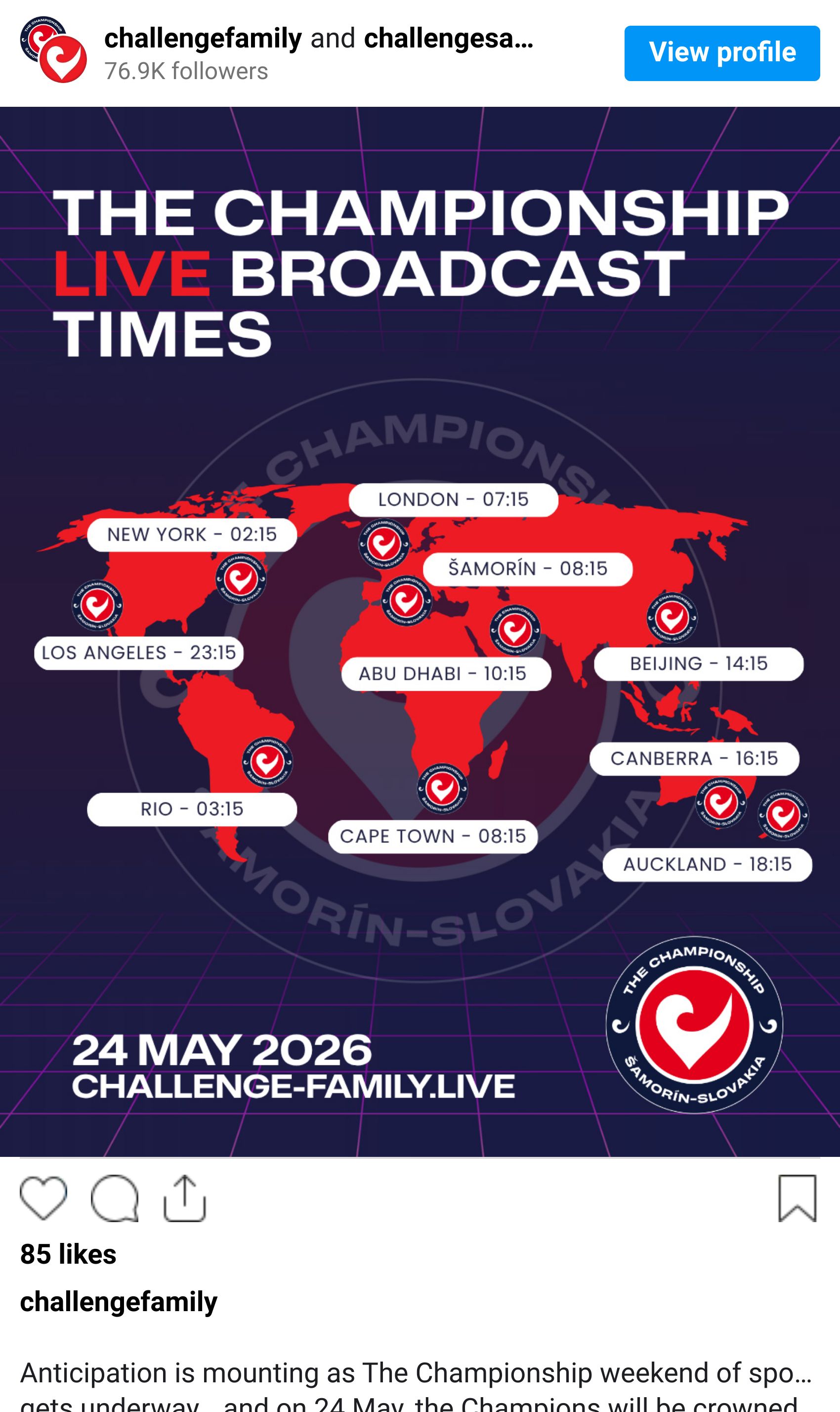
The Championship will take place tomorrow (Sunday, 24 May), with the men kicking things off at 08:30 local time. This corresponds to 07:30 in the UK, 02:30 on the East Coast and 23:30 on Saturday on the West Coast.
Starting ten minutes later, the women will begin at 08:40 local time. This corresponds to 07:40 in the UK, 02:40 on the East Coast and 23:40 on Saturday on the West Coast.
Live coverage of the full race, with commentary from Belinda Granger, is available on the Challenge Family YouTube page, and you can find a link to this HERE.
The Championship will also be broadcast live and for free at www.challenge-family.live and on Instagram Live @challengefamily. And there’s a timing tracker link on the Challenge Family website HERE.
🏊♀️ PRO WOMEN:
There’s only one place to start with the women’s field, and that’s German duo Caroline Pohle and Lena Meissner.
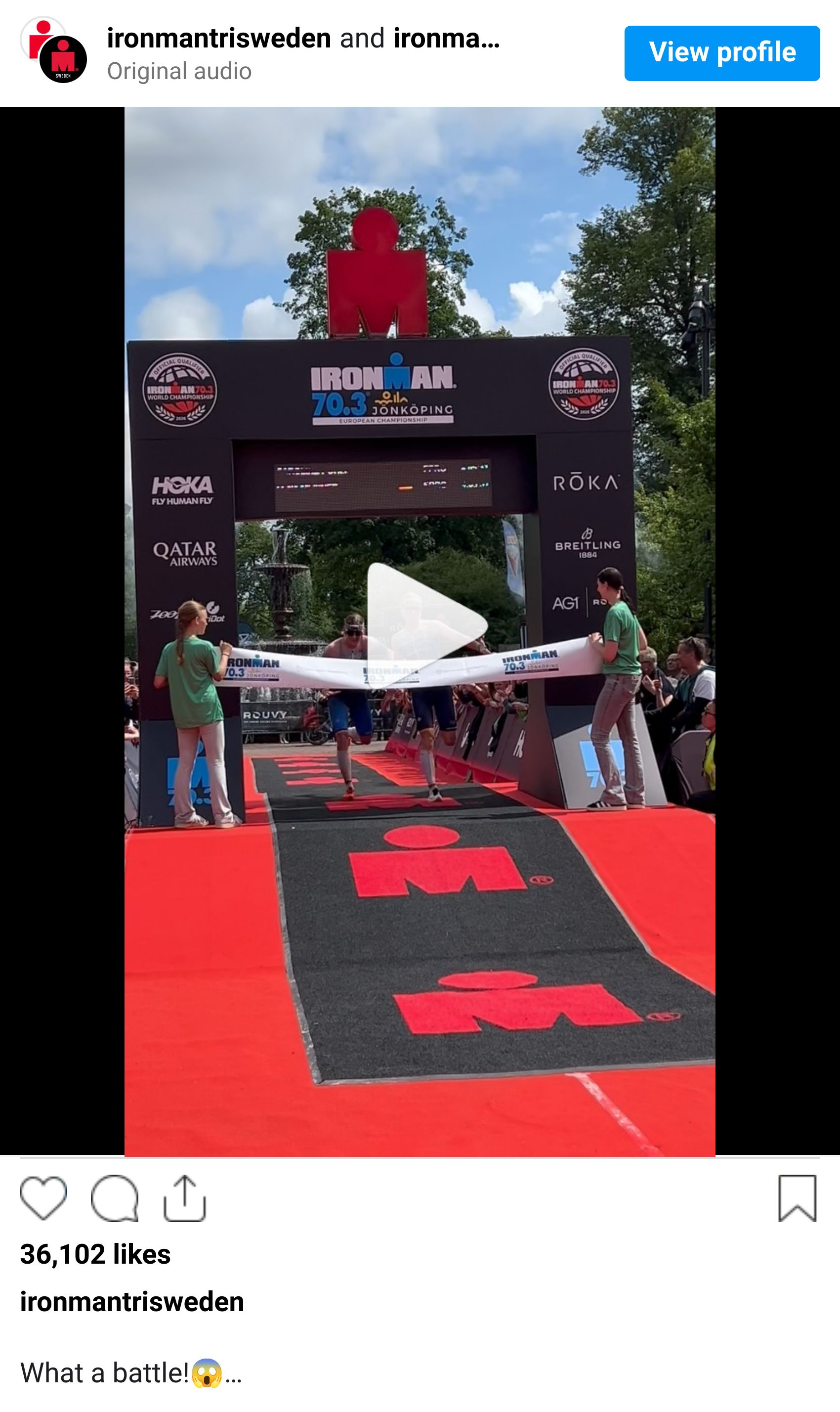
Last year, they fought out an epic sprint finish at IRONMAN 70.3 Jönköping European Championship (see above) where virtually nothing separated them on the line.
The verdict initially went to Meissner, but then a protest was upheld, and the title of European Champion went to Pohle. There were more twists and turns to come in a case that went on for months, but the record books now show Meissner as the winner!
So that’s one fascinating showdown, and both arrive in good form. Pohle is looking to back up her recent Challenge Gran Canaria win, while Meissner was third in a high-class 70.3 Valencia behind rising star Cathia Schär and Sophie Evans.
Pohle is also warming up for her full-distance debut at Challenge Roth.
Marta Sánchez (ESP) finished a terrific third behind IRONMAN World Champion Solveig Løvseth and Taylor Knibb at IRONMAN Texas, so she will be a threat to all.
As will Katrine Græsbøll Christensen (DEN), who kicked off her season with victory at Challenge Sir Bani-Yas and was sixth at 70.3 Aix-en-Provence last weekend.
And Italy’s Elisabetta Curridori won Challenge Salou last time out and was fourth in this event 12 months ago. However, last year’s champion, Hanne De Vet, will not be defending her crown as she focuses on the T100 tour in Spain.

Kristian Høgenhaug stormed to victory at The Championship last year. [Challenge Family]
🚴♂️ PRO MEN:
In the men’s race, Will Draper (GBR) will be looking to continue his winning streak fresh from his Challenge Salou victory, but he will face strong competition from the likes of Frederic Funk (GER), Henry Räppo (EST), Pieter Heemeryck (BEL), Kieran Lindars (GBR) and many others.
Funk is the most experienced athlete of this group on The Championship course, having lined up no less than six times and standing on the podium for half of them, but he has never secured the win. Is this the year?
Others to watch include Jannik Schaufler (GER), Harry Palmer (GBR), Michele Sarzilla (ITA), James Teagle (GBR) and former champion Florian Angert (GER).
If Teagle in particular is anywhere near at the start of the run, then watch out as he won the Cambridge Half Marathon in March in a time of 1:04:15.
📍 THE CHAMPIONSHIP COURSE:
The first edition of The Championship took place at the X-bionic sphere in 2017, and the 1,900m swim has now moved to the Danube canal (as opposed to the river), with the athletes completing a point-to-point swim.
On to the bike, the flat and fast course is just one loop on a primarily out-and-back course. For the run, the course takes in five laps of the X-Bionic Sphere venue.
You can find out much more via our in-depth course preview here and the embedded video below.
🏆 PREVIOUS WINNERS:
2025: Hanne De Vet (BEL) and Kristian Høgenhaug (DEN)
2024: India Lee (GBR) and Kyle Smith (NZL)
2023: India Lee (GBR) and Mathis Margirier (FRA)
2022: Sara Perez Sala (ESP) and Gustav Iden (NOR)
2021: Lucy Buckingham (GBR) and Florian Angert (GER)
2019: Lucy Charles-Barclay (GBR) and Sebastian Kienle (GER)
2018: Lucy Charles-Barclay (GBR) and Lionel Sanders (CAN)
2017: Lucy Charles-Barclay (GBR) and Lionel Sanders (CAN)
💰 PRIZE MONEY
The crown jewel of the Challenge Family middle-distance racing calendar, The Championship offers a significant total prize purse of €100,000.
The total funds will be paid ten-deep, as follows:
€15,000
€9,000
€7,000
€5,000
€4,000
€3,000
€2,500
€2,000
€1,500
€1,000
🚴♂️ News from the saddle
Alberto Bettiol barrelled to victory on the shores of Lake Maggiore at the Giro d’Italia on Friday, winning from the breakaway in Verbania.
The XDS-Astana was part of a 15-rider move that formed within the first hour of racing on stage 13. He attacked with 13km to go, choosing the summit of a category-three climb as his launchpad, and soloed like a rocket on rails to the line.
There were no changes in the top 10 of the general classification; Afonso Eulálio (Bahrain Victorious) continues to lead Jonas Vingegaard (Visma-Lease a Bike) by 33 seconds.
Today’s 14th stage will bring one of the shortest but most punishing days of this year’s Giro. Only 133km long, the route will take the peloton across the Aosta Valley, climbing a total of 4,350m to a summit finish in Pila.
For a full report on this story, read Cycling Weekly, HERE.
👩💻 Trending in triathlon
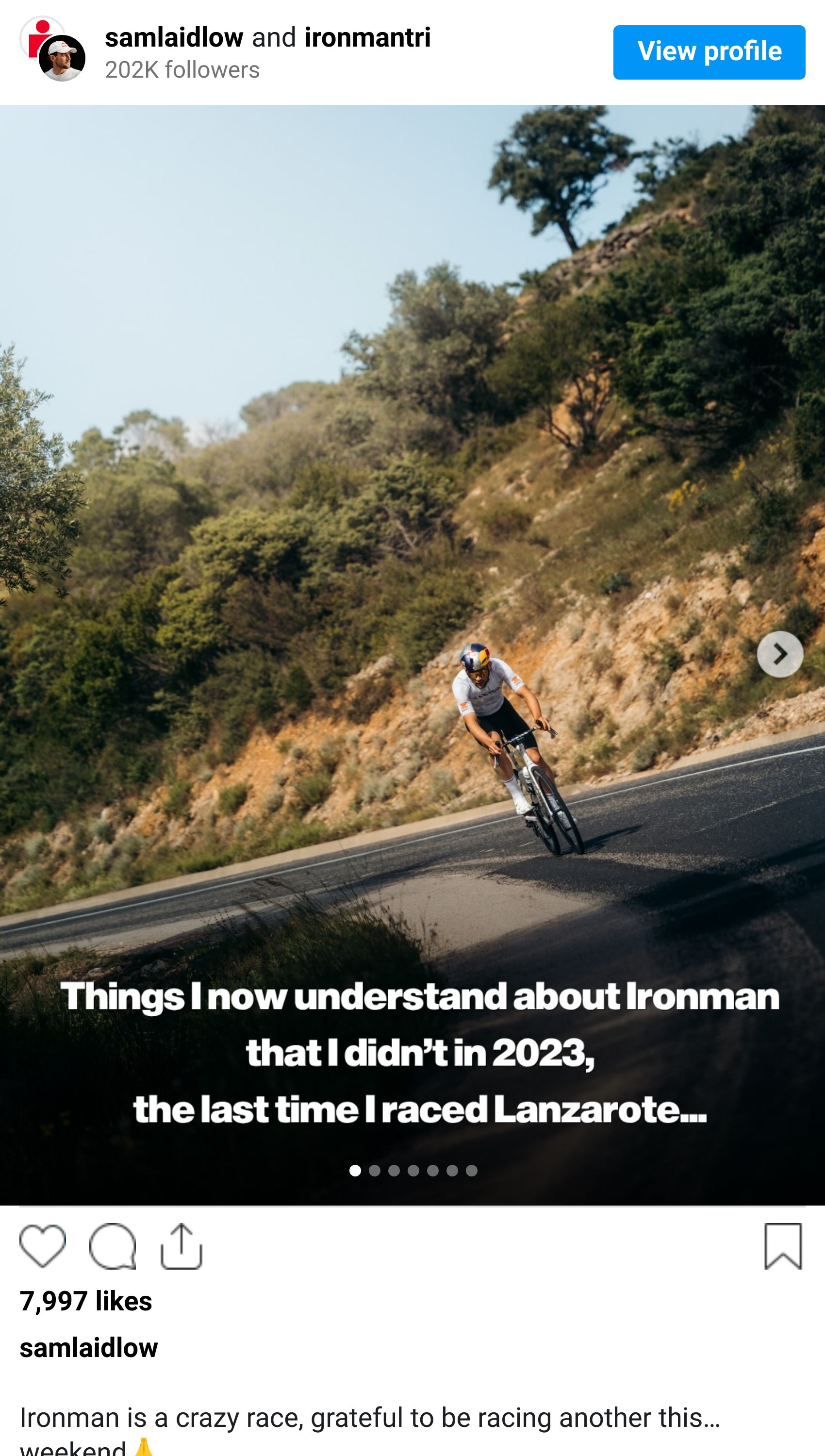
By the time you read today’s edition of the Daily Split, Sam Laidlow should be deep into his IRONMAN Lanzarote return as he seeks validation for his exemption to Kona and another shot at the World Championships.
However, before he got his toes wet in the crystal-clear waters of Playa Grande in Puerto del Carmen, he posted some of his thoughts about the race on Instagram… some might even say he bared his soul as he opened up about what it means to be an IRONMAN.
The last time he raced on the volcanic isle of Lanzarote, the harsh conditions beat him… he returned this week with a more humble outlook on what could be a season-defining race for the Frenchman.
“I’d just gone toe-to-toe with the best in the world in Kona. Confidence was high, and I truly believed my time was coming,” he wrote. “Ironman Lanzarote didn’t care who I was. I didn’t finish. And honestly, I’m grateful for that now… No fitness number or training session alone will win you an Ironman. The race will always decide.
“Don’t train from a place of insecurity. Let race day be the reassurance. An Ironman is plenty long enough for things to go wrong. Embrace it. Don’t fight it."
“Most of all, I’ve learned not to take any of this for granted. Racing an Ironman is a privilege. Lanzarote, I’m ready to go again.”
⏱️ Coaches corner: Triathlon running
Triathlon running is different from standalone running because the body begins the run already fatigued from swimming and cycling. Good run technique helps triathletes maintain efficiency, reduce energy waste, preserve posture, and run stronger under fatigue.
Improving run technique is not about copying elite-looking form or forcing unnatural movement patterns. The goal is to make running more efficient, controlled, and sustainable during race conditions.
An efficient technique also reduces unnecessary muscular stress, which helps triathletes maintain consistency during heavy training periods. This becomes especially important when preparing for different race formats.
🧘♂️ Good triathlon running starts with posture
Posture strongly affects running efficiency as fatigued triathletes often:
Collapse through the shoulders.
Lean excessively from the waist.
Lose hip stability.
Shorten stride inefficiently.
Efficient posture should feel relaxed, stable, slightly forward from the ankles, and tall through the hips. The goal is to reduce unnecessary tension while maintaining controlled movement.
Good posture improves breathing, cadence, force transfer, and energy efficiency. Poor posture usually becomes more noticeable later in races as fatigue increases.
☺️ Cadence helps reduce energy waste
Cadence refers to running step frequency. Many triathletes overstride when fatigued, which increases braking forces, impact stress, energy cost and lower-leg fatigue.
A slightly quicker, controlled cadence often helps runners to stay lighter on the ground, maintain rhythm, reduce overstriding and improve efficiency.
Cadence should remain natural rather than artificially forced. Small adjustments are usually more effective than dramatic changes. Athletes improving pacing and rhythm through Zone 2 running often develop more efficient movement naturally over time.
🙆♂️ Relaxed upper-body movement matters
Tension wastes energy. Triathletes frequently tighten their shoulders, hands, jaw and arms, especially during fatigue.
Efficient arm movement should feel more relaxed, controlled, compact and rhythmic.
The arms help maintain balance and cadence rhythm during running. Excessive upper-body tension increases fatigue and often disrupts breathing efficiency.
🏃🏼 Running off the bike requires specific adaptation
Triathlon running begins after cycling fatigue has already altered movement patterns.
After the bike, a series of things can happen which make it harder to run:
Hip flexors tighten.
Cadence changes.
Glute fatigue.
Posture becomes harder to maintain.
Legs feel heavy initially.
This is why triathletes need to practise running under fatigue through race-specific training. Brick workouts help athletes improve their neuromuscular adaptation, running rhythm, and transition pacing. Triathletes learning race-specific efficiency benefit from these brick sessions, which see athletes combine two disciplines in one session.
✅ Key tips while running
Keep a natural foot strike: Triathletes run better when the foot contact is quiet, controlled, balanced under the body and not forced. Focus on stable posture, smooth cadence, and controlled landing.
Core stability is essential: Core strength improves your force transfer, stability, running control, and breathing mechanics. Useful exercises to improve this include: planks, dead bugs, pallof presses, and side planks.
Glute strength improves efficiency: The glutes play a major role in hip stability, stride power, posture control and running economy. Triathletes benefit from strength exercises such as split squats, step-ups, glute bridges, and single-leg deadlifts.
Breathing rhythm helps control pace: Efficient breathing supports relaxation, pacing control, oxygen delivery and rhythm consistency. Triathletes who panic-breathe can often tighten their shoulders, increase tension and burn energy unnecessarily. Many athletes improve pacing simply by focusing on a smoother breathing rhythm during fatigue.
❌ Common technique mistakes triathletes make
Many triathletes reduce running efficiency through avoidable habits. Common mistakes include:
Overstriding.
Running too tense.
Ignoring posture.
Neglecting strength training.
Skipping mobility work.
Starting the run too aggressively.
Forcing unnatural form changes.
🧐 Practical ways to improve triathlon technique
Triathletes can improve running mechanics by:
Maintaining a relaxed posture.
Improving cadence control.
Strength training consistently.
Practising brick sessions.
Using running drills regularly.
Improving mobility.
Focusing on efficient breathing.
Running most of the time aerobically.
💪 Outside edge of endurance
The controversial Enhanced Games take place in Las Vegas this weekend, with athletes from around the world taking part in a series of sporting events having been allowed to take performance-enhancing drugs (PEDs) or medication.
A purpose-built arena has been erected at Resorts World, ready for the swimmers, sprinters and weightlifters to arrive and compete in a spectacle that many of its harshest critics have dubbed as the ‘Steroid Games’.
There are 42 athletes due to compete – athletes who have taken substances that would, under International anti-doping rules, see them banned from competing at any World Cup, Olympics or World Championship.
While there are some restrictions – only substances approved by the US Food and Drug Administration (FDA) can be taken – it is, however, very different and far more lenient than the list WADA allows for elite athletes.
The idea of Australian businessman Aron D'Souza, who noticed many people at a gym in the US were using steroids, his co-founders include Maximilian Martin, an investment banker and bitcoin entrepreneur and German biotech billionaire Christian Angermayer.
They believe that the Enhanced Games is a “new global sports competition designed to push the boundaries of human performance”, adding: “The Games challenge traditional models of sport by embracing science, innovation, and measurable performance enhancement under regulated conditions.”
While not all athletes who have signed up for the Enhanced Games actually intend to take any PED’s, there are significant financial rewards on offer – a $25m prize pot (£17.1m) with some athletes set to take home $1m for their efforts in Las Vegas if they break existing legal world records.
Unsurprisingly, the Enhanced Games have riled many who believe that sport should remain clean, with the World Anti-Doping Agency President Witold Bańka referring to it as ‘an irresponsible and dangerous event’ that is ‘completely against the values of sport’.
“To be clear, WADA condemns the Enhanced Games as a dangerous and irresponsible project. The health and well-being of athletes is WADA’s number one priority, and this event jeopardises that,” he said. “I call on all Anti-Doping Organizations, all Governments and all our clean sport partners, including athletes, to join us in condemning the Enhanced Games.”
Despite the backlash, the Games will go ahead tomorrow… and 42 athletes, rightly or wrongly, will get the chance to show what they can do with the help of performance-enhancing drugs.

Should the Enhanced Games be allowed to take place?
What did you think of today's email?
That’s your Split. Until Next Time
Together, we go the distance. — @247_endurance 🏃♂️🚴♀️🏊♂️