


👋 Welcome back
Morning endurance fans…
The triathlon family has a new arrival – and it’s bringing sled pushes, sandbag lunges and Olympic ambitions. HYROX’s deal with World Triathlon has put Hybrid Racing firmly in the endurance spotlight, promising new formats, championship opportunities and a potential path towards the biggest sporting stage of all.
But what does it actually mean for you? In this edition of the Daily Split, we tackle seven key questions behind the deal: what HYROX is, why triathlon wants in, what could change for age-groupers and just how realistic those Olympic dreams might be. From ‘Ultimate’ to ‘Ultra’, we look at what’s been agreed – and what we’re still waiting to find out.
Here’s what we have lined up for you today…
LATEST: The endurance news headlines
RACES: Hauser wins at no-swim Noosa
ANALYSIS: What does the HYROX deal mean for triathlon?
TRENDING: Familiar faces line up for Taiwan 70.3
TIPS: How you should plan your races next season
🏃🏼 Quick splits

Cassandre Beaugrand is still looking to improve after a stunning 2026 season.
[World Triathlon]
⭐️ THRIVING: She may have beaten all before her in 2026, but could France’s Cassandre Beaugrand raise the standards even further in 2027? Read HERE.
🏥 BUSY: American athlete Matthew Marquardt has revealed how he continues to juggle medical studies, family life and triathlon. Read HERE.
🤝 SUPPORT: The message from Olympic teammate Kevin McDowell which propelled Taylor Knibb towards her world title dream. Read HERE.
🎽 DIFFICULT: Legend Courtney Dauwalter reveals why she struggled in China after tackling the shorter 50km race distance in Tsaigu. Read HERE.
Presented By

World of Triathlon LIVE returns to ExCeL London on 10–11 April 2027, powered by TriDot and promising a bigger second edition after its debut. The weekend brings more than 100 brands (including HUUB, Zone3, FORM and ROUVY), a Multisport Academy for technique and training advice, and the Beyond the Finish Line stage with Alistair Brownlee, Jess Learmonth, Kieran Lindars and Nikki Bartlett, hosted by Annie Emmerson.
New for 2027 is a Sunday-morning community 10 km run led by Brownlee. Weekend tickets start at £10, making it a practical stop for anyone wanting kit, insight and community in one place. Read more
🏁 Race news

Matt Hauser won the 2026 Garmin Noosa Triathlon on Sunday. [Photo credit: Korupt Vision]
Garmin Noosa Triathlon
Matthew Hauser made it back-to-back Noosa titles, while fellow Aussie Natalie Van Coevorden claimed an emotional maiden victory as a cancelled swim forced a change of format at Sunday’s Noosa Triathlon.
The ‘presence of marine life’ on the swim course meant the elite fields instead tackled a 5km opening run, followed by the scheduled 40km bike and 10km run.
Hauser proved emphatic in his title defence, winning by more than three minutes from Luke Willian, with John Reed completing the podium.
There was a much closer contest in the women’s race, where Van Coevorden finally pulled clear of Richelle Hill in the closing kilometres to secure the title after several previous podium finishes.
IRONMAN Florida
Holly Lawrence and Alanis Siffert headline the provisional women’s field for IRONMAN Florida, while Sam Long and Magnus Ditlev feature among a heavyweight men’s entry.
The race – on Saturday, November 7 – offers an early opportunity to secure qualification for the 2027 IRONMAN World Championship, with three slots available per pro gender.
And with Florida, IRONMAN Cozumel on November 22 and IRONMAN Western Australia on December 6 the only remaining qualifying opportunities in the 2026 calendar year, several big names could finish their seasons by booking next year’s Kona places.
The provisional lists contain 15 women and 60 men, although inclusion does not guarantee an athlete will start. Long has already revealed he is weighing up Florida against Cozumel.

🔍 The BIG issue: World Triathlon and HYROX – historic deal explained
There was some HUGE news for the multisport endurance community this past week after a partnership was agreed to bring HYROX into the World Triathlon family – a deal which recognises the discipline under triathlon’s international governing body, and sets out ambitious plans for the future.
New formats, championship ambitions and a potential route to the biggest stage of all – the Olympics and Paralympics. But what has actually been agreed? Will anything change for everyday racers, and why should triathletes even care?
Here are seven key questions answered for you…
1: So, what’s the deal???
In a nutshell, Hybrid Racing – the combination of running and functional fitness workouts – will now be regarded as a recognised discipline within World Triathlon.
The partnership follows a year of discussions and establishes a framework for governing the discipline and developing its competition structure.
There is still detail to settle. The organisations have signed a term sheet, with a fuller agreement to follow covering how the partnership will operate, its governance and commercial arrangements. This is a significant starting gun, with the race ahead still to be mapped out.

2: What is HYROX anyway?
Think of it as taking your gym training onto a racecourse. HYROX combines eight 1km runs with eight workout stations, alternating between the two until you reach the finish. Those stations include sled pushes and pulls, rowing, sandbag lunges and the dreaded wall balls – testing your strength as well as your stamina.
Launched in Hamburg in 2017, HYROX was created by mass-participation event organiser Christian Toetzke, Olympic hockey champion Moritz Fürste and marketing expert Michael Trautmann. The idea was to give fitness enthusiasts a competitive challenge to train for, with a standardised format allowing performances to be compared across events.
From those German beginnings, it has grown into an international racing series. Now its partnership with World Triathlon signals ambitions that stretch well beyond the gym floor – potentially all the way to the Olympics.

3: Is HYROX really aiming for the Olympics?
That is the ambition. An Olympic debut, however, has not yet been confirmed and would likely require a test event before officially becoming one of the main medal contests.
HYROX chief executive Christian Toetzke has declared Hybrid Racing “officially on the road to the Olympics”, with the partners aiming to secure places in multisport Games and ultimately the Olympic and Paralympic programmes.
That gives the sport a direction of travel, rather than a guaranteed destination. The announcement names no target Games, qualification system or timetable for inclusion.
For now, aspiring Olympians can dream – but there is no Olympic HYROX start line to qualify for.

4: What are Ultimate, Fast and Ultra?
They are the three Hybrid Racing formats being developed through the partnership, with World Triathlon sanctioning and governing all three.
Ultimate will mirror the existing HYROX competition. Fast promises a shorter, higher-intensity challenge, while Ultra will stretch the endurance demands.
HYROX’s own explanation provides a useful reassurance alongside those plans: its existing race format remains unchanged, with age-group and community competition continuing to be central to the experience.
Exactly how short Fast will be, or how far Ultra will push competitors, remains unanswered in the announcements. Distances and workout specifications for those two formats have yet to be revealed.
5: More titles for age-groupers to chase?
Potentially, yes – and this could become one of the most interesting developments for HYROX regulars and potential new athletes.
National triathlon federations will have the opportunity to organise Hybrid Racing events across all three formats, including age-group national championships.
There is a distinction at elite level, however, as HYROX’s exclusive role ensures they will operate the official World, Continental and National Championships in Ultimate within its existing elite structure.
For everyone else, federation involvement could eventually create more opportunities to compete for titles. However, the announcement does not provide an event calendar or explain entry requirements, qualification arrangements or how those competitions would connect with existing HYROX racing. The opportunity has been announced; the practical route onto the start line is still to come.

6: Why has World Triathlon got involved?
The appeal is another way to bring people into multisport.
Hybrid Racing reaches athletes who combine running with strength and fitness training, potentially introducing a different audience to national triathlon federations and their events.
HYROX says those federations will have a central role in developing the new competition structure.
For triathlon, the potential benefit is a bigger pool of participants and more ways to engage them. Whether someone progresses from a fitness race to a duathlon or triathlon is another question – participation growth will depend on what federations build around the agreement.
For established endurance athletes, meanwhile, it could offer another competitive outlet. Running fitness would be useful; mastering the workout stations would be a challenge of its own.

7: So what happens next?
The next major development is the fuller agreement, which should explain how this ambitious partnership will work in practice.
Beyond that, athletes will want answers to some straightforward questions: When will Fast and Ultra launch? What will the races involve? Which national federations will organise events? And when will there be championships people can actually enter?
HYROX’s immediate message is that the familiar racing experience continues while the new structure develops.
The Olympic ambition will grab the headlines. For most athletes, the first meaningful sign of progress will be rather more practical: a race date, a set of rules and an entry button.

What HYROX and World Triathlon had to say…
Christian Toetzke, HYROX co-founder and chief executive: “From the very beginning, our goal was to build a standardised, global sport that could earn a place on the world’s biggest athletic stage. Partnering with World Triathlon is a monumental step toward that vision. By formally establishing Hybrid Racing within the World Triathlon family, we are creating an official framework, from national and continental championships to multi-sport games, forging a path and paving the way towards the Olympic and Paralympic Games. Hybrid Racing is no longer just a global fitness movement; it is officially on the road to the Olympics.”

Antonio Arimany, World Triathlon president (Pictured above): “This agreement is the result of a full year of dedicated work between World Triathlon and HYROX, and it is enormously gratifying to see it move from negotiation into reality. Hybrid Racing is a natural evolution for our movement, and this partnership will not only accelerate the growth of World Triathlon on the global stage, but it will also open genuine new opportunities for every one of our national federations to grow participation, engage new audiences, and strengthen our sport at every level. This is exactly the kind of forward-looking collaboration our members deserve.”
Moritz Fürste, HYROX co-founder and chief marketing officer: “Having lived the Olympic dream twice as an athlete, I know firsthand what it means to step onto that stage. To now stand on the brink of taking a sport we created from scratch all the way to the Olympic and Paralympic Games is surreal. What started in a German exhibition hall has filled arenas across six continents, and this partnership with World Triathlon brings our ultimate ambition closer to a reality. This moment belongs entirely to our community; every athlete who has crossed a finish line has helped build this sport into what it is now. We are paving the way for an entire generation of hybrid racers to chase their Olympic dreams.”
Do you support the new partnership between HYROX and World Triathlon?

Gustav Iden and Kristian Blummenfelt joined athletes in Taiwan this weekend. [IRONMAN]
👩💻 Trending in triathlon
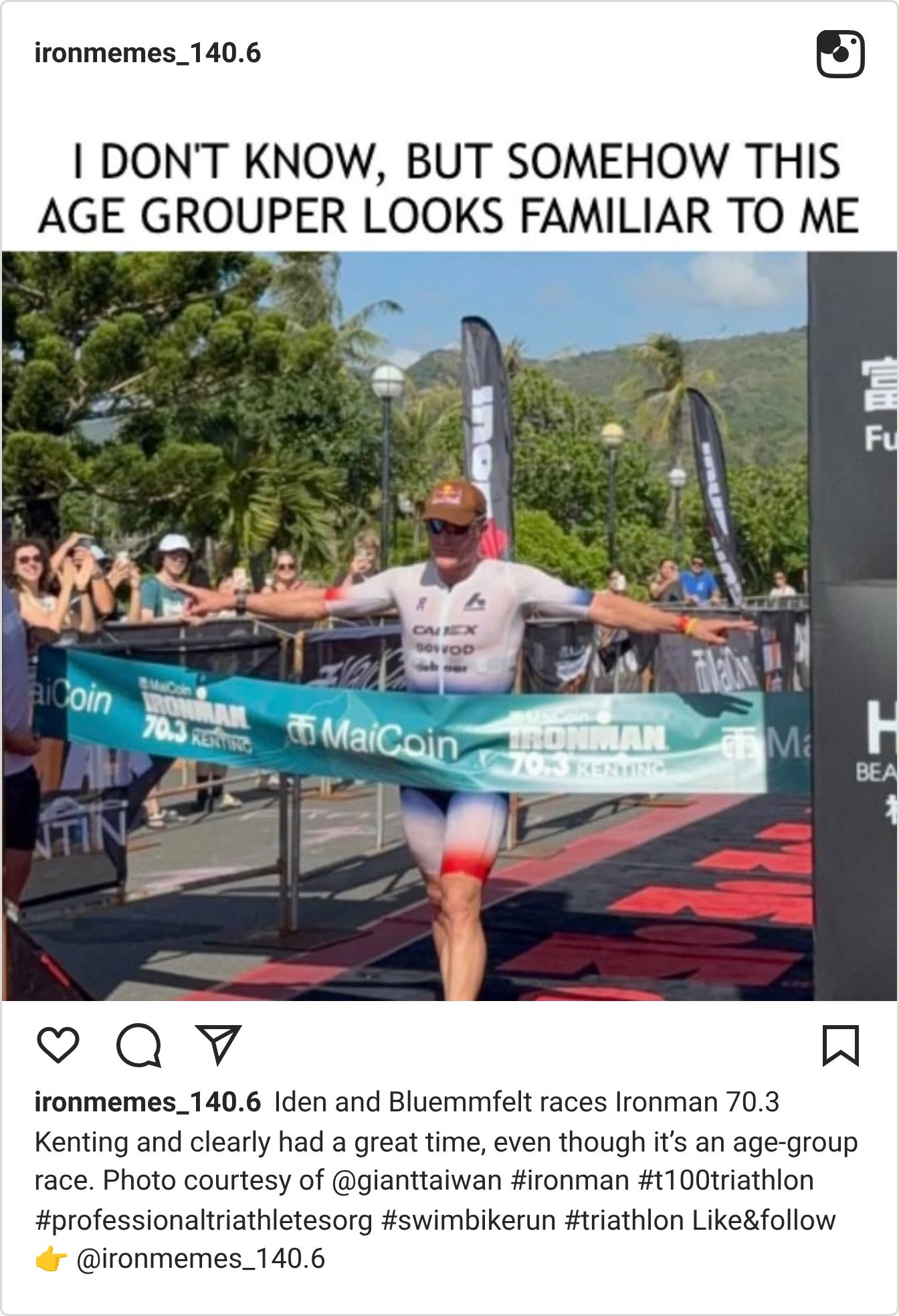
Imagine turning up for your age-group IRONMAN 70.3 race, and, while casually eyeing up your rivals on the start line, you spot Norwegian superstars and former World Champions Gustav Iden and Kristian Blummenfelt limbering up alongside you!!!
The duo were in Taiwan as special guests ahead of their participation in this weekend’s Challenge Xiamen in China and decided to add a little 70.3 Kenting workout to their promotional duties.
Blummenfelt finished in a time of 3:56:09, recording splits of 25:43, 2:03:28 and 1:21:02, while Iden crossed the line in 4:11:11 with splits of 25:53, 2:08:03 and 1:31:10.
Despite being the fastest times of the day, as professionals they were not allowed to claim the win, with organisers crowning Chang Chia-Hao as the amateur male winner, who finished in 4:12:11 (25:49, 2:13:48, 1:25:38).
⏱️ Coaches corner: How to plan next year’s triathlon race schedule
With the triathlon season coming to an end, thoughts will have already turned to 2027 as plans for next season are pencilled in and races are selected on various race calendars and rotas.
Picking the right schedule, however, is not always easy and involves choosing suitable events, allowing enough training time, and managing recovery between competitions. A balanced calendar helps triathletes prepare for important races without accumulating unnecessary fatigue.
Here is our guide to selecting race distances, organising priority events, and building a realistic season around your fitness, experience, and goals.
PICK YOUR MAIN GOAL: Start by choosing your most important event, then organise other races around its training and recovery requirements. Consider your experience, preferred race distances, available preparation time, and how much recovery you need between competitions.
A realistic schedule should help you arrive at priority races prepared rather than exhausted. Triathlon calendars often include sprint, Olympic, middle distance, and Ironman events. Each distance places different demands on endurance, pacing, nutrition, and recovery. Entering too many races without considering these differences can interfere with consistent training.
ALLOW ENOUGH TIME BETWEEN RACES: Recovery requirements depend on race distance, intensity, experience, and individual response. Shorter events may require several easier days, while an Ironman can create fatigue lasting considerably longer. Avoid scheduling another demanding event before normal training feels manageable. Persistent fatigue, unusual soreness, or declining performance indicate that more recovery is needed.
BUILD TRAINING BLOCKS: Divide the season into periods focused on developing fitness, preparing for race demands, and recovering. A simple progression includes:
Base training to develop endurance.
Build training to increase race-specific fitness.
Race preparation to practice pacing and nutrition.
Tapering to reduce fatigue before competition.
Recovery following the event.
USE SHORTER RACES AS PREPARATION: A sprint or Olympic distance triathlon can provide useful experience before a longer event. These races allow athletes to practice open water starts, transitions, equipment setup, and pacing under competition conditions. However, shorter races should not create so much fatigue that they disrupt important training sessions. Choose preparation events that support your main goal.

CONSIDER TRAVEL AND WEATHER: Race location affects more than convenience. Travel can influence sleep, hydration, equipment logistics, and recovery. Weather conditions may also differ significantly between events. Consider:
Travel time and cost.
Expected temperature.
Water conditions.
Course elevation.
Equipment transport.
Time needed to recover from travel.
PLAN YOUR TAPER: Tapering involves reducing training demands before competition to allow fatigue to decrease while maintaining fitness. The appropriate duration depends on the event and athlete. Avoid placing another demanding race inside an important taper unless it has been deliberately incorporated into the training plan.
AVOID OVERLOADING THE SEASON: Too many races can interfere with training consistency and recovery. Warning signs include persistent tiredness, declining motivation, and difficulty completing familiar workouts. A smaller calendar with well-prepared races may be more productive than frequent competition without adequate rest.
EXAMPLE TRIATHLON RACE SCHEDULE: The following example illustrates a season built around one main Olympic distance race.
January to February: Base endurance.
March: Sprint practice race.
April: Structured training.
May: Secondary sprint or Olympic race.
June: Race-specific preparation.
July: Main Olympic distance race.
August: Recovery and reassessment.
COMMON MISTAKES:
Entering too many races.
Choosing events before setting goals.
Underestimating recovery needs.
Racing hard during every competition.
Ignoring travel fatigue.
Scheduling races during important training blocks.
Failing to plan a taper.
Continuing to race through injury.
Leaving no flexibility for setbacks.
PRACTICAL TIPS:
Select one main seasonal goal.
Classify races by priority.
Check course and weather conditions.
Allow sufficient recovery.
Use shorter events for practice.
Keep travel arrangements realistic.
Protect important training blocks.
Review the calendar after each race.
Adjust plans when fitness changes.
🚴♂️ News from the saddle
Tadej Pogačar has said that he is ‘happy to be alive or standing’ after his serious crash at the Vuelta a España resulted in three broken vertebrae.
The five-time Tour de France winner revealed in an interview with Jacob Whitehead for The Athletic that it wasn't until returning to Slovenia and going to hospital that the full extent of his injuries was revealed.
Separately, over the weekend, the former world champion said there was a ‘big chance’ that his season would be structured around the UAE Tour, then the Classics, and then the Tour de France.
Pogačar crashed during stage eight of this year's Vuelta, which left him with multiple serious injuries, including a fractured collarbone, a vertebra injury and a concussion.
Read the full story at Cycling Weekly HERE.
💪 Outside edge of endurance
Rebecca Hormann has completed her 275-mile Ethels challenge, linking all 95 of the Peak District’s hills, tors and summits in a continuous round despite battling storms and difficult conditions.
The ultrarunner returned to Hope in Derbyshire after 4 days, 11 hours and 44 minutes, establishing the first benchmark for her Ethels route.
Hormann set off from the village at 11am on Thursday, October 22, on a journey that involved more than 40,000ft of ascent and took her across exposed moorland in high winds and heavy rain as two named storms – Austen and Boelo – hit the UK.
And after completing the challenge, she paid tribute to the support crew and members of the public who helped her along the way.
“I find it really tricky (basically impossible) to express my gratitude to everyone who had a hand in making the Ethels mission a success,” she posted on her Instagram page. “These ‘thank yous’ are best delivered personally, and social media doesn’t need to broadcast absolutely everything, but I do want to make sure that there is a level of recognition about the selflessness my team (friends!) showed over the 107 hrs and 44 min in the Peak District.
“Regardless of how many miles they ran with me or whether that was support in the van or on the course... it all mattered. Every encounter, every encouraging word, every joke and laugh, every smile and nod, every muddy trail shoe in front of me to follow... you guys are incredible. Thank you for saying ‘yes’ to this idea and rolling with it when things went sideways.”
The challenge was inspired in part by her completion of the Lake District’s Bob Graham Round earlier this year, as well as her own experiences exploring the Peak District while training for her first 100-mile race.
But the weather added another layer of difficulty, with those two storms bringing high winds, heavy rain and saturated ground.
“It was a crazy adventure, a tough challenge, and I had to dig deep!” Hormann said.
What an incredible effort from Rebecca!!! 👏👏👏👏👏

What did you think of today's email?
That’s your Split. Until Next Time
Together, we go the distance. — @247_endurance 🏃♂️🚴♀️🏊♂️