

👋 Welcome back
Morning endurance fans…
When does a triathlon stop being a race and become an adventure?
The answer was written across the mountains of Norway this weekend as the remarkable athletes of Norseman reminded us exactly why this sport continues to captivate. From elite stars rolling back the years to age-group competitors battling cold water, brutal climbs and sheer exhaustion, it was endurance sport at its most raw.
Today's Daily Split celebrates the extraordinary feats at Norseman before turning its attention to the future of the Commonwealth Games, where World Triathlon is hoping to secure a return in 2030. Throw in all the latest news, results and talking points, and there's plenty to get stuck into.
Here’s what we have lined up for you today…
LATEST: The endurance news headlines
REPORTS: Norseman and Via Alpina record bid
ANALYSIS: Will triathlon return to the Games?
TIPS: Hydration rules when cycling in a heatwave
🏃🏼 Quick splits

Jelle Geens won the 70.3 World Championships in both 2024 and 2025. [IRONMAN]
🏆 TARGET: Jelle Geens has switched his attention from Kona to becoming the first athlete to record a consecutive hat-trick of 70.3 Worlds wins. Read HERE.
⚠️ RISKY: Lasse Priester says he is ready to do whatever it takes to be a success in middle-distance triathlon after making the step up. Read HERE.
🤕 DEFIANT: Luckless triathlete Justin Riele is confident he can battle back to fitness after his second devastating bike crash this season. Read HERE.
🎽 RETURN: Laura Philipp will make her return from injury and illness when she lines up for IRONMAN Kalmar later this month in Sweden. Read HERE.
❓ UNSURE: Cassandre Beaugrand has yet to decide whether to prioritise the WTCS title, despite winning three races so far this season. Read HERE.
🏁 Race news

Alistair Brownlee crosses the line to finish second at the Norseman. [NXTRI]
Norseman 2026
MEN’S RACE: Double Olympic champion Alistair Brownlee rolled back the years to deliver a stunning display at the world’s toughest triathlon – but fell just short of denying Kristian Grue a successful title defence at the iconic Norseman Xtreme Triathlon.
The London and Rio gold medallist may have retired from professional competition in 2024, but he continues to impress on the endurance scene with yet another extreme ‘bucket list’ challenge added to his ever-growing collection.
Having raced up the Empire State Building, gravel cycled in South Africa and skied across vast mountain landscapes, the 38-year-old celebrated ‘Yorkshire Day’ by pushing home-favourite and last year’s winner, Grue, all the way in this most brutal of swim-bike-run experiences.
As a proud Yorkshireman, it will surely not have been lost on him that his efforts came on a day when the English county of his birth is celebrated, as he gave more than a glimpse of his past glories in securing a second extreme triathlon podium, following his third place at Patagonman in 2025.
Indeed, although Brownlee insisted beforehand that he was there to participate rather than compete, he admitted afterwards that there were plenty of moments when instinct took over, and he was simply racing.
In an interview with Slowtwitch, which was shared on the Norseman Instagram page, Brownlee wouldn’t confirm if he was ready for another extreme challenge but had plenty to say about the infamous Zombie Hill – an 11km stretch of hairpin bends with a gradient of 10% all the way to the finish line.
“It was just a grind up Zombie Hill… that is just savage. Yes, there are hairpins on it, but the straights must be 2-3km long, and the climb is absolutely brutal,” he said. “Coming up the mountain, I was just keeping going as fast as I could, really.
“I enjoy the challenge; I enjoy coming to different places, and I enjoy the community as well. You can ask me if I enjoyed it, but don’t ask me if I am going to do a third one, because right now the answer will be no… although it might be different in the morning.”
Grue set the pace from the start, emerging first from the 3.8km swim, while Brownlee exited the water in sixth.
The British legend quickly erased the deficit on the bike as he and Grue rode much of the course across Hardangervidda in close company, pulling away from their fellow athletes and producing a gap that would eventually secure them the top two places.
Grue eventually edged ahead of Brownlee and gradually extended his lead, while behind the leading duo, the battle for the final podium position remained intense as former Norseman winner Hans-Christian Tungesvik (NOR) battled with American Ernest Mantell.
Brownlee held on to second place, but Tungesvik produced a remarkable finish, overtaking Mantell in the final kilometre to secure third. The Norwegian crossed the line just 35 seconds behind Brownlee.
MEN’S RESULTS (3.8km Swim - 180km Bike - 42.2km Run)
🥇 Kristian Grue (NOR) 56:36 - 5:05:35 - 3:48:35 = 9:53:46
🥈 Alistair Brownlee (GBR) 58:00 - 5:17:02 - 3:58:07 = 10:18:19
🥉 Hans-Christian Tungesvik (NOR) - 1:06:26 - 5:14:14 - 3:54:05 = 10:18:55

Kristian Grue successfully defended his Norseman title on Saturday. [NXTRI]
WOMEN’S RACE: The women’s race was equally captivating, with the lead changing hands repeatedly throughout the day. Dutch athlete Ilona Eversdijk exited the water first before Norway’s Tonja Lunde Johansen, Finland’s Maisa Tuliniemi and Slovakia’s Nikola Čorbová all enjoyed spells at the front as the race ebbed and flowed.
When the athletes started the run, Tuliniemi led the race, with Čorbová in second and Kaja Bergwitz-Larsen (NOR) in third. But with several strong runners close behind, the race was far from settled, and the marathon would prove decisive.
Among those chasing was Helene Melson Tungesvik (NOR), who produced one of the strongest runs of the day. Starting more than 12.5 minutes behind Čorbová, she steadily reduced the gap and moved into podium contention.
Despite the pressure from behind, Čorbová claimed the victory after a consistently strong performance across all three disciplines.
Behind her, Tungesvik’s impressive run earned her second place, while Spain’s Sonia Tomegros Regalado claimed the final podium spot.
WOMEN’S RESULTS (3.8km Swim - 180km Bike - 42.2km Run)
🥇 Nikola Čorbová (SVK) 1:14:11 - 6:13:40 - 4:28:17 = 12:04:56
🥈 Helene Melsom Tungesvik (NOR) - 1:32:08 - 6:10:54 - 4:18:43 = 12:09:24
🥉 Sonia Tomegros Regalado (ESP) - 1:18:06 - 6:15:03 - 4:34:21 = 12:13:59

Nikola Čorbová wins the women’s race at Norseman. [NXTRI]
Via Alpina FKT challenge
Sophie Grant took a huge margin off the previous fastest known time (FKT) – for both women and men – when she completed the epic 2,000km Via Alpina route on Sunday inside 30 days.
She had set off on Saturday 4th July from Trieste to take on the route across the rugged terrain of the Alps. Eight countries, over 2,000km and 109,613m of climbing – the equivalent of climbing Everest from sea level 12 times – lay ahead.
The schedule was to reach the finish line in Monaco on Sunday, 2nd August, to become a world record holder – and that’s exactly what happened.
The previous women’s record was 38 days, and the men’s is 35 days, meaning Sophie has completed it significantly faster than anyone before.
🚴♂️ News from the saddle
Tadej Pogačar will race the 2026 Vuelta a España, UAE Team Emirates-XRG confirmed on Monday morning, as he seeks to complete the Grand Tour triple.
The 27-year-old, who won his fifth Tour de France title last month, will be on the start line of the Spanish Grand Tour for the first time since 2019, when he finished third. Just three riders have won the Tour and Vuelta in the same year previously: Jacques Anquetil, Bernard Hinault and Chris Froome.
Read the full story on Cycling Weekly HERE.

Hayden Wilde, Alex Yee and Matt Hauser on the 2022 Commonwealth Games podium.
[World Triathlon]
🔍 The BIG issue: Will triathlon make a 2030 Commonwealth comeback?
It was short, it was sweet, and if you blinked, you probably missed it, but as the 2026 Commonwealth Games concluded on Sunday, few could argue that it had restored some much-needed energy to an event that had looked to have run its last race just three years ago.
Left without a host city after Victoria relinquished their responsibilities in the face of mounting costs, there were genuine questions over whether this international gala still had a place in the increasingly crowded global sporting calendar.
By rescuing the seemingly doomed Games, Glasgow has done more than simply deliver 11 days of competition. It has demonstrated a sustainable blueprint for the future – one which has breathed new life into the concept and shown how it can thrive once again.
Its use of existing venues and realistic budgets, rather than spending billions on new infrastructure, has shown that it is possible to host a Commonwealth Games without breaking the bank; the trick now is to make it work with a full sporting schedule.
With the baton handed over to the Amdavad 2030 team, the hope will be that Indian organisers can restore the Games to their past glories and bring back those sports that were sadly sacrificed in Scotland as the emergency hosts were forced to reduce their capacity.
Birmingham 2022 boasted 19 sports on its roster, nine of which were cut by Glasgow, with the likes of badminton, beach volleyball, cricket T20, hockey, rugby sevens, squash, table tennis, wrestling and, of course, triathlon all omitted.
Triathlon was first introduced at the Auckland Commonwealth Games as a demonstration sport in 1990 and made its full medal debut in Manchester twelve years later. After inclusion again at Melbourne in 2006, it was left out of Delhi in 2010 due to the lack of a swimming venue.
It returned for Glasgow 2014, together with the introduction of a mixed relay, and saw paratriathlon added four years later on the Gold Coast of Australia.
Having featured in 2022 and originally been included in Victoria’s programme, World Triathlon has made no secret of its desire to return in Amdavad, and this week confirmed to TRI247 that it had submitted its bid for inclusion.
A World Triathlon spokesperson said: “We are actively working with the Commonwealth Games' future organising committees to bring triathlon back to the programme; we remain hopeful of a return in Ahmedabad in 2030. We’ve submitted a bid and are now waiting on their feedback.”
While the programme for Amdavad (also known as Ahmedebad) has yet to be finalised, the signs are promising, with triathlon remaining part of the Youth Commonwealth Games programme, which is being held in Malta next summer, and Katie Sadleir, CEO of Commonwealth Sport, which has ultimate responsibility for approving the programme, saying the Games were likely to feature “15 to 17” sports and would be “exciting and dynamic”.
Amdavad is the largest city in the state of Gujarat, and at a press briefing marking the transition, Deputy Chief Minister of Gujarat Harsh Sanghavi said they would embrace the responsibility of staging what will be the Centenary Games with deep gratitude.
Hinting that cricket was one of the possible sports to be included, he promised the para-sport programme would be one of the best ever as they also geared up to bid for the 2036 Olympic and Paralympic Games – another event for which triathlon has become a regular participant.
Glasgow sacrificed breadth to ensure the Commonwealth Games survived. Few would argue with that decision given the circumstances. But with Amdavad expected to deliver a significantly expanded programme in 2030, the justification for triathlon’s absence disappears.
World Triathlon has made its case. Now the decision rests with Commonwealth Sport and the organisers in India.
Over to you, Amdavad…

World Triathlon has submitted its bid for triathlon to return in 2030. [World Triathlon]
Should triathlon be included in the 2030 Commonwealth Games?
👩💻 Trending in triathlon
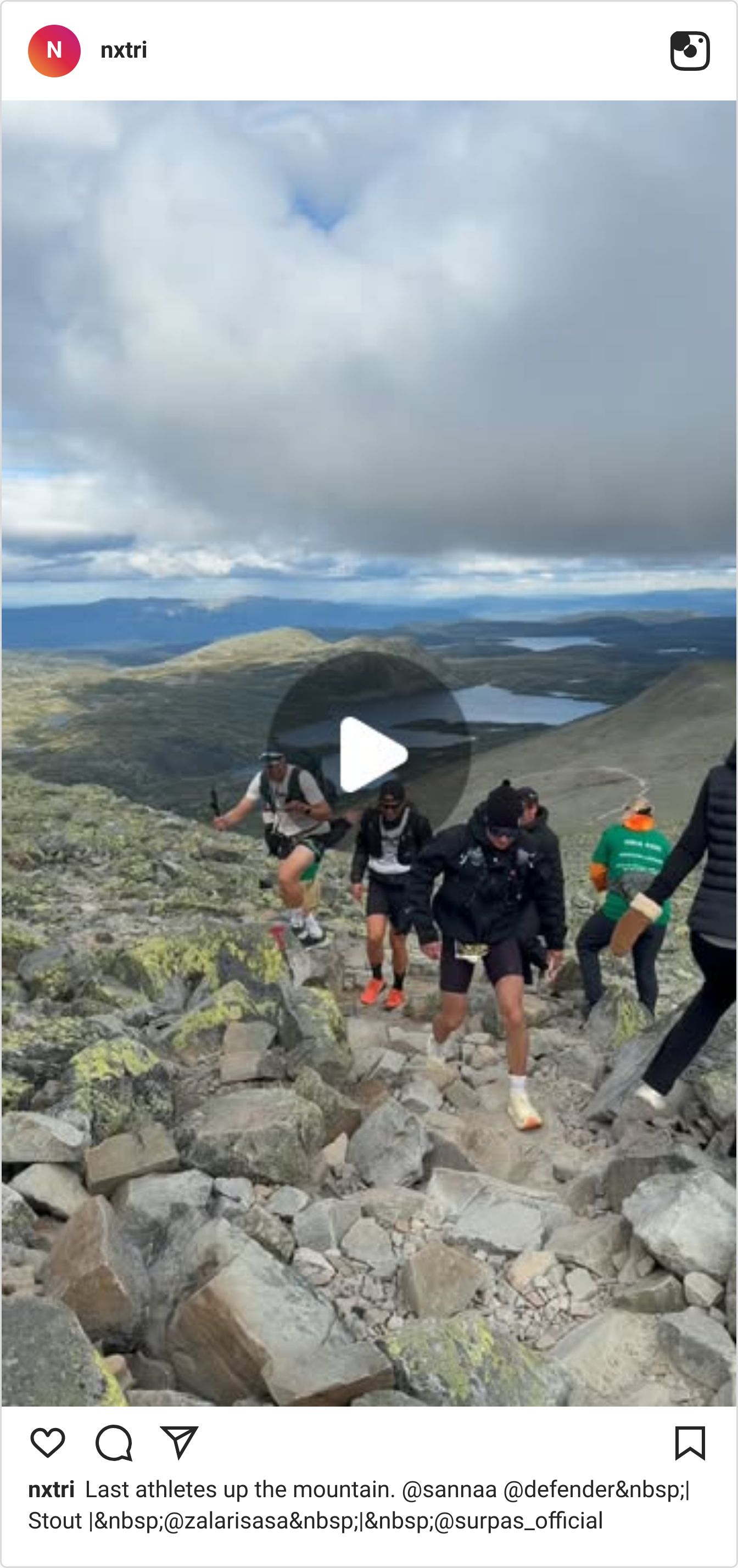
In this week’s ‘Trending’ section, we pay homage to the wonderful athletes who took on the brutal Norseman on Saturday and came away with their black… or white t-shirts.
Between 250 and 300 hardy souls jumped from the ferry into the bitter waters of Hardangerfjord at 05:00 before swimming the 3.8km to Eidfjord, biking 180km across to Austbygde and then running a marathon through Zombie Hill and up to the finish line at Mount Gaustatoppen.
A truly epic achievement, and you all deserve our congratulations. 👏👏👏
⏱️ Coaches corner: Hydration tips for when cycling in the hot weather
Cycling in hot weather places extra demands on your body. As temperatures rise, you lose more fluid through sweat in an effort to regulate body temperature. If these losses aren’t replaced, dehydration can reduce power output, increase heart rate and make rides feel much harder than they should.
At the same time, drinking too much water without replacing electrolytes can also cause problems. Successful hydration isn’t about consuming as much fluid as possible; it’s about replacing enough water and sodium to maintain performance while avoiding both dehydration and overhydration.
WHY HYDRATION MATTERS: Your body relies on sweat to cool itself during exercise. Even moderate dehydration can noticeably affect endurance performance during longer rides. As fluid is lost through sweating, you can notice the following:
Blood volume decreases.
Heart rate rises.
Cooling becomes less efficient.
Muscles receive less oxygen.
Performance declines.
HOW MUCH SHOULD YOU DRINK PER HOUR? There isn’t a single hydration target that suits everyone. But as a guideline:
500-750ml per hour may be sufficient in warm conditions.
750-1,000ml per hour is appropriate during very hot or humid rides.
Heavy sweaters may require even more, depending on individual sweat rate.
Rather than copying another athlete’s strategy, determine what works for your own body.
SWEAT RATE VARIES BETWEEN ATHLETES: Several factors influence how much fluid you lose, including air temperature, humidity, ride intensity, body
size, fitness level and heat acclimation.
Some athletes lose less than half a litre of sweat per hour, while others may exceed one litre. Weighing yourself before and after a training ride can help estimate your personal sweat losses.
DON’T WAIT UNTIL YOU ARE THIRSTY: Thirst is useful, but it often lags behind actual fluid loss during prolonged exercise.
Instead, start rides well hydrated, drink small amounts regularly, aim for steady fluid intake throughout the ride, and avoid drinking large volumes all at once, with regular sipping generally easier for your stomach than infrequent large drinks.

Hydration is crucial when embarking on a long cycle ride in hot conditions.
REPLACE ELECTROLYTES TOO: Sweat contains more than just water. It also contains important electrolytes that are necessary for triathletes, particularly sodium.
Replacing sodium helps to maintain fluid balance, support muscle function, encourage fluid absorption, and reduce the risk of hyponatraemia during very long events.
Sports drinks, electrolyte tablets or sodium supplements may all play a role depending on the duration and intensity of your ride.
CONSIDER RIDE DURATION: Hydration needs increase as rides become longer. General guidance includes:
Under one hour: Water is often sufficient.
One to two hours: Water plus electrolytes may be beneficial.
Over two hours: Combine fluids, electrolytes and carbohydrates.
Longer rides require a complete fuelling strategy rather than hydration alone.
DRINK BEFORE YOU FEEL OVERHEATED: Once dehydration significantly raises your core temperature, catching up becomes difficult.
Start drinking early, particularly during hot afternoons, humid conditions, long climbs, and high-intensity intervals.
Remember… Preventing dehydration is much easier than reversing it.
TRAIN YOUR HYDRATION STRATEGY: Race day shouldn’t be the first time you test your hydration plan. Practising during training improves confidence and reduces surprises during competition. It can help to determine such issues as bottle placement, drinking frequency, preferred electrolyte products, fluid volume and stomach tolerance.
RECOVERY AFTER THE RIDE: Hydration doesn’t stop when the ride ends. After cycling, you must continue drinking fluids, replace electrolytes if needed, eat carbohydrate-rich foods and include protein for recovery.
Replacing fluids after training is just as important as drinking during the ride. Good post-ride hydration helps:
Restore blood volume.
Replace sweat losses.
Support muscle recovery.
Prepare for your next workout.
Combining fluids with adequate nutrition improves recovery even further.
PLAN REFILLS AND USE COLD FLUIDS IF POSSIBLE: Long rides often require more fluid than two bottles can provide. Before heading out, identify refill locations, carry enough bottles, consider hydration packs if appropriate and know where water fountains or shops are located.
Running out of water during a hot ride can quickly turn an effective session into a difficult one. Cool drinks can help reduce perceived exertion during hot rides, with chilled fluids improving comfort and lowering body temperature.
Insulated bottles can help keep drinks cooler for longer in very hot weather.

💪 Outside edge of endurance
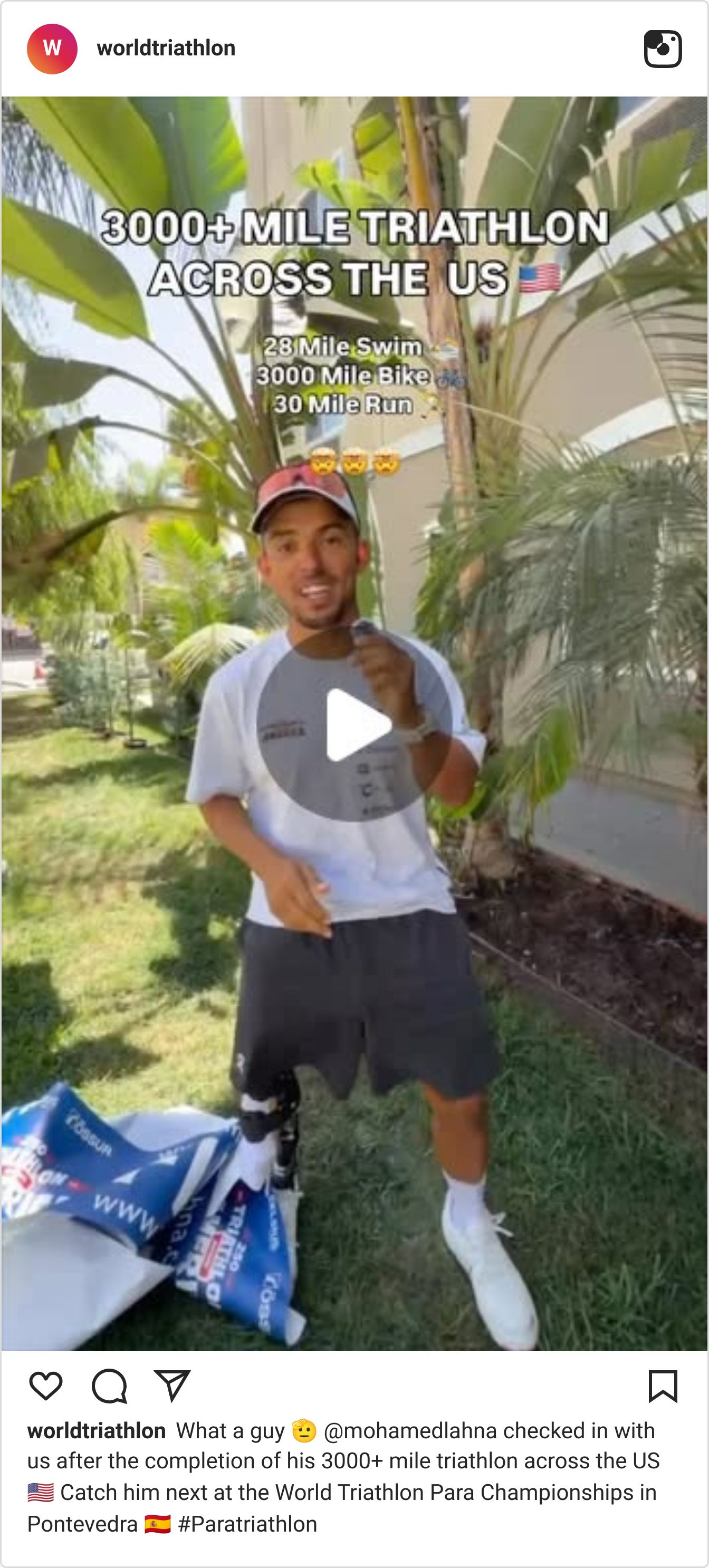
Three-time Paralympian Mohamed Lahna has completed one of the most incredible endurance challenges ever attempted after finishing his 3,300-mile triathlon across the United States in just 47 days.
The Paris 2024 Paralympic silver medallist crossed the finish line at Venice Beach in Los Angeles last week after swimming, cycling and running coast-to-coast in what is believed to be the first triathlon across America completed by an athlete using a prosthetic leg.
Lahna’s extraordinary journey began in New York on June 13 with the famous 20 Bridges swim around Manhattan Island. He covered 28.5 miles in 7:44:58 before setting off on a 3,000-mile bike ride through 16 states, climbing more than 100,000 feet on his way to Las Vegas.
From there came perhaps the toughest challenge of all – a 300-mile run through the blistering heat of the Mojave Desert to the Pacific Ocean.
It was this final stage that pushed Lahna to his absolute limits, with temperatures soaring into three figures as he tackled exposed roads, mountain trails and soft sand that placed relentless pressure on his prosthesis.
The Triathlon Across America was designed to raise funds for two charities that helped shape his own life: Save the Children, which funded the school he attended growing up in Morocco, and the Challenged Athletes Foundation, which supported his sporting journey after moving to the United States.
“We have raised more than $166,000, which is incredible, but our goal is $250,000,” Lahna said. “I hope people will recognise what this challenge represents and give whatever they can. Every donation can help create opportunities for children and people with physical disabilities.”
To help with Mohamed Lahna’s fundraising, you can click the link HERE.
What did you think of today's email?
That’s your Split. Until Next Time
Together, we go the distance. — @247_endurance 🏃♂️🚴♀️🏊♂️