


👋 Welcome back
It’s the weekend – so get out there and do your thing.
Whether it’s a long ride, a steady run, a session in the water, or just chasing that feeling we all come back for, this is what it’s all about. Training, racing, pushing limits… and maybe earning that well-deserved coffee and cake at the end.
Before you head out, here’s everything you need to know from the world of endurance sport – the stories, previews and inspiration to fuel your next session. 🏊♂️🚴♂️🏃♂️
LATEST: The endurance news headlines.
PREVIEW: The Norwegians have arrived for Oceanside 70.3.
DECISION: IOC bans transgender women from Olympics.
TIPS: Why heart rate is crucial to maximising running potential.
🏃🏼 Quick splits

Jess McClain was denied victory when she was led off the course by a pace car. [Alamy].
👟 SELECTED: The three athletes who looked destined to make up the podium before being led off course at the US Half Marathon Championships have been given places at September’s World Road Running Championships. Read HERE.
🎽 EXTENDED: There’s a strong chance that around 100,000 amateur runners will be able to take part in next year’s London Marathon, with talks for a two-day festival said to be in progress between the various stakeholders. Read HERE.
💊 DEBATE: Jocelyn McCauley has cast aside her anonymity and revealed that she was the one triathlete to have been denied a TUE exemption after explaining that she had requested to use a substance for fertility treatment. Read HERE.
😅 RETHINK: Taylor Knibb admits she may need to have a rethink on her plans for the coming season as she bids for success at all three distances of triathlon, with a shot at both world championships and Olympic qualification. Read HERE.
⛷️ CHALLENGE: Legendary Olympian Alistair Brownlee tested himself to the limit in another extreme endurance challenge last weekend when he took part in the Sellaronda Skimarathon in the Dolomites of Italy. Read HERE.

We’ve teamed up with Georgia Taylor-Brown and Tactic to give one lucky Daily Split subscriber the chance to design their very own high-performance tri-suit. [PTO]
What if your next race kit wasn’t just another suit… but YOUR suit – built exactly how you want it, inspired by one of the best in the world?
Most athletes show up on race day looking the same. This is your chance to stand out; whether you’re chasing your first finish line or your next podium, this is the kind of upgrade that changes how you feel when you race.
We’ve teamed up with triathlon superstar Georgia Taylor-Brown and Tactic to give one lucky athlete the chance to create their very own custom performance tri-suit, just like the pros wear on race day.
However, this isn’t just any old suit off the shelf. This is YOUR design, YOUR fit, YOUR identity on course.
THE PRIZE
✅ A fully custom-designed Tactic tri-suit.
✅ Inspired by elite-level performance standards.
✅ Built for speed, comfort, and race-day confidence.
✅ Designed by you — with guidance from the experts.
🏁 Race news

Norwegian trio Gustav Iden, Casper Stornes and Kristian Blummenfelt will be at the IRONMAN 70.3 at Oceanside this weekend. [IRONMAN]
🌊 IRONMAN 70.3 Oceanside
Fresh from his incredible win at Geelong last weekend, Kristian Blummenfelt will be reunited with his fellow Norwegians Gustav Iden and Casper Stornes this weekend as the trio heads the Oceanside 70.3 field in California.
With Iden and Stornes not having raced so far this season, it will be the first time this terrific trio will have graced a race circuit together in 2026, and it promises to deliver yet another thrilling spectacle.
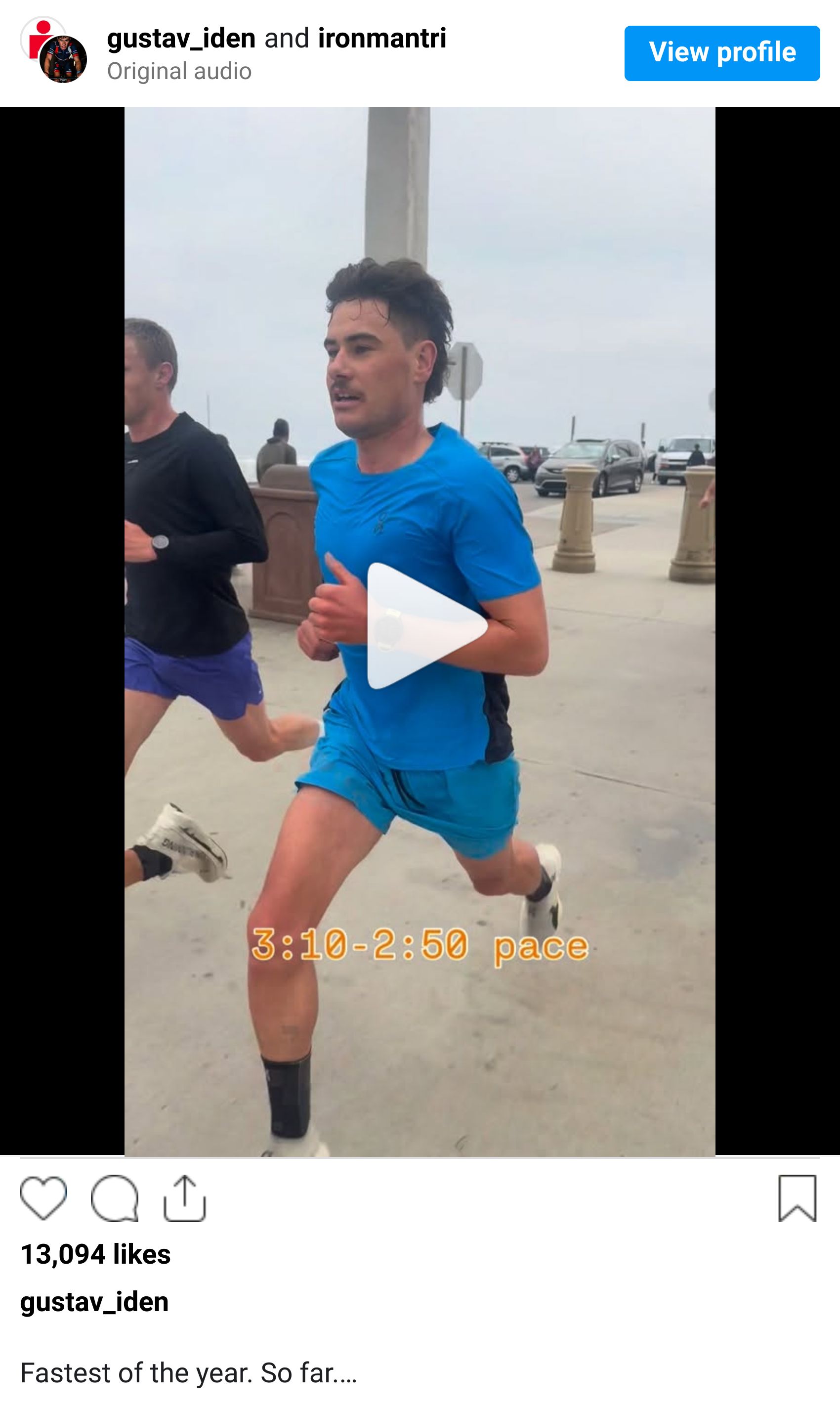
Anyone thinking that Blummenfelt might be feeling the effects of his incredible 1:06:39 run, which beat Hayden Wilde (NZL) and Jelle Geens (BEL) so convincingly on the Victoria coast, can rest assured that he looks in fine fettle – with videos of the Norse competitors on Instagram showing that Big Blu is very much still leader of the pack.
The likes of Sam Long (USA), Rudy Von Berg (USA) and Jonas Schomburg (GER) will be looking to prevent the very high possibility of another Norwegian 1-2-3.
Another athlete to have hopped straight on a plane and jetted out to the West Coast after winning in Australia last weekend is American Taylor Knibb, who took the tape at the T100 Gold Coast. She will be going for a hat-trick of wins at Oceanside, having won there in 2022 and 2024.
It won’t be easy for her, however, as Canada’s Paula Findlay is back to defend her title, while full-distance World Champion Solveig Løvseth makes her bow for 2026, having spent the majority of this past winter training with compatriots Iden, Blummenfelt and Stornes.
IRONMAN 70.3 Oceanside gets underway today at 06:40 local time (PST). That’s 09:40 on the eastern seaboard of the United States, while in Europe this corresponds to 14:40 CET, with the race starting at 13:40 in the UK.
T100 Singapore start list
The first 15 men to line up in the pro field for next month’s T100 Triathlon World Tour opener have been revealed – with another packed field of stars lined up in what promises to be a real thriller.
After his outing at the Geelong 70.3 last weekend, Kiwi Hayden Wilde is back in his more familiar surroundings, as last year’s champion starts as favourite against the likes of Jonas Schomburg (GER), Mika Noodt (GER), Youri Keulen (NED), Sam Dickinson (GBR), Mathis Margirier (FRA), Menno Koolhaas (NED) and Jacob Birtwhistle (AUS).
The race takes place in Singapore on Saturday, April 25.
🚴♂️ News from the saddle
Volta a Catalunya: Great Dane Jonas Vingegaard (Visma-Lease a Bike) took an imperious summit victory on stage five of the Volta a Catalunya on Friday. On what was a big day in the mountains, with 4,500m of vertical ascent, Vingegaard attacked with 6.5km of the final climb – the Col de Pall. Initially, he dragged a handful of GC contenders with him, but they were distanced 500m later when the Dane turned on the afterburners.
👨💻 For a full report on Cycling Weekly, click HERE.
Ronde Van Brugge: Carys Lloyd outsprinted the top favourites, including Lorena Wiebes (NED), to win the Ronde Van Brugge and her first-ever professional victory.
The Movistar rider, just 19, launched a long-range sprint past a boxed-in Wiebes in the final few metres of the race. The early attack surprised a crash-marred bunch, allowing the Brit to finish ahead of Italian Elisa Balsamo (Lidl-Trek) and Dutch rider Nienke Veenhoven (Visma-Lease a Bike) to take the win.
👩💻 For a full report on Cycling Weekly, click HERE.
🔍 The BIG issue: Olympic ban for transgender women athletes

The International Olympic Committee announced this week that transgender women would be banned from competing at the Olympics. [World Triathlon]
The International Olympic Committee says its new eligibility policy banning transgender women from competing at future Games will “protect fairness, safety and integrity in the female category”.
A 10-page document issued this week confirms how the new restrictions will apply for any female event at the Olympic Games or any other IOC event, including individual and team sports.
Only biological females will now be allowed to compete, based on a one-time test for the SRY gene, which “is fixed throughout life and represents highly accurate evidence that an athlete has experienced male sex development”.
While it is unclear how many, if any, transgender female athletes were planning to bid for Olympic qualification, it has been confirmed that there were no women who transitioned from being born male competing at the 2024 Paris Summer Games.
New IOC president Kirsty Coventry announced the new policy after launching her own review into the complex issue, which had seen some individual sports seek IOC guidance before being advised that it was their own responsibility to decide on appropriate action.
Among those to have already issued rulings which exclude transgender women are track and field, swimming and cycling; the IOC report, which states that being born male ‘provides a performance advantage in all sports and events that rely on strength, power and endurance’, could now result in more following their lead.
The policy comes after the IOC says it has reassessed the scientific and medical evidence, looked into the legal viability of introducing such a policy and consulted with more than 1,000 athletes.
IOC president Kirsty Coventry said: “We really went above and beyond talking to a lot of different athletes around how the process should be followed and what that looks like, and the support networks that need to be in place for the athletes.
“I don’t think it’s limited to a specific age group of athletes; we want it for all athletes in this implementation process. This is the first phase, we’re now stepping into the second phase, working with international federations, national Olympic committees to walk through what implementation looks like and help develop these safeguarding opportunities, to help ensure there is counselling being provided and that the date and athlete is being treated in the best way.”
World Triathlon announced its Revised Eligibility Regulations for Transgender Athletes’ Participation in January 2025, introducing a new Age Group Open Category which allows Age Group transgender athletes, male and female, to compete without any medical or legal eligibility criteria.
It applies to all athletes competing in all World Triathlon and Continental Triathlon Age Group competitions, and has been adopted by IRONMAN.
The four-year eligibility period for full participation by transgender women in the Elite Female Category of the sport has also been modified to enable continued participation in the sport throughout that period, and to require athletes to participate in academic research.
Transgender women must also provide evidence of testosterone levels below 2.5 nMol/L for at least two consecutive years, and they cannot have competed in the male category of triathlon, swimming, cycling, or athletics for four years prior.

There are strict rules for transgender women competing in triathlon events.
What are the rules for transgender women in sport?
An issue which is both complex and controversial revolves around two key arguments: The inclusion of transgender women allowing them to compete in women’s sport, and the question of fairness, ensuring no athlete has retained a performance advantage.
An IOC working group reviewed the latest scientific evidence, including developments since 2021, and reached a clear consensus: “Male sex provides a performance advantage in all sports and events that rely on strength, power and endurance. To ensure fairness and to protect safety, particularly in contact sports, eligibility should therefore be based on biological sex.”
Eligibility for any female category event at the Olympic Games or any other IOC event, including individual and team sports, is now limited to biological females, determined on the basis of a one‑time SRY gene screening.
In the world of endurance sport, where small margins matter, there are arguments which point to athletes who were born male and who have been through the stages of puberty, having increased oxygen capacity, greater haemoglobin levels, better muscle mass and stronger bone structure.
The World Triathlon guidelines have a specific pathway for transgender women seeking to compete at an elite level. This includes: a 4-year eligibility process where testosterone levels must remain below 2.5nmol/L; a written declaration of gender identity; the provision of medical data; and the request being assessed by an expert panel.
World Triathlon modified its Elite eligibility process in 2025 to enable continued participation for transgender women in the sport’s new Age Group Open Category throughout the 4 years.
Transgender women athletes are required to participate in academic research for the final 3 years of their eligibility period.
They are also required to compete in a minimum number of races in the Age-Group Open category for the first 3 years, and in the Elite Female Category for the final year, before full eligibility rights are bestowed.
Transgender Male athletes can compete in the Elite Male Category by submitting a signed declaration of male identity. There are no testosterone requirements or eligibility periods for this category.
All applications from either transgender men or women will be treated as confidential by World Triathlon.
👩💻 Trending in triathlon
There was something ‘fishy’ going on at the opening T100 Triathlon World Tour of the season last weekend… literally!!! 🐟🐡🐠
We don’t truly know what this lad was doing as he crossed the road in front of Jess Fullagar, brandishing what seems to have been a freshly caught golden trevally – a species which frequents the Gold Coast Seaway – but he certainly got his five seconds of fame.
All praise to Jess, who maintained her concentration and didn’t even give the guy a second glance as she powered on to secure an impressive second place on debut.

⏱️ Coaches corner: Running heart rate zones
Heart rate can be a powerful tool for runners. In this first of a two-part special, we take a deeper dive into what running heart rate zones mean and how to use that data to dial in your training, get the most out of your run workouts and pace yourself to perfection come race day.
♥️ Why run to heart rate?
Heart rate is a really valuable data point to make sure you’re working at the prescribed intensity during a run workout. Or to ensure you’re not ‘overcooking it’ and setting off too fast in the early stages of a race.
Unlike pace, which doesn’t account for how fatigued your body is on any given day, or how environmental factors like heat and humidity might be impacting your performance, heart rate gives a real-time measure of how hard your body is working.
🏃♂️ Get the best from your workout
Different styles of run workouts will be designed to stimulate different energy systems (ie, training zones). The aim of a run workout with 3x15 minutes at Zone 3 intensity, for example, is designed to raise your first lactate threshold (LT1) to work on your marathon pace. Whereas short Zone 6 intervals will be designed to boost your VO2 max.
Your training programme will be carefully designed to balance load and fatigue. So it’s important to make sure you’re working at the prescribed intensity to get the desired training adaptation from the session, and ensure you’re not putting unnecessary fatigue into your body that could lead to injury.
Using heart rate means you can adjust the pace to work at the correct intensity level on any given day. Sometimes you might be able to go faster than the target pace for the same effort. Other days, you might be fatigued and need to scale back.

Running to heart rate can help you tackle half and full marathon distances.
💨 Manage your race pace
Pacing is key once you step up to the half-marathon and marathon distances; setting off at the appropriate pace can make or break your race. Running to heart rate will help you to avoid the all too common runner’s error of getting swept up in the excitement and going off way too fast at the start of the race – resulting in an epic blow-up in the closing miles and a slower overall finish time than you’re capable of.
If you run to pace alone, you could risk not fully achieving your potential. Using pace and heart rate in tandem will help you to run at your full potential on race day.
❓What rate should I be running at?
There’s no such thing as a one-size-fits-all ‘ideal heart rate’ for running. That number will change for every individual, depending on factors including age and fitness level. And the length and intensity of the run you’re doing. The heart rate you’d target for a 5km is going to be drastically different to the average heart rate you’d hold for a 100km ultra!
This is why most run training programmes and running coaches will use heart rate zones to indicate intensity when prescribing sessions and setting race plans. These are based on percentages, which you individualise to give yourself a target range using your maximum heart rate.
🧮 How do I calculate mine?
Maximum heart rate is the highest number of beats per minute (bpm) your heart can safely sustain during maximum stress. We use maximum heart rate (MHR) to calculate heart rate zones – the higher the percentage of your MHR that you’re working at, the higher the intensity of the run workout.
The best way to find your max heart rate is to perform an exercise test. If you want the most accurate measure possible, there are dedicated exercise and physiology labs you can visit to get tested under controlled conditions.
But otherwise, you can find your maximum heart rate by running a 5km as fast as you can (or looking at your most recent 5km PB if you wore a heart rate monitor) and recording your heart rate. The highest number of bpm you reached during that 5km effort will be a fairly accurate indication of your current maximum heart rate.
🚨 Part two will be included in Tuesday’s edition of The Daily Split, where we will take a closer look at the six-zone model, giving a summary of each heart rate zone and providing a percentage range of your max heart rate for each one.
💪 Outside edge of endurance
The UTMB World Series has ‘expanded its commitment to inclusion’ by providing an even more dedicated parental support policy for athletes taking part in its races. Developed in collaboration with the Pro Trail Runners Association (PTRA), it both addresses the specific needs of elite athletes and reflects the different forms of parenthood and life journeys for all runners across the UTMB WS circuit.
Nicolas Lagrange, CSR Manager, UTMB World Series, says the evolution of its 2023 policy marks a key milestone in the overall growth of trail running and establishes a clear and structured framework which ensures sporting fairness and respects athletes’ personal and family journeys.
He said: “We want every athlete, regardless of their status, to be able to fully embrace parenthood without having to give up their passion for trail running. This policy aims both to support runners and to help shift mindsets toward a more equal and inclusive sport.”
The key points ensure that for both parents, whether in cases of pregnancy, adoption, surrogacy, or medically assisted reproduction, the policy offers the option to:
Receive a full refund.
Defer their race entry.
For lottery-based races, receive a refund and benefit from priority access for a future edition.
For top elite women, the UTMB Index is frozen for 5 years.

What did you think of today's email?
That’s your Split. Until Next Time
Together, we go the distance. — @247_endurance 🏃♂️🚴♀️🏊♂️