

👋 Welcome back
Morning endurance fans…
What a weekend! Records were smashed, reputations enhanced, and Kona dreams made and broken during a breathless few days of racing.
We sift through all the drama in today’s Daily Split before casting an early eye towards Nice, where two ridiculously stacked start lists promise an IRONMAN 70.3 World Championship for the ages.
Here’s what we have lined up for you today…
LATEST: The endurance news headlines
REPORTS: Kalmar, California and Vancouver.
ANALYSIS: 70.3 worlds draw ever nearer.
TIPS: How to coordinate your breathing when swimming.
🏃🏼 Quick splits

The swim leg in Leeds was cancelled this weekend. [IRONMAN]
❌ CANCELLED: The second edition of IRONMAN Leeds had to be reduced to a duathlon on Sunday after algae caused the swim to be cancelled. Read HERE.
📵 GONE: The fabled WhatsApp group which saw lead swimmers combine forces at some of the sport’s major races has been disbanded. Read HERE.
👏 RETIRED: Danish triathlete Maja Stage Nielsen has called time on her professional career after more than a decade of competition. Read HERE.
🎽 EXCITED: Kiwi legend Hayden Wilde has signed up to race at the Supertri Pro Series Final in Jersey against GBR star Alex Yee. Read HERE.
🥾 MOUNTAINS: Four-time winner Kilian Jornet faces Jim Walmsley and Vincent Bouillard when he returns for the UTMB in Chamonix. Read HERE.
🏁 Race news

Laura Philipp and Jonas Schomburg won in Kalmar on Saturday. [IRONMAN]
IRONMAN Kalmar
While much of the pre-race chat was focused on IRONMAN Kalmar being the last chance for Kona qualification, it was the performances of two athletes already confirmed for the Big Island that stole the headlines after a fascinating day in Sweden.
The six final slots for October’s World Championships were duly awarded to three deserving men and women, but with the line-up for Hawaii now complete, all thoughts turn to picking potential winners… And Saturday’s events certainly gave triathlon fans something to think about.
WOMEN’S RACE: Laura Philipp may not have had the best of seasons after struggling with injury and illness, but the German showed she was back to her brilliant best with this dominant win at IRONMAN Kalmar.
In what will surely be seen as a warning to her rivals that nobody can rule her out of contention with regard to the big prizes this season, the 2024 World Champion delivered a masterclass on the bike and then eased through to the line with a marathon performance that saw her run solo from start to finish.
Defending champion Katrine Christensen took second place but saw her course record that she set last year smashed by an athlete who will surely now – if she wasn’t already – be installed as one of the favourites for Kona in October.
Third place went to the ever-consistent American Jackie Hering, while the final three slots for the Big Island were taken by Germans Jenny Jendryschik, Leonie Konczalla and Antonia Milowsky.
WOMEN’S RESULTS: (Swim: 3.8km - Bike: 180km - Run: 42.2km)
🥇 Laura Philipp (GER) 52:37 - 4:24:51 - 2:52:57 = 8:13:37
🥈 Katrine Christensen (DEN) 56:29 - 4:26:23 - 3:06:08 = 8:32:22
🥉 Jackie Hering (USA) 52:40 - 4:35:13 - 3:03:34 = 8:34:56
MEN’S RACE: Jonas Schomburg secured his first-ever IRONMAN victory with a dominant and powerful display in Sweden – and showed that he could be a huge threat as championship season draws ever closer.
Part of the leading pack out of the swim, the German remained in contention throughout a seriously fast bike leg before then showing his incredible pace on the marathon by running a 2:34:36 to cross the finish line in a stunning time of 7:22:57, just outside the fastest full-distance time set by Sam Laidlow and a new course record by more than 15 minutes.
Matthew Marquardt of the USA showed once again how he can drive through late to pick up a podium place by taking second place (+5:31), while Switzerland’s Andreas Salvisberg came home third, picking up one of the three final Kona spots on offer.
Fourth-placed Gregory Barnaby (ITA) and fifth-placed Dane Daniel Bækkegård took the other two Big Island slots, much to the agony of Swede Robert Kallin, who had earlier recorded the fastest-ever IRONMAN bike time of 3:53:12.
MEN’S RESULTS: (Swim: 3.8km - Bike: 180km - Run: 42.2km)
🥇 Jonas Schomburg (GER) 44:57 - 4:00:44 - 2:34:36 = 7:22:57
🥈 Matthew Marquardt (USA) 46:30 - 3:58:50 - 2:39:50 = 7:28:28
🥉 Andreas Salvisberg (SUI) 44:59 - 4:02:23 - 2:38:43 = 7:28:54
IRONMAN 70.3 Northern California
There was a brand new race on Sunday, and it was an American duo, Jason West and Grace Alexander, who took the first-ever pro titles at 70.3 Northern California in Redding.
Plenty of North America’s big names took part, especially on the men’s side, where Sam Long (USA) and Lionel Sanders (CAN) renewed their rivalry for the 26th time in a pro race (including the Collins Cup).
Long won that particular battle here to make it 14-12 between them, but in truth, they never really threatened the win as they came third and fourth, respectively, with Jackson Laundry (CAN) well ahead of them in second.
For the women, Alexander was the clear favourite – especially after Grace Thek was a late withdrawal – and she more than justified that status.
She was second after the swim to Rebecca Clarke, the New Zealander, the only non-North American in the female field, and then took control on the bike before closing things out on the run.
WOMEN’S RESULTS: (Swim: 1.9km - Bike: 90km - Run: 21.1km)
🥇 Grace Alexander (USA) 27:51 - 2:19:05 - 1:27:04 = 4:17:02
🥈 Rebecca Clarke (NZL) 27:22 - 2:22:09 - 1:25:57 = 4:18:28
🥉 Clare Dasso (USA) 28:37 - 2:21:21 - 1:26:25 = 4:19:02
MEN’S RESULTS: (Swim: 1.9km - Bike: 90km - Run: 21.1km)
🥇 Jason West (USA) 26:21 - 2:02:07 - 1:08:49 = 3:39:23
🥈 Jackson Laundry (CAN) 26:36 - 1:58:27 - 1:13:41 = 3:41:13
🥉 Sam Long (USA) 28:42 - 2:00:32 - 1:12:30 = 3:43:50
T100 Vancouver
Julie Derron roared back to winning ways in the T100 as she overhauled reigning T100 world champion Kate Waugh (GBR) on the run to take the title in Vancouver.
Last year saw the Swiss star, who was runner-up in the 2024 Olympics in Paris, become the first woman to beat Taylor Knibb in a T100 race when she triumphed in San Francisco, and she also went on to win in Dubai.
This year she was runner-up at T100 Spain in May and followed that with victory on home roads at IRONMAN Switzerland before heading to Vancouver, where she came out on top against the strongest T100 women’s field so far in 2026.
Waugh was superb on her comeback from a serious calf injury – leading the way first on the swim and then the bike – but she had no answer to a charging Derron on the 18km run.
And Georgia Taylor-Brown (GBR), who beat Derron at T100 Spain, rounded out the podium in third.
WOMEN’S RESULTS: (Swim: 2km - Bike: 80km - Run: 18km)
🥇 Julie Derron (SUI) 25:27 - 2:01:40 - 1:04:19 = 3:33:26
🥈 Kate Waugh (GBR) 24:01 - 2:02:14 - 1:06:45 = 3:35:06
🥉 Georgia Taylor-Brown (GBR) 24:42 - 2:03:18 - 1:06:08 = 3:36:27
🚴♂️ News from the saddle
Young British rider Finlay Tarling has died after an accident at the Volta a Portugal on Friday afternoon.
Cycling is in mourning after a crash on stage eight of the UCI 2.1 race, from Megalaço to Fafe, claimed the life of the 19-year-old. The news was confirmed by his team and the race organisers.
Tarling, the younger brother of Netcompany-Ineos rider Josh, was riding in his second season with the NSN Development team. He appeared to be following in his brother’s time trialling footsteps, finishing on the podium of the National U23 event in June.
In a statement, the team said: “We are heartbroken to announce the passing of Finlay Tarling at the Volta a Portugal today. Fin was a much-loved member of our team, but most importantly, he was a son, a brother, and a friend to so many. He will be deeply missed.”
Read the full story on Cycling Weekly HERE.

Lucy Charles-Barclay will defend her 70.3 world title in Nice. [IRONMAN]
🔍 The BIG issue: Who will take the 70.3 world championship glory?
While we have known for some time who has qualified for the IRONMAN 70.3 World Championships next month, confirmation of the super-stacked fields only came last week when the official start lists were released.
Reading like a ‘who’s who’ of modern-day triathlon heroes and legends, both the women’s and men’s line-ups have so many star names heading to Nice for the weekend of September 12 and 13 that predicting a winner in either race will be pretty much impossible.
How do you pick the winning card out of a deck stacked entirely with aces? The simple answer is that you can’t… but that won’t stop us from trying!!!
These are the key battles that we cannot wait to see unfold when the big guns finally get to fire on the French Riviera.
🔥 FIVE-STAR BATTLE IN WOMEN’S RACE: The five best women triathletes in the world will all do battle in Nice on Saturday, September 12, when reigning champion Lucy Charles-Barclay (GBR) looks to fend off what is expected to be a monumental challenge from the likes of Taylor Knibb (USA), Solveig Løvseth (NOR), Laura Philipp (GER) and Kat Matthews (GBR).
Knibb has finished on the podium at every IRONMAN 70.3 World Championship event she has contested, stretching back to 2021, but is set to race in Nice for the first time next month.
Løvseth has had an incredibly strong year since winning her maiden IRONMAN World Championship race in October last year, with her 2026 performances to date featuring a second at IRONMAN 70.3 Oceanside and back-to-back full-distance wins in Texas and Hamburg.
Matthews heads to the south of France in the midst of another exceptionally strong year, with the two-time Pro Series champion having already tasted victory in 2026 at IRONMAN New Zealand and the 70.3s at Geelong and Elsinore.
She knows what it takes to be in contention at the 70.3 World Championship race, having finished second to Knibb in 2023 and 2024.

Can Jelle Geens make it three world titles in a row? [IRONMAN]
GEENS THREE-PEAT OR BIG BLU REVENGE? With his Kona hopes in tatters, Belgium’s Jelle Geens is now fully focused on making history by becoming the first athlete ever to win three 70.3 world titles in a row.
Injury may have put paid to his full-distance hopes this season; however, his pragmatic decision to accept that chasing qualification for the Big Island just isn’t going to be possible this year has vastly increased his chances of winning in Nice.
Of course, he will have the beast of Norway breathing down his neck and seeking revenge for what was one of the most thrilling, although obviously heartbreaking for Kristian Blummenfelt, races of last year.
Geens had just enough kick in his legs to edge it on the day in Marbella, but Blummenfelt is a different animal in 2026. He has won two 70.3s this season, and in recording the first at Geelong, he hunted down his Belgian rival, blowing him and Hayden Wilde (NZL) away to record a breathtaking come-from-behind win.
Such is the form of Blummenfelt that it is felt that whoever beats him wins the race… Geens at least knows he has done that before.
👩💻 Trending in triathlon
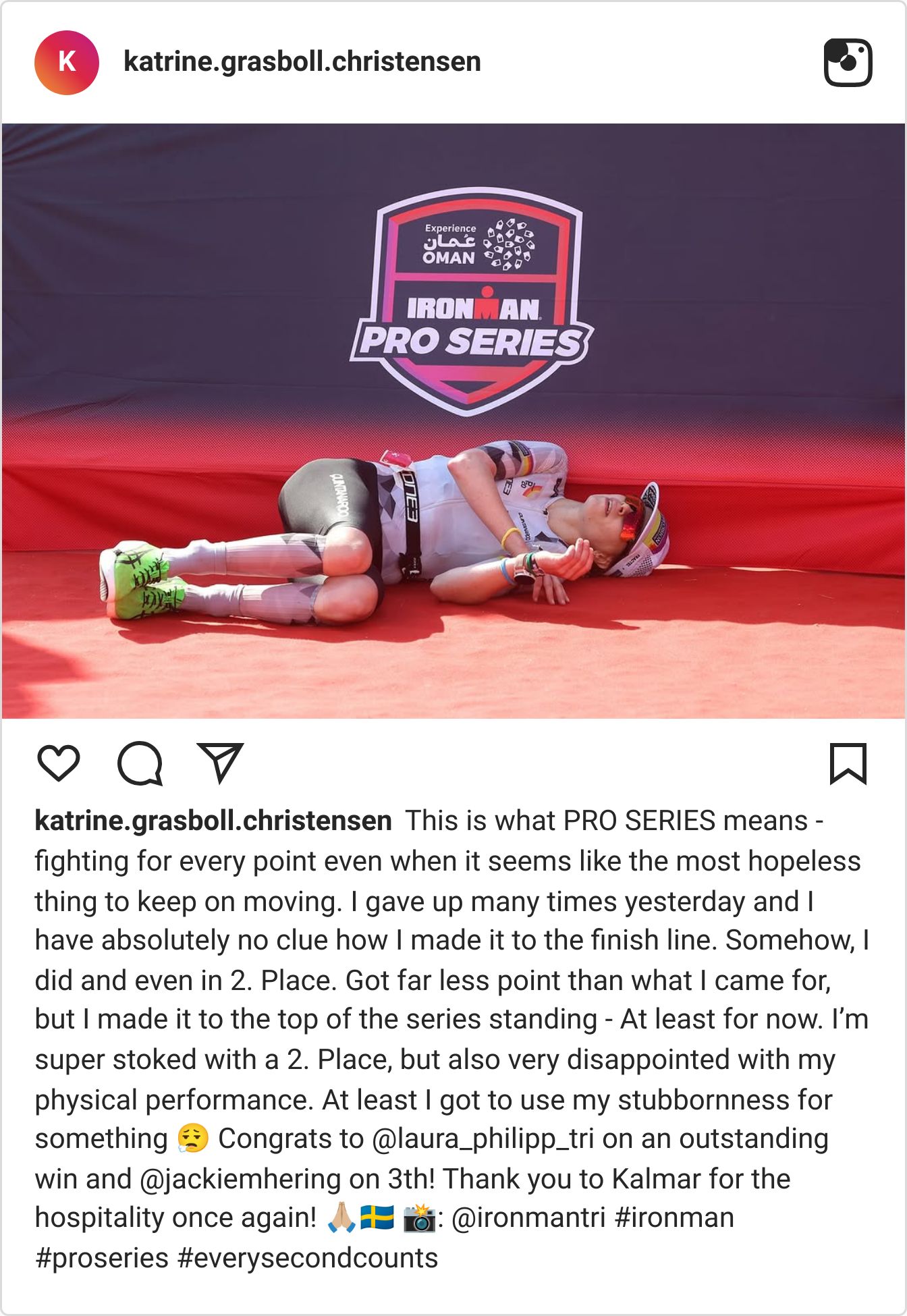
If ever there was an image that showed what it actually takes for a pro athlete to cross the line and make the podium at a full IRONMAN, then this post from Katrine Christensen is very much it.
Exhausted and frustrated with her performance, the reigning champion at Kalmar saw her title snatched away by the brilliant Laura Philipp in a display which smashed the Dane’s course record by more than 14 minutes.
Despite having to stop and walk for sections of the run, Christensen showed the battling qualities – and, in her own words, the stubbornness – required to drag herself into a second-place finish.
A truly inspiring effort… 👏👏👏
⏱️ Coaches corner: Coordinate breathing with your swim stroke
Many triathletes spend countless hours trying to improve their swimming technique, yet overlook one of the most important skills of all, breathing.
Poor breathing can disrupt your stroke, increase drag and leave you feeling exhausted long before you’ve reached the first buoy. In contrast, efficient breathing creates a smooth rhythm that allows you to swim with less effort while maintaining better body position in the water.
IN SHORT: Here are your top tips.
Exhale continuously underwater.
Turn your head with your body, not independently.
Avoid lifting your head.
Practise bilateral breathing when appropriate.
Stay relaxed during every breath.
Develop breathing skills in both the pool and open water.
WHY BREATHING MATTERS IN TRIATHLON: Unlike cycling and running, swimming requires you to breathe while your face is submerged.
Without proper breathing coordination, many athletes tend to hold their breath, lift their head excessively, lose body position, interrupt their stroke rhythm and tire much more quickly.
Efficient breathing allows your stroke to remain smooth while ensuring your muscles receive the oxygen they need throughout the swim.
EXHALE UNDER WATER: One of the most common mistakes beginners make is holding their breath until it’s time to inhale. Instead, begin exhaling as soon as your face returns to the water.
Continuous underwater exhalation helps:
Prevent carbon dioxide build-up.
Reduce feelings of breathlessness.
Create a calmer breathing rhythm.
Make inhaling quicker and easier.
Promote relaxation.
By the time your mouth reaches the surface, your lungs should already be mostly empty and ready for a quick inhale.
ROTATE YOUR BODY, NOT JUST YOUR HEAD: Good freestyle breathing begins with body rotation. Rather than lifting or twisting your neck independently, allow your natural body roll to bring your mouth to the air.
This approach helps maintain better body alignment, reduced drag, smoother stroke timing, improved balance and lower neck tension.
Your head should simply follow the rotation already created by your shoulders and hips.

KEEP ONE GOGGLE IN THE WATER: A useful coaching cue is to keep one goggle submerged while breathing. This encourages a small, efficient head turn instead of lifting your face completely out of the water.
Benefits include improved body position, reduced frontal resistance, faster return to the stroke and better stroke rhythm. The less your head moves, the easier it becomes to maintain an efficient swimming position.
MATCH YOUR BREATHING TO YOUR STROKE RHYTHM: Breathing should become part of your stroke rather than interrupting it. Many triathletes breathe every two or three strokes, although the ideal pattern depends on various issues, which include:
Swimming speed.
Fitness level.
Race distance.
Water conditions.
Personal comfort.
The most important goal is maintaining a rhythm that feels natural and sustainable. Avoid changing your breathing pattern repeatedly throughout a swim unless conditions require it.
BILATERAL Vs UNILATERAL BREATHING: Many swimmers practise bilateral breathing, where they alternate breathing to both sides, which offers improved stroke symmetry, better body balance, increased comfort in open water and greater flexibility when waves or competitors affect one side.
However, many experienced triathletes breathe predominantly to one side during races if it feels more comfortable or suits the course. Rather than forcing bilateral breathing at all times, develop the ability to breathe confidently on either side when needed.
AVOID LIFTING YOUR HEAD: Lifting your head to breathe is one of the quickest ways to slow yourself down. When your head rises, your hips tend to sink, drag increases, your kick becomes less efficient and forward momentum decreases.
Instead, rotate smoothly and keep your chin close to the water’s surface while taking a quick breath.
RELAX DURING EVERY BREATH: Breathing should never feel rushed or panicked. This is important, especially in different water temperatures, as they might affect swim performance.
A relaxed swimmer generally breathes rhythmically, maintains steady stroke timing, conserves energy, swims more efficiently and finishes stronger.
If you feel yourself becoming anxious, reduce your pace slightly and focus on smooth exhalation before attempting to swim faster.
ADAPT YOUR BREATHING IN OPEN WATER: Pool swimming provides calm, predictable conditions, but open water often requires greater flexibility. You may need to adjust your breathing when dealing with waves, wind, other swimmers, sighting buoys and crowded starts.
Being able to breathe comfortably on either side becomes especially valuable if waves are breaking on your preferred breathing side.
Practising in open water before race day helps you develop the confidence to adapt without disrupting your stroke.
COORDINATE SIGHTING WITH YOUR BREATHING: Triathlon swimming requires occasional sighting to stay on course. Many beginners make the mistake of lifting their head high before taking a separate breath, creating unnecessary drag.
Instead, combine sighting with your normal breathing rhythm whenever possible. A common sequence is:
Look forward briefly to identify the next buoy.
Rotate naturally into your regular breathing stroke.
Return your face smoothly to the water.
This minimises disruption and helps maintain your momentum.
USEFUL DRILLS TO IMPROVE COORDINATION: Breathing is a skill that improves through focused practice rather than simply swimming more laps. Useful drills include:
Side-kick breathing drill.
6-3-6 drill.
Single-arm freestyle.
Catch-up drill.
Bubble-bubble-breathe drill.
These exercises help reinforce proper timing, controlled exhalation and smooth body rotation without causing burnout. Even spending a few minutes on breathing drills during each swim session can lead to noticeable improvements over time.
If you've ever thought about doing your first triathlon — or you know someone who has — we built something specifically for you. The First Tri Guide is a free, structured guide that walks complete beginners through everything they actually need to know: which distance to start with, how much training is realistic around a normal life, what gear you genuinely need (and what you don't), and exactly what to expect on race day. No fluff, no overwhelm — just a clear path from "thinking about it" to crossing a finish line. If you know someone who's been toying with the idea of triathlon, send this their way. It's free, it takes two minutes to get started, and it might be the nudge that finally gets them to a start line.
💪 Outside edge of endurance
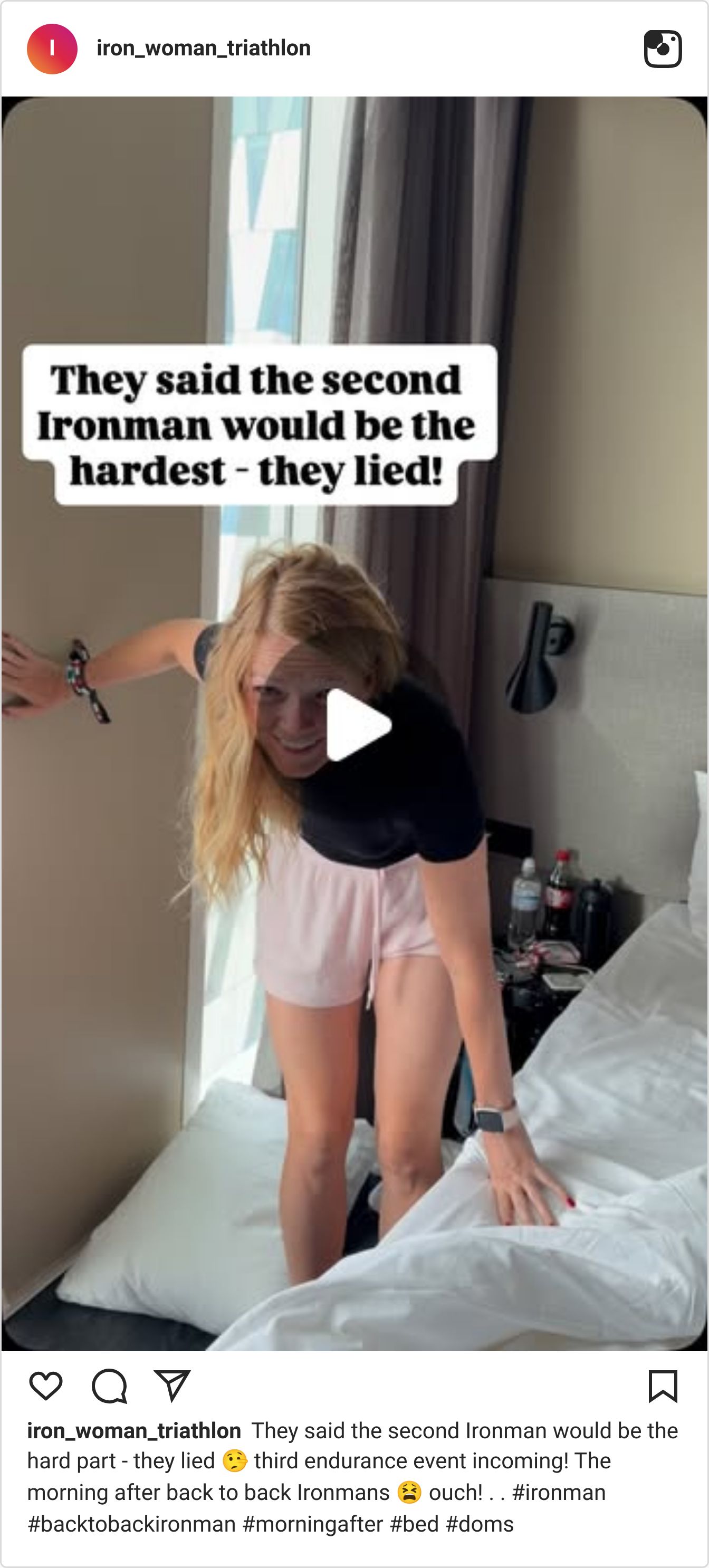
Most people would be happy with completing the one full-distance IRONMAN, but British triathlon coach Jen Done decided that would not be enough and instead doubled up over the weekend.
Her Scandinavian adventure saw her first complete the IRONMAN Kalmar on Saturday before she then drove across to neighbouring Denmark for Sunday’s IRONMAN Copenhagen.
She completed them both… although from the looks of this video here that was posted on her Instagram page, the toughest part of the whole weekend was actually getting out of bed on Monday morning.
What did you think of today's email?
That’s your Split. Until Next Time
Together, we go the distance. — @247_endurance 🏃♂️🚴♀️🏊♂️