

👋 Welcome back
Morning endurance fans…
Saturday morning, and you can feel it building already…
The big names are circling, and all roads now lead to what is shaping up to be the race of the season so far – IRONMAN Texas. A stacked start list, a fast course and a genuine who’s who of triathlon ready to throw down… this one has blockbuster written all over it.
So grab a coffee, settle in and get ready – because if the hype is anything to go by, we’re in for something special. 🏊♂️🚴♂️🏃♂️.
Here’s what we have lined up for you today…
LATEST: The endurance news headlines.
REPORT: Latest news from the Marathon des Sables.
DISTANCE: Jelle Geens looks to take Texas by storm
TIPS: How to improve your swimming endurance.
🏃🏼 Quick splits

Lucy Charles-Barclay has revealed she has started running again after tendon surgery. [PTO]
🏃♀️ RUNNING: Lucy Charles-Barclay is running again as she takes the next steps on her road to recovery from an ankle tendon injury. Read HERE.
💯 CROSSOVER: Short-course champion Matt Hauser explains why he answered the call to race in this month’s T100 Singapore. Read HERE.
⏱️ PERFORMANCE: Coach to the stars, Dan Lorang, gives his invaluable insight into the world of endurance sport and training. Read HERE.
🚫 BLOCKING: Sam Long reveals how harsh criticism of his swimming technique last season hurt him, as he “blocked the haters” Read HERE.
🥇 WINNER: Alistair Brownlee took first place in the gruelling Dales Divide coast-to-coast off-road bike race in the UK this week. Read HERE.

What if your next race kit wasn’t just another suit… but YOUR suit – built exactly how you want it, inspired by one of the best in the world?
Most athletes show up on race day looking the same. This is your chance to stand out; whether you’re chasing your first finish line or your next podium, this is the kind of upgrade that changes how you feel when you race.
We’ve teamed up with triathlon superstar Georgia Taylor-Brown and Tactic to give one lucky athlete the chance to create their very own custom performance tri-suit, just like the pros wear on race day.
However, this isn’t just any old suit off the shelf. This is YOUR design, YOUR fit, YOUR identity on course.
THE PRIZE
✅ A fully custom-designed Tactic tri-suit.
✅ Inspired by elite-level performance standards.
✅ Built for speed, comfort, and race-day confidence.
✅ Designed by you — with guidance from the experts.
🏁 Race news

Mohamed El Morabity. [Marathon des Sables]
🏜️ Marathon des Sables
It always promised to be the race’s defining stage, and how it delivered.
The distance for the fourth stage was upped to 100km to celebrate the 40th anniversary of the ‘toughest footrace on earth‘, and Morocco’s Mohamed El Morabity and France’s Maryline Nakacke took giant steps towards outright glory.
❌ Paris Marathon
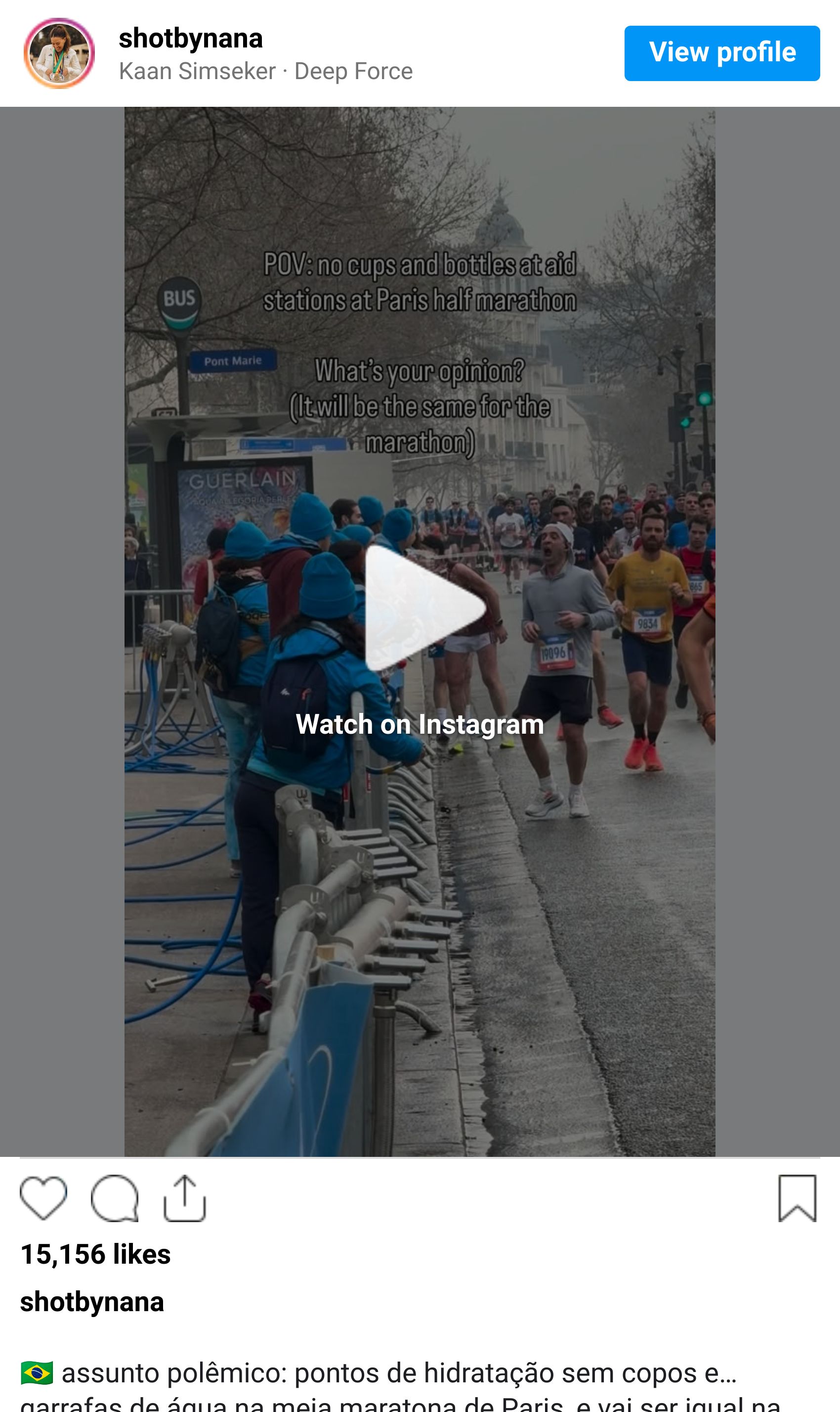
Runners taking part in this weekend’s Paris Marathon have been told to bring their own hydration containers after organisers confirmed there will be a ban on single-use bottles and cups.
Permitted containers include soft flasks, collapsible cups or even hydration packs, with the runners able to refill their receptacles at water stations along the course.
While many have applauded the marathon for taking a stand for sustainability, some within the running community have complained that having to stop for their refreshment will not only impact PB attempts but also affect cadence.
Other concerns focus on the rule that enables runners to bring pre-filled personal water bottles on the course, provided they are targeting a time under two hours and 50 minutes.
The number of aid stations has been increased as a result, with the usual eight boosted to 13, and water spray systems will be in operation to cope with hot weather.
A similar process was trialled at the Paris Half-Marathon last month.
🚴♂️ News from the saddle
Trophy hunters are being warned they could cause serious injury or even the death of a rider after cobbles were removed by fans desperate for a souvenir from the famous Paris-Roubaix course.
Sunday’s race will see the peloton fly through the Forest of Wallers section at 50km per hour, and what is already regarded as a treacherous section of the route is now being made much worse.
Course designer Thierry Gouvenou spoke out to the Dutch newspaper De Telegraaf after another cobblestone went missing from the infamous section: “On this section, and also on the ‘Carrefour de l’Arbre’ sector, we have a lot of extra work. These are legendary stretches, and people steal the cobbles as souvenirs. They don’t realise that they cause large and deep holes in the road.
“What those people are doing can be life-threatening. Just imagine what happens if they ride into such a hole… They’re going at speeds of 50 kilometres per hour on these sections.”
👩💻 Read the full story on Cycling Weekly, HERE.

Jelle Geens will compete in his first full-distance IRONMAN in Texas next week. [IRONMAN]
🔍 The BIG issue: Jelle Geens goes the distance at Texas
It could perhaps be classed as one of the greatest compliments ever made that, in amongst all the IRONMAN Texas hyperbole, Jelle Geens’ jump to full-distance triathlon is still being discussed with such intrigue and importance placed upon it.
The Belgian star was even name-dropped by Lionel Sanders this week as the 15-year veteran of multisport racing reeled off the long list of big names who will be congregating at The Woodlands next week.
Talking on his YouTube vlog, the Canadian all but confirmed him as a threat when he said: “Jelle Geens is there. New addition. One of the best in the world…”
The truth is that not even Geens knows whether he can live up to such billing as he finally takes the plunge and completes a career journey from the 2016 Olympics through WTCS short-distance racing into T100 and 70.3 and now on to full IRONMAN.
He certainly has the pedigree of someone capable of bridging a crossover that very few have been able to make a success of in the past. His 38th place at the Rio games seems a long time ago for the 33-year-old, who has since gone on to win World Triathlon Series, World Cups and 70.3 World Championships in a hugely successful career.
Geens could easily have settled into a career chasing more success at middle-distance, and nobody would have ever questioned his logic. But it seems IRONMAN was an itch that he simply could not ignore… and now he can’t wait to give it a good scratch.
He won’t have too far to look for inspiration either, with current Pro Series leader and the man he beat to last year’s 70.3 title, Kristian Blummenfelt, having trodden a relatively similar career path from the Olympics up to full distance.
The Norwegian’s Olympic gold in 2021 was followed by World Triathlon Series success and IRONMAN success a year later, before he then took the 70.3 title for good measure in 2022.
History points to two GOATS of the sport who excelled in their versatility: Jan Frodeno (GER), winning Olympic gold in Beijing before claiming three IRONMAN and two 70.3 championships; and double Olympic champion Alistair Brownlee (GBR), whose career saw him dominate European and Triathlon World Championships while also claiming two runners-up spots at the 70.3 finals.
The modern era, too, has also seen America’s Taylor Knibb winning two silver medals at the Olympics and picking up three 70.3 World Championship titles, while she continues to dominate at T100 level and will be among the favourites for a full-distance title at Kona later this year.
Knibb and Blummenfelt have helped pave the way for other short-coursers to go the full distance, with the likes of Norwegian trio Solveig Løvseth, Casper Stornes and Gustav Iden all winning IRONMAN world titles.
But let’s not kid ourselves here… This leap into the unknown is not going to be easy. If it were, then you’d see short-course legends Alex Yee and Matt Hauser lining up at Kona every year expecting to compete for honours.
Geens admits that he has based his entire season around a bid for such world championship glory; his training regime these past couple of months has been relentless, explaining how he was looking to teach his legs how to run when they are fatigued.
He wasn’t to know that the one race he was going to pick would end up being so stacked full of stars that it has already been dubbed Kona 2.0, but in a way that will help take the pressure off his shoulders.
Win, or take a podium place, and then he is already a legend… anything else, and it’s a case of taking the lessons learned and moving on to the next one.
Whether he can add his name to that list of multi-distance heroes remains to be seen, but one thing is for sure: it will be a thrilling subplot to what is already shaping up to be the race of the season.
The challenge that awaits Geens at Texas
In his latest YouTube training vlog, Jelle Geens admits that he has never cycled 180km, or even run 42km, and yet now he is going to do both in Texas next weekend, and all after completing a 3.8km swim.
His entire season has been focused on trying to win the World Championships in Kona, and he has been working with coach Ben Reszel on an IRONMAN-specific training plan to try and get his body accustomed to the rigours and tests that await it at full-distance.
Running blocks are currently 8×6 minutes at ‘goal’ IRONMAN pace, with two minutes of a floating recovery in between each rep. In total, the session amounts to 28-30km. His pace during those six-minute pushes was 3:27 per/km, and during the down sections, he was at 3:50.
Geens is also getting in 2-hour bike sessions, which are a mix of both outdoor road cycling and indoor ‘heat training’ on the rollers as he prepares for the expected tough temperatures in Texas.
Geens has also been improving his swim, taking on a 6.2km session, which he then followed with a lengthy bike ride at IRONMAN pace.
Much of his training is designed to get ‘fatigue into the legs’ so that he can prepare them for the challenge of running a marathon after already having swum and biked further than he has before.
He recently revealed on his ‘All in Triathlon’ podcast that his coach has suggested he aim for a marathon pace of between 3:27 and 3:33 per kilometre, which would equate to a finishing time of between 2:25 and 2:30. He accepts that this may not be possible after his swim and bike exursions.
Nutrition has also been a huge part of his preparations as he works out the amounts of fluids and gels that he needs, and at what stages of the race. He admits that his dentist probably won’t be too happy with the amount of sugar that he has been packing away to give him energy.
He said: “It’s a big unknown, isn’t it? It is a bit daunting, I guess, but I have the mindset that, because I haven’t done it yet. It’s also a bit like the sky is the limit; I don’t know yet where my IRONMAN limits are.”
There was no inclination that next week’s race was going to be quite so stacked as it has turned out to be, but Geens is not hiding away from the challenge: “I could do IRONMAN South Africa, which is the same weekend. I guess there are a few strong people there, but it’s not nearly as dense as Texas. For me, it’s more exciting that it’s such a quality field rather than me getting nervous over it.”
Will Jelle Geens make a success of his switch to full-distance IRONMAN?
👩💻 Trending in triathlon
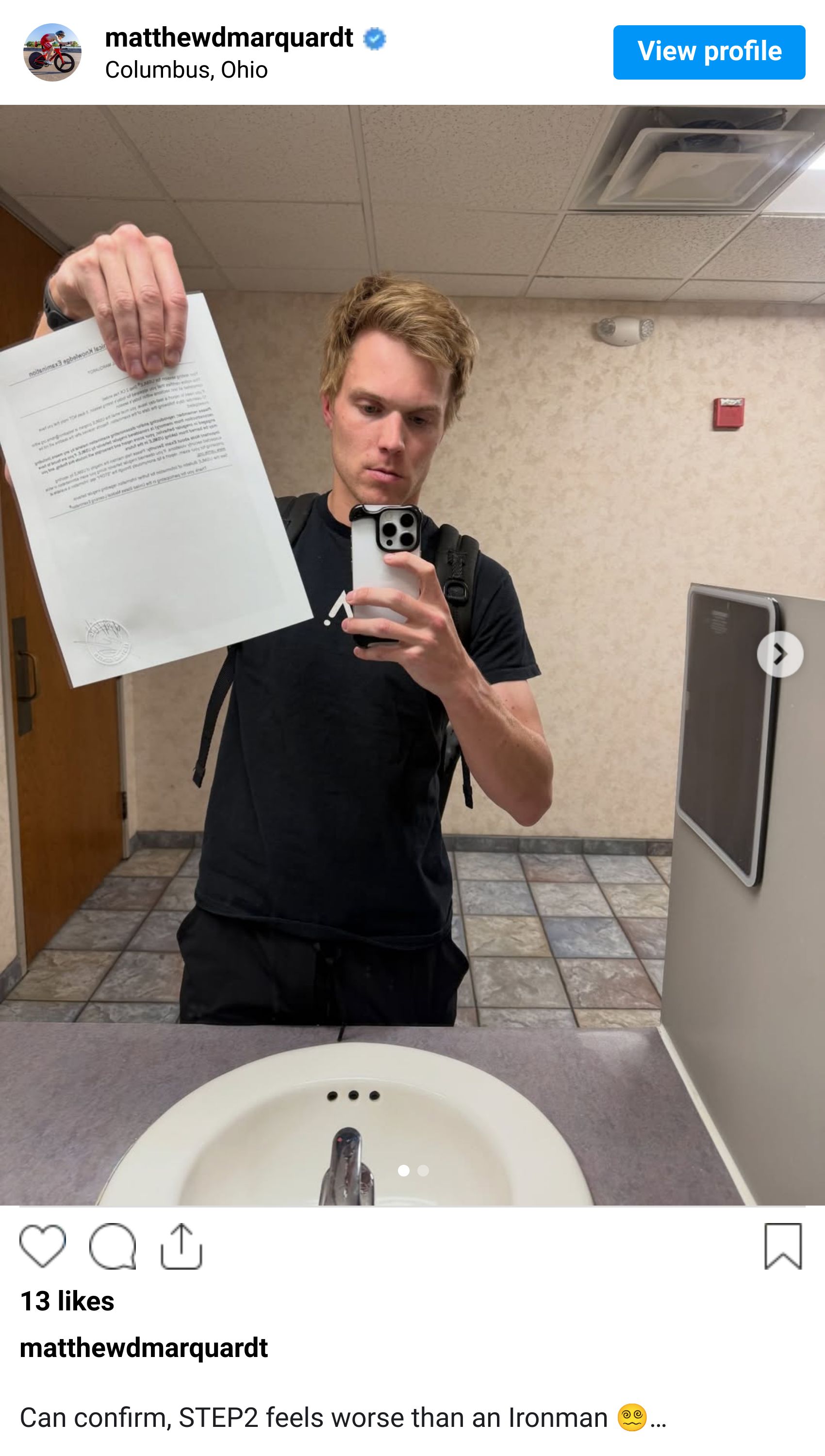
Matthew Marquardt has likened the sitting of his STEP 2 Clinical Knowledge exam to that of competing in an IRONMAN, after spending nine hours answering 316 questions in his bid to qualify from medical school.
Not your average triathlete, Marquardt combines racing and training with his studies at the Ohio State College of Medicine, where his passion is to play a role in the fight against Cancer. He will be at IRONMAN South Africa next weekend.
This week, he took another large step in that direction by taking his STEP 2 – a one-day, nine-hour, computer-based test assessing a student’s ability to apply clinical science to patient care.
He wrote on his Instagram page: “Can confirm, STEP2 feels worse than an Ironman. I was warned that no matter how well or poorly STEP2 goes, everyone leaves feeling terrible.
“I entered the testing center around 7am, by the end of the 6th section (around 3pm), I thought I might beat the odds. But, just like an Ironman, the last hour from 4pm-5pm was the hardest, and I too left feeling 😵💫😵💫😵💫😵💫
“What now? Well… the beauty of my life is there isn’t much time to perseverate on wrong questions or “what ifs”… I leave for South Africa tomorrow! Onward we go 😁
“And yes, I still biked the night after the exam was over…”
⏱️ Coaches corner: Improve your swim endurance
If you’re looking to improve your swimming endurance, there’s no getting away from the fact that you’re going to have to put the work in, swim consistently, and spend more time in the water. There are no hacks or shortcuts!
Here, Glenn Smith, the Great Britain coach and childhood coach of double Olympic champion Rebecca Adlington, and professional triathlete Andrew Horsfall-Turner, provide you with an insight into what you need to be doing to take your swim endurance to the next level.
📊 Structure your training
If you’ve not got a background in swimming, the primary way you can build up your endurance is to swim more. But you also need to work on your technique to be efficient and avoid overuse injuries.
Glenn Smith says: “You need to do a lot of skill work, then build the engine. If you’ve not got an endurance engine, you have to build it. You need a relatively long base training period; only then can you go into threshold, race pace and speed work leading into race season. If you’re building from a low place, don’t do too much threshold work when you should be doing winter base work.”
Building your endurance engine means plenty of time spent swimming at that steady Zone 2 intensity to develop your aerobic swim fitness. But it’s not just all about the base. Poor technique can be a limiting factor for many swimmers, making it harder to swim for longer distances because you’re not swimming efficiently.
Structure your swim training around three key phases:
Skill work: Go back to basics, including streamlining, push and glide, improving feel for the water and efficiency drills such as stroke counting.
Base work: Base work is aerobic training at around 70% of your maximum heart rate. Push up the distance gradually and reduce the amount of rest you take as fitness improves.
Race-specific work: Interval work at 80-90% of your maximum heart rate, swimming at race pace and above, incorporating some speed work.
🤕 Avoid injury
Increasing the overall volume of swimming is essential to improve endurance, but it can lead to an increased chance of injury. Here’s how best to avoid it.
Don’t skip the warm-up and cool down: These are very important and should never be overlooked. Triathletes should add some backstrokes to their cooldown, as this will help stretch out the muscles that can become tight during freestyle.
Prioritise recovery: If you’re following a programme where the rate of volume increase is fairly steep from week to week, consider a rest or de-load week every three weeks or so. You need to take a short break and give your body a chance to absorb the training, otherwise you’ll hit a plateau – or worse, get injured.
Use band exercises: Most injuries in swimming tend to be shoulder-related. Spend some time on dry land using fitness bands to keep your rotator cuffs and other shoulder muscles strong and stable.

Triathlete Andrew Horsfall-Turner shares his training programme. [Activ’ Images]
🔓 Pacing could be the key to unlocking endurance
If you’re doing the training, but still feeling like you run out of energy before you’ve completed the swim distance in a triathlon. It might have more to do with your pacing than your fitness.
For most people, the recommendation is not to start too fast. If you push into your anaerobic energy system and start to produce lactate, your body is going to hurt very early in the race. That’s going to make it difficult for you to continue swimming over a longer distance. While it can be difficult not to get swept up in the adrenaline of the race start, try starting at an easier pace and building into your race effort.
👍 Putting it into practice
This is Andrew Horsfall-Turner’s winter training plan, which mixes steady aerobic swimming with dedicated 50-metre repeats to focus on a particular drill or skill. Use the 50m ‘skill’ repeats to focus on a specific coaching point. Then, in the next aerobic swim set, try to incorporate the cue from that drill into your swim stroke.
1000m aerobic swimming
4 x 50m skill
800m aerobic swimming
4 x 50m skill
600m aerobic swimming
4 x 50m skill
400m aerobic swimming
4 x 50m skill
200m aerobic swimming
4 x 50m skill
100m aerobic swimming
If you’re not sure what ‘skill’ you need to work on, try heading down to your local triathlon club session to ask for some pointers… and remember that a 4000m swim set would probably be overkill, but you can still use Andrew’s session as a template by starting at 400m and dropping down to 100m with 1×50m of drills in between.
💪 Outside edge of endurance
Ultra-runner Hass Waseem has completed his latest endurance challenge by running the 640km from Land’s End to Manchester in just four and a half days.
He posted footage of himself arriving in the Lancashire city earlier this week and wrote on his page: “In a world full of negative male role models. Take me as proof that you are capable of incredible things if you put yourself to positive use.
“Work hard, be kind and refuse to f*****g quit ❤️”
At one point in the run, as he was closing in on his destination, he revealed just how tough the challenge was proving: “Day 4. Could be day 3. All blurred. Not slept. Pain beyond words. Can’t walk. Struggling to function. Whether I finish or not, I don’t know. But I will go, until I physically can’t.”
The exact figures behind his feat were: Distance - 639.93km; Time - 75 hours and 27 minutes; Elevation Gain - 5,291m.
Amazing effort 👏👏👏

What did you think of today's email?
That’s your Split. Until Next Time
Together, we go the distance. — @247_endurance 🏃♂️🚴♀️🏊♂️