


👋 Welcome back
Morning endurance fans…
Today, we hail the relentless brilliance of Kristian Blummenfelt, the Olympic gold medallist who produced another jaw-dropping performance at the weekend as he continues to redefine what is possible in triathlon – and setting a standard that few can live with, let alone match.
Here’s what we have lined up for you today…
LATEST: The endurance news headlines
OCEANSIDE: Stunning performances from Knibb and Big Blu.
RUNNING MAN: Blummenfelt sets new running standards.
TIPS: The science behind heart rates and why you need to know it.
🏃🏼 Quick splits

Steph Clutterbuck is looking for a solution which will enable her to compete with POTS disease. [IRONMAN]
😓 BRUTAL: Lionel Sanders believes his recent win at Dallas Little-Elm was one of the toughest, yet most rewarding, of his career, as he battled against bouts of illness and an ankle injury to take the tape in Texas. Read HERE.
🫶 ILLNESS: Steph Clutterbuck is taking time out of her season to seek an answer to the ongoing health issues, which have seen the symptoms of POTS disease blight her opening two races of the new season. Read HERE.
🎽 EXPANDING: The UTMB World Series is evolving its pioneering pregnancy policy by furthering its commitment to inclusion with a series of changes to address the needs of athletes experiencing parenthood issues. Read HERE.
🥾 LESSONS: Gemma Hillier-Moses says her road to this year’s CCC has been about patience and learning as she looks to bounce back from her difficult experience in the Mont Blanc massif at Chamonix last year. Read HERE.
What if your next race kit wasn’t just another suit… but YOUR suit – built exactly how you want it, inspired by one of the best in the world?
Most athletes show up on race day looking the same. This is your chance to stand out; whether you’re chasing your first finish line or your next podium, this is the kind of upgrade that changes how you feel when you race.
We’ve teamed up with triathlon superstar Georgia Taylor-Brown and Tactic to give one lucky athlete the chance to create their very own custom performance tri-suit, just like the pros wear on race day.
However, this isn’t just any old suit off the shelf. This is YOUR design, YOUR fit, YOUR identity on course.
THE PRIZE
✅ A fully custom-designed Tactic tri-suit.
✅ Inspired by elite-level performance standards.
✅ Built for speed, comfort, and race-day confidence.
✅ Designed by you — with guidance from the experts.
🏁 Race news

Taylor Knibb is joined by Solveig Løvseth and Audrey Merle on the Oceanside podium. [IRONMAN]
🌊 IRONMAN 70.3 Oceanside
Pro women: Taylor Knibb once again showed her dominance of the middle-distance course as she stormed to an impressive victory at Oceanside – just one week after winning on the T100 tour in Australia.
The American phenom, as she so often does, effectively put the contest to bed on the bike as she shattered her own course record for that discipline.
That gave her a near five-minute lead starting the run and plenty of breathing space, which proved useful as reigning IRONMAN World Champion Solveig Løvseth (NOR) closed to within a couple of minutes late on as she produced a superb performance herself on what was her first race of the 2026 campaign.
Both Knibb and Løvseth crossed the line under the previous course best of 4:06:31 set by Knibb in 2022. France’s Audrey Merle came home in third.
Oceanside 70.3 – Women’s Results (Swim/Bike/Run)
🥇 Taylor Knibb (USA) – 23:29/ 2:15:27/ 1:17:28 = 4:01:39
🥈 Solveig Løvseth (NOR) – 26:13/ 2:17:12/ 1:14:49 = 4:03:34
🥉 Audrey Merle (FRA) – 24:43/ 2:21:03/ 1:19:21 = 4:10:33
Pro men: Just as he had done less than a week earlier at Geelong, Norway’s Kristian Blummenfelt produced an incredible running display to take a thrilling come-from-behind victory in Oceanside.
Just six days after producing a 1:06:39 run to hunt down and overtake Jelle Geens (BEL) and Hayden Wilde (NZL) in Australia, Big Blu delivered a carbon copy display as he picked off Sam Long (USA) and Jonas Schomburg (GER) to take the win.
His run in California would have been a 1:06 had he not taken the time to high-five the fans as he neared the finishing line; his 1:07:01 was still way too much for his opponents, however, as he once again took his running to another level.
Schomburg took an excellent second place, while reigning IRONMAN World Champion Casper Stornes (NOR) paced the perfect race for third in what was his first race of the season after an Achilles issue.
Long was a fine fourth, having battled for the lead for much of the day with Schomburg and setting a new course bike record; indeed, the first nine men over the line all beat the previous Oceanside course record of 3:44:59 set by Jackson Laundry (CAN) in 2022.
Oceanside 70.3 – Men’s Results (Swim/Bike/Run)
🥇 Kristian Blummenfelt (NOR) – 22:49/ 2:05:41/ 1:07:01 = 3:40:08
🥈 Jonas Schomburg (GER) – 22:26/ 2:04:12/ 1:09:38 = 3:40:32
🥉 Casper Stornes (NOR) – 22:37/ 2:05:39/ 1:08:35 = 3:41:58
🚴♂️ News from the saddle
In Flanders Fields (men): Belgian Jasper Philipsen (Alpecin-Premier Tech) produced an incredibly strong sprint to win In Flanders Fields, as he beat Dane Tobias Lund Andresen (Decathlon CMA CGM) at the finish in Wevelgem to take an emphatic victory.
Philipsen was back to his best in the final sprint, as a gap opened up for him along the barriers, which gave him space to emerge from the slipstream and launch for the line.
His teammate, Dutchman Mathieu van der Poel (Alpecin-Premier Tech), had been up the road with Belgian Wout van Aert (Visma-Lease a Bike) after the pair went clear on the final ascent of the Kemelberg with 36km to go but were caught by the peloton just before they went under the flamme rouge, setting up a sprint from the reduced bunch.
👨💻 You can read a full report on this race at Cycling Weekly, HERE.
In Flanders Fields (women): An emphatic performance saw Lorena Wiebes (SD Worx-Protime) win In Flanders Fields from the breakaway in an atypical showing from the Dutch rider, as she split the race on the final ascent of the Kemmelberg to draw a small group clear and sprinting to victory in the final few hundred metres.
👨💻 You can read a full report on this race at Cycling Weekly, HERE.
Volta a Catalunya: Brady Gilmore (NSN Cycling) took victory in the final stage of the Volta a Catalunya on the circuit around Montjuïc, beating Dorian Godon (Ineos Grenadiers) on the bike throw in the final sprint to prevent the Frenchman from taking his third stage win of the race.
Jonas Vingegaard (Visma-Lease a Bike) finished in the front group to ensure overall victory in the general classification for the in-form Dane.
👨💻 You can read a full report on this race at Cycling Weekly, HERE.

Kristian Blummenfelt is breaking new ground with his incredible running abilities in triathlon. [IRONMAN]
🔍 The BIG issue: Big Blu sets new running standard
He may have been smiling on the outside, but as Kristian Blummenfelt stood on the podium clutching his $200,000 cheque for winning last year’s Pro Series, it was clear that a raging fire had already been lit inside him.
Just moments before, he had been asked about his ‘successful’ season – a campaign which had seen him finish as a clear leader in the IRONMAN standings, having won three of his six races, and coming second and third in two of the others.
“Average, I would say. It gives me motivation at least for the next year… trying to do better in those World Championships. That’s what we race for – we want to win world titles. A podium is a podium, but I want to take that tape. Failed twice this year, but two more chances next year.”
For an athlete who gauges success with world titles, 2025 had been a ‘failure’. Yes, he had won three races (IRONMAN Texas, 70.3 Pays d’Aix, and Frankfurt), but he came third in the World Championships in Nice and was runner-up in the 70.3 World Championships in Marbella.
Those defeats clearly hurt – but it was perhaps the manner of them which really gave him the added desire to seek improvement in 2026.
In Nice, he was well-placed to take the tape; running with compatriots and training pals Casper Stornes and Gustav Iden, he was favourite to win his second world title.
The fact that he was unable to respond when Stornes and Iden broke away not only surprised the watching world but also left Big Blu to ponder what had gone wrong and why.
Two months later, he once again saw his world championship dreams shattered in the closing stages of the 70.3 run as Belgian Jelle Geens snatched victory with a stunning late burst of pace, which left the big Norwegian on his heels.
To lose one world title through not having the legs to finish the job was heartbreaking; to lose another so soon after was clearly devastating… and something needed to be done to make sure that he would never again find himself wanting when it mattered.
We’ve all heard about the much-vaunted Norwegian method; we’ve read about the intense levels that Blummenfelt, Stornes and Iden now train at, but it seems Big Blu has taken things to an even higher level over the winter as he seeks to avoid further repeats of his double disappointment.
Sometime between that podium and the start of this season, ‘Beast Mode’ seems to have been activated… Images of his VO2max ‘world record’ score of 101.1 were proof of that.
Scoffed at by some, who said it simply wasn’t possible for a man of his age, maybe his recent 70.3 performances at Geelong and again this weekend at Oceanside are proving the validity of those numbers, where needed.
His 1:06:39 in Australia was followed less than a week later by another incredible time of 1:07:01 in California – both could have been even faster had he not slowed down to high-five the supporters on the final yards before the tape.
His average pace for both runs was 3:10 min/km, with one commentator at Geelong explaining his approach perfectly by stating: “Blummenfelt looks like he is sprinting, while the rest of the field are just running.”
Nobody has ever run a 70.3 in under 1 hour and 6 minutes, yet Blummenfelt could easily have done so in both of these recent races. While it is difficult to compare race times in triathlon due to the varying course set-ups around the world, it is worth noting that these two times are the best and third-best of his entire 70.3 career, with only a 1:06:57 back in 2018 at Bahrain bettering what he achieved at Oceanside.
Currently placed 6th in the PTO run rankings, he has already blitzed three of the athletes who sit above him (Wilde 2nd, Geens 3rd, and Jason West 4th) this season.
However, with his 70.3 marker now set, he moves back to full distance in Texas next month, no doubt fully aware that his opening race of the campaign in New Zealand certainly did not go as he would have wished.
All eyes will be on him now to see whether that display in Taupō was merely an early-season blip as he looks to replicate his 70.3 running dominance at full-distance.
Improved nutrition, science, technology, and training have all helped to improve triathlon running times over the years… but has KB now nudged the dial even further?

Kristian Blummenfelt won the Pro Series last season after missing out on the two big world championship races at both full and middle distance. [IRONMAN]
The evolution of triathlon running
Run times are getting faster in both middle-distance and full triathlon, with improved swimsuits and bike technology, coupled with better nutritional awareness, ensuring that athletes are approaching their final discipline feeling better and with vastly improved energy reserves.
A rough average time for a pro male triathlete to complete the half-marathon 20 years ago would range between 1:12 and 1:18, depending on the course, while today’s competitors are disappointed if they don’t achieve a sub-1:10.
It is difficult to compare 70.3 times due to the different courses the races are held on; however, in 2006, Craig Alexander won the 70.3 World Championships on a flat, fast Clearwater course with an overall time of 3:45:37, including a run of 1:12:43 – a split more than two minutes ahead of his nearest competitor, Simon Lessing.
In 2025, on a much hillier course, Jelle Geens took the tape in a time of 3:42:52, with a run of 1:07:35. Only eight of the top 20 finishers in Marbella ran a slower run leg than Alexander did in 2006.
Using the same two races for the women, the winner in 2006 was Samantha McGlone with an overall time of 4:12:58 and a run split of 1:20:22; In 2025, Lucy Charles-Barclay won in 4:14:54 but had a run split of 1:17:14 – McGlone’s run would only just have made it into the top ten Marbella times, sitting in ninth.
It is easier to compare full-distance World Championships by using Kona as the baseline and Patrick Lange’s last outing on the Big Island, when he won in 2024 with an overall time of 7:35:53 and ran his split in 2:37:34 – compared to 20 years earlier, when fellow German Norman Stadler won with a time of 8:33:29 and a run of 2:57:53. Although the fastest run that day was recorded by Peter Reid of Canada with a 2:46:10.
Only four run times have been recorded below 2:40 at Kona, with Germany’s Patrick Lange achieving three of those (2016, 2017, 2024) along with Gustav Iden (NOR) in 2022; not even the great Mark Allen could beat the 2:40 mark, with his best at Kona coming in 1989 when he recorded a run of 2:40:04.
The first woman athlete to break the three-hour marathon at Kona was Lori Bowden of Canada, who timed in at 2:59:16 on her way to a 9:13:02 victory in 1999. However, it took another eight years before Britain’s Chrissie Wellington joined her with a 2:59:58 in her 2007 win (9:08:45).
Since 2007, there have only been two races where a woman athlete did not break the three-hour mark for the marathon (2017 and 2015).
While Iden holds the current Kona run record for the men, the women’s best time was recorded last year by Kat Matthews (GBR) when she crossed the line in 2:47:23 on her way to finishing in second place behind Solveig Løvseth.
What has been the biggest evolution in triathlon running?
👩💻 Trending in triathlon
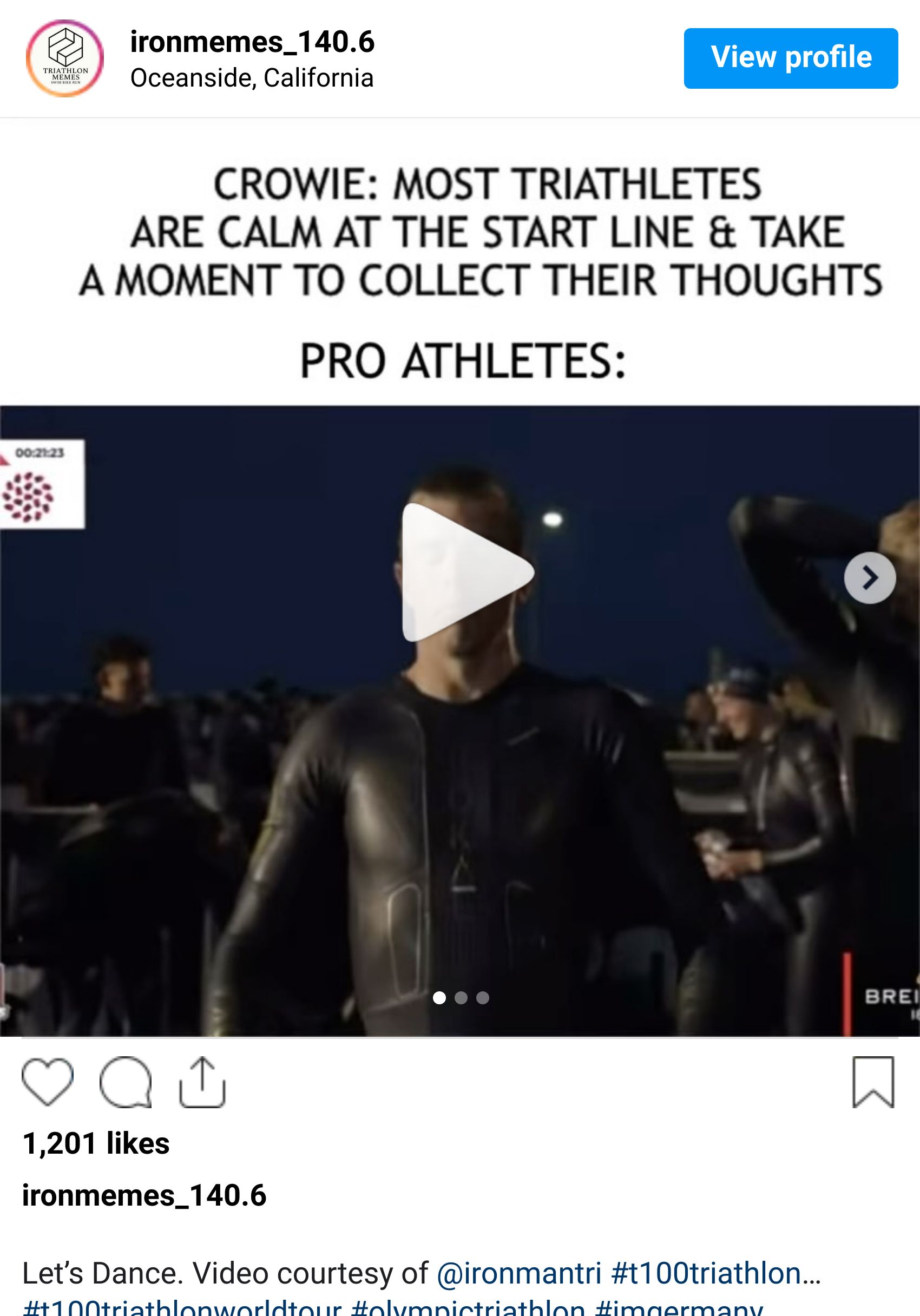
As if their moves out on the course were not special enough, the likes of Kristian Blummenfelt, Sam Long and Sam Appleton also wanted to share some of their dancing skills ahead of the 70.3 in Oceanside at the weekend.
We love the enthusiasm, guys, but maybe just stick to swim, bike, run in the future?
⏱️ Coaches corner: Heart rate zones explained
In Saturday’s newsletter, we looked at the importance of running heart rates and how they can be a powerful tool for runners when both in training and competing. Today, we are looking at the heart rate zones themselves.
There are a few different ‘zone’ structures around, but for this article, we’ll be working with a six-zone model. Below you’ll find a summary of each heart rate zone – including the target percentage range of your max heart rate for each zone. We have also added some details on the training effect of each zone to help with your run workouts and get the desired benefit depending on your training goals.
For endurance runners, a significant proportion of training (typically 80%) will be completed at Zone 2 intensity to build the aerobic engine. But adding in a variety of speed work, alongside some shorter stints of race pace work, can be seen as the ‘cherry on the cake’ to help you improve your speed over longer distances.
ZONE 1:
Description: Active recovery
% max heart rate: 50-60%
Training effect/benefits: Warm-ups, cool-downs and active recovery. Stimulates blood flow to the muscles, helping to prepare them for activity before a workout, or helping to speed up the removal of waste products and the delivery of oxygen and repair agents post-workout to aid recovery.
ZONE 2:
Description: Endurance
% max heart rate: 60-70%
Training effect/benefits: Develops aerobic fitness by improving cardiovascular efficiency. Low-intensity Zone 2 activity helps your body to get more efficient at oxygen delivery and uptake and promotes better fat oxidation and the use of lactate as a fuel source. This raises your first lactate threshold, enabling you to run faster for longer before the onset of fatigue.
ZONE 3:
Description: Steady
% max heart rate: 70-80%
Training effect/benefits: Lactate clearance. At Zone 3 intensity, we generally hit our first lactate threshold, which aligns with marathon race pace. Longer intervals (~15 minutes) at Zone 3 intensity will help your body to get better at holding your target marathon pace.
ZONE 4:
Description: Tempo
% max heart rate: 85%
Training effect/benefits: Working in the ‘comfortably uncomfortable’ sweet spot, Zone 4 effort aligns with your 10km pace. Intervals at this intensity will help to raise your 2nd lactate threshold. 8-10 minute reps at Zone 4 are a solid bang-for-your-buck workout to boost your run fitness. Particularly useful for marathon training because this intensity won’t put a huge amount of fatigue into your body – ideal when you’re fitting in higher mileage.
ZONE 5:
Description: Threshold
% max heart rate: 85-95%
Training effect/benefits: Threshold means you’re working at the very top end of your aerobic capacity. Zone 5 work typically aligns with your 5km all-out race pace. Shorter intervals (3-5 minutes) at this intensity will help to improve your 5km time and boost your run speed.
ZONE 6:
Description: VO2 Max
% max heart rate: 95
Training effect/benefits: VO2 Max refers to the maximum amount of oxygen you are able to take up and use. Zone 6 efforts typically last at most 1-2 minutes, depending on fitness levels – think short track intervals. Zone 6 work provides a serious run fitness boost, raising the ceiling on your aerobic fitness. But it’s tough on the body, so plan these sessions carefully around your other training and factor in recovery time to let the adaptations soak in.
💪 Outside edge of endurance
What do you do to pass the time when swimming non-stop across the English Channel for 11 hours and 51 minutes without any music or company in the water?
Endurance swimmer Georgia Dolan-Mould first kicked her way from England to France last July and is now looking to complete the Jersey to France in August and the iconic London Dock2Dock in September.
Under her Instagram guise of georgia.swims, she admits to stressing out her mum ‘one ridiculous swim at a time’ and recently gave an insight into what goes through the mind of a long-distance swimmer mid-challenge… and she admits, ‘it got weird’.
From playing A-Z games in her head to singing Taylor Swift songs, and even seeing a hallucination of her beloved dead dog, this was one incredible journey of endurance.

What did you think of today's email?
That’s your Split. Until Next Time
Together, we go the distance. — @247_endurance 🏃♂️🚴♀️🏊♂️