


👋 Welcome back
Morning endurance fans…
The mountains are calling as UTMB week brings the world’s finest trail runners to Chamonix for one of endurance sport’s greatest celebrations. With three huge races – the OCC, CCC and UTMB – taking centre stage, the trails around Mont Blanc are set to deliver plenty of drama, suffering and unforgettable performances.
Away from Chamonix, there is also top-level triathlon action to savour as the stars head to Weihai and Zell am See.
From punishing mountain trails to fast and furious multisport racing, welcome to another action-packed edition of the Daily Split.
Here’s what we have lined up for you today…
LATEST: The endurance news headlines
RACE NEWS: Previews and reports
Analysis: UTMB big race preview.
TIPS: The science behind wanting to stop
🏃🏼 Quick splits

Cassandre Beaugrand struggled in the final race of the WTCS season in Wollongong and missed out on winning the overall title. [PTO]
💪 COMEBACK: Cassandre Beaugrand has revealed how the pressures of wanting to secure the WTCS title left her feeling ‘so much pain’. Read HERE.
😷 MISSING: Sophie Evans will not line up for this weekend’s WTCS Weihai after tests revealed she has been battling two viral infections. Read HERE.
🏅 EXPERIENCE: Ten years after winning Olympic gold in Rio, USA’s Gwen Jorgensen is already going to great lengths ahead of LA28. Read HERE.
🙋♀️ BACKING: IRONMAN has backed the new ForTheGirls support group as it looks to attract women athletes into the sport of triathlon. Read HERE.
⛰️ BRAVERY: Jelle Geens believes the secret to success at this year’s 70.3 World Championships will be bravery on the bike descent. Read HERE.
🏁 Race news

Laura Philipp will race at IRONMAN 70.3 Zell am See this weekend. [IRONMAN]
IRONMAN 70.3 Zell am See
Laura Philipp is poised to make a quick return to racing at IRONMAN 70.3 Zell am See – just 15 days after her dominant victory at IRONMAN Kalmar.
The 2024 IRONMAN World Champion produced a superb performance in Kalmar, clocking 8:13:37 as she claimed victory by almost 20 minutes and broke Katrine Christensen’s 2025 course record by more than 14 minutes.
But rather than taking some downtime following that full-distance effort, Philipp is pencilled in for the #1 bib in Austria on August 30 for what is the last IRONMAN Pro Series event before the two World Championships.
And that last point could help explain why Zell am See makes so much sense with a clear Pro Series incentive for making the quick return. Philipp currently sits sixth in the standings on 12,163 points following three scoring performances this season.
She collected the maximum 5,000 points for victory in Kalmar, adding to the 4,922 she earned for second place at IRONMAN Hamburg and 2,241 for third at IRONMAN 70.3 Aix-en-Provence.
It is that Aix score which gives her significant scope for improvement in Austria, with 2,500 points available to the winner at Zell am See. If Philipp could take maximum points, she would replace her Aix score and improve her total to 12,422 – moving her ahead of reigning IRONMAN World Champion Solveig Løvseth.
There is an equally intriguing storyline in the men’s race, where Jelle Geens will make his final competitive appearance before attempting to win a third successive IRONMAN 70.3 World Championship title.
The Belgian will race at Zell am See exactly two weeks before the men’s 70.3 World Championship showdown in Nice on September 13.
WTCS Weihai
Cassandre Beaugrand will look for a fourth win from as many starts as she lines up for the WTCS Weihai in China this weekend.
Having spent much of her season jumping between track and triathlon, she has decided to give the series another shot after missing out so painfully last year when she seemingly had success in the bag at Wollongong.
The best four scores plus the Grand Final in Pontevedra determine the title, and Beaugrand is in sixth with those 3,000 points (the rest of the top 10 have all raced at least four times) and still has one more race to count.
Victory in Weihai will probably see her rest up ahead of the season’s finale, knowing she has maximum points… anything else and you can bet she will be racing at Karlovy Vary in the Czech Republic on September 13.
There is a similar situation in the men’s race, with Australian Matt Hauser also looking to pick up a fourth win of the season and lift himself into a position where he can better defend his 2025 title.
IRONMAN 70.3 Tallinn
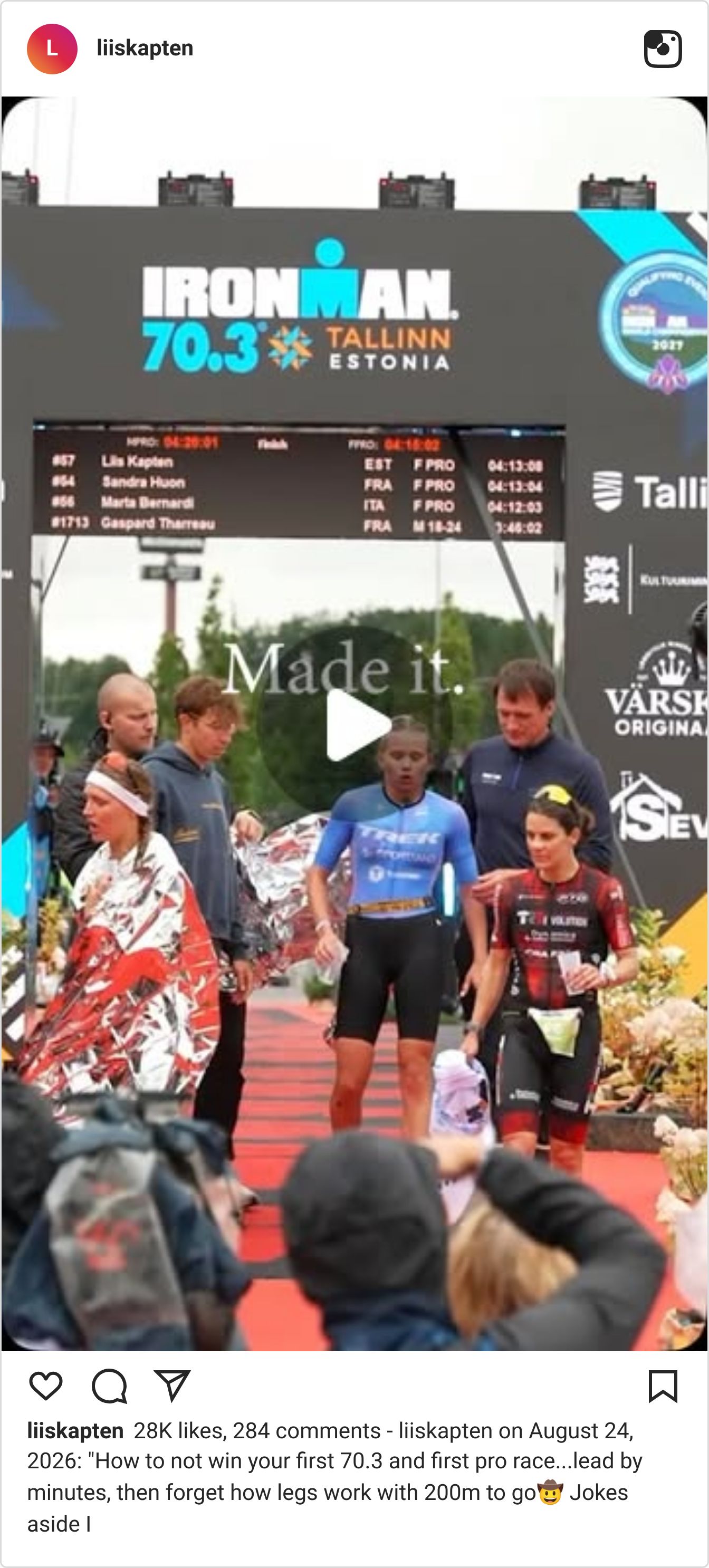
There was real drama on the finishing line in Tallinn over the weekend as leader Liis Kapten hit the wall with only 200m to go and stumbled her way over the line after crashing into barriers and fences.
As the video below shows, she took several serious blows along the IRONMAN red carpet as she eventually managed to crawl her way to a valiant third place.
Italy’s Marta Bernardi took the win, and France’s Sandra Huon took advantage of Kapten’s struggles down the finishing chute, who later posted on Instagram that she was OK… if a little bruised.
The Estonian wrote: “How to not win your first 70.3 and first pro race... lead by minutes, then forget how legs work with 200m to go. 🤠
“Jokes aside, I’m all fine now, only a few bruises and a sore body (probably from the 70.3 itself). Still came away with 🥉. And showed I can fight. Special to race at home; every cheer meant the world out there. ❤️
“Pro tip: eat more than 1/2 gel on the run even if you feel amazing...”
Estonian Henry Räppo won the men’s race for the second year running, with Hannes Butters (GER) and Enzo Bourdon (ITA) completing the podium.
Buenos Aires half-marathon
Yomif Kejelcha, who made history when he went under two hours on his marathon debut in London in April, has now rewritten the half-marathon record books.
The Ethiopian became the fastest debutant at the marathon with a stunning 1:59:41 on an historic day in London when the two-hour barrier was broken for the first time by Sabastian Sawe in 1:59:30.
And in Buenos Aires, Argentina, on Sunday, he ran a staggering 56 minutes 51 seconds for 13.1 miles or 21.1km.
That knocked no less than 29 seconds off the previous best mark of 57:20, set by Uganda’s Jacob Kiplimo in Lisbon in March, though both records have to go through the usual ratification process.

Courtney Dauwalter is looking for more UTMB glory this week. [UTMB]
The BIG race: Preview to this week’s HOKA UTMB Mont-Blanc 2026
The world’s best trail runners have descended on Chamonix for a spectacular week of racing that will culminate with the three showpiece UTMB World Series Finals.
First up is Thursday’s ‘fast and furious’ OCC, where Tove Alexandersson and Rémi Bonnet headline fields packed with formidable short-distance speed, and triathlon GOAT Jan Frodeno will also be lining up.
Attention then turns to the 101km CCC, with Toni McCann, Yngvild Kaspersen, Miao Yao and Eli Hemming among those preparing to tackle the demanding journey from Courmayeur to Chamonix.
The main event begins on Friday evening as defending champion Ruth Croft renews her rivalry with three-time winner Courtney Dauwalter in a mouthwatering women’s UTMB race.
With Kilian Jornet, Jim Walmsley and defending champion Tom Evans all absent, Vincent Bouillard, Ben Dhiman and British duo Jonathan Albon and Josh Wade will lead the battle for the men’s crown.
Three countries, three world finals and thousands of metres of climbing await as Chamonix once again becomes the beating heart of the trail-running world.
🎽 OCC
👟 Distance: 60km
📆 When: Thursday, August 27
📍 Where: Orsières to Chamonix
Named ‘The Little Swiss Miss’, this 60km course with 3,500m of elevation gain starts in Orsières, located southwest of the canton of Valais in the Val d’Entremont.
The OCC route takes runners into the heart of this distinctive and authentic landscape before reaching Champex-Lac and then Trient. They then cross the Franco-Swiss border via the iconic Col de Balme and its breathtaking views over the Mont Blanc massif.
After reaching Tête de Balme (2,321 m), the new high point of the course, the runners will descend onto the Swiss side before crossing back in France through the municipality of Vallorcine and climbing up to Col des Posettes.
Competitors will then continue to Le Tour before reaching Chamonix via the valley’s northern balcony trails, where they will cross the legendary finish arch in the heart of the town.
The OCC is now the annual 50km category final of the UTMB World Series, regarded as the ultimate challenge for all mid-distance ultrarunners.
🎽 CCC
👟 Distance: 101km
📆 When: Friday, August 28th
📍 Where: Courmayeur to Chamonix
The CCC, regarded as one of the most prestigious races in the world, starts in Courmayeur, Italy, and almost immediately presents its first major challenge as runners climb steeply towards an altitude of more than 2,500m.
The path to Grand col Ferret takes runners into Switzerland and through La Fouly, Champex and Trient before then crossing into France and experiencing Vallorcine and Vallons des Chéserys – described as a true corner of paradise with magnificent views over Mont-Blanc.
After 101km, the runners will be delighted to make their way into the heart of Chamonix, where they will be met by enthusiastic crowds and, no doubt, granted a hero's welcome.
A fitting finale to the 100km UTMB category, competitors will need to cope with a 6,050m of elevation gain.
🎽 UTMB
👟 Distance: 174km
📆 When: Friday 28th August - Sunday 30th August
📍 Where: Loop starting and ending in Chamonix
The ultimate in trail running, the UTMB takes competitors through three countries and 10,000m of positive elevation around Mont Blanc in a race which has established itself as one of the most iconic events in the sporting world.
Starting in Chamonix late on Friday afternoon, competitors head down-valley to Les Houches, heading anticlockwise to Saint Gervais, Les Contamines and La Balme.
Les Chapieux and Lac Combal are checkpoints five and six before the race descends to Courmayeur, before climbing once more, eventually hitting Grand Col Ferret, the highest peak of the race at 2,537m.
The route continues via La Fouly and Trient, with the final checkpoint coming at La Flégère, 166.3km into the course. From there it’s all downhill, resulting in an exciting finish as runners descend into Chamonix hoping to be inside the 46:30 cut-off time.
📺 Watch live: Broadcasts will be streamed on the UTMB website HERE

Ruth Croft returns to Chamonix this week. [UTMB]
🚴♂️ News from the saddle
Stage three of the Vuelta a España was neutralised and then cancelled on Monday after a hailstorm meant racing was impossible on the final climb.
Race leader Tadej Pogačar (UAE Team Emirates-XRG) was seen telling riders in the peloton to slow down with around 15km to go on the climb to Font Romeu after they had topped the Col de Mont-Louis.
Read more on this story at Cycling Weekly HERE.
👩💻 Trending in triathlon
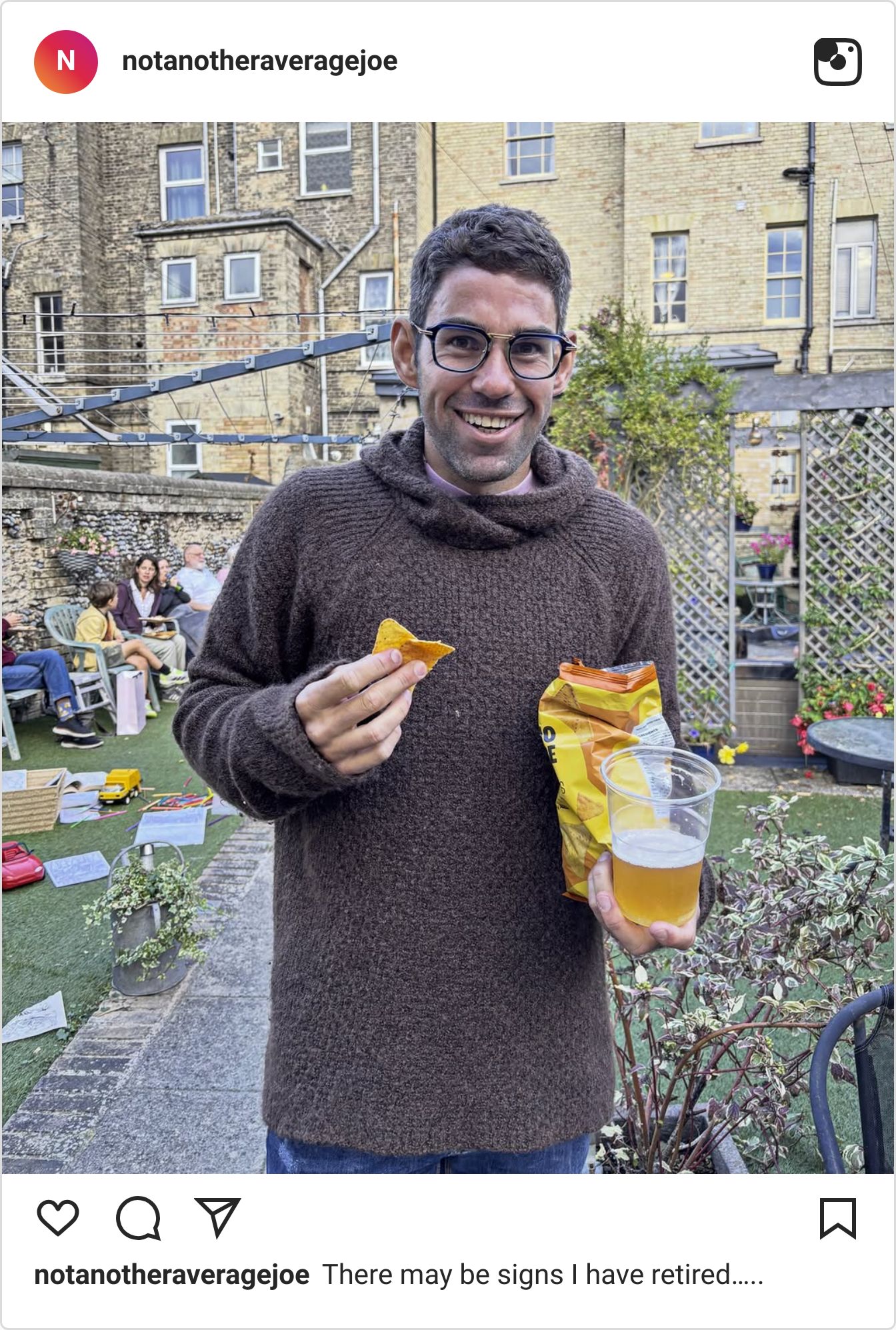
After years of being a professional athlete, you can probably forgive Joe Skipper for allowing himself to enjoy a few of life’s little indulgences.
The former Brit triathlete announced his retirement last month and is now focusing on a new sporting challenge as he prepares to compete in the high-intensity world of Hyrox.
And from the picture he posted on Instagram last week – coupled with the caption ‘There may be signs I have retired’ – it seems the eight-time IRONMAN race winner is certainly making the most of not being confined to the strict diet usually associated with a triathlete.
But we are not going to begrudge him a few beers and snacks after all the enjoyment, effort and sacrifice he has given to the sport over the years – particularly when the next image on his account is one of him working hard in the Hyrox gym!!!!
Enjoy your retirement, Joe, and best of luck with your new adventure.
👏 🍻 🍿 💪
⏱️ Coaches corner: The science behind wanting to stop running
Most runners eventually experience a long run where the strongest thought in their mind is simply to stop. It may happen halfway through a difficult training session, during the final miles of marathon preparation or unexpectedly on a run that should have felt comfortable.
The urge to quit can come from physical fatigue, but it also reflects how your brain interprets effort, discomfort, motivation and the distance remaining. Poor pacing, inadequate fuelling, heat, lack of sleep and accumulated training fatigue can make the feeling considerably stronger.
WHY DOES YOUR BRAIN TELL YOU TO STOP? Long-distance running creates a steadily increasing sense of effort. Your brain receives a raft of information about muscle fatigue, breathing, body temperature, energy availability, discomfort, motivation and the distance remaining.
As these demands increase, continuing can begin to feel less appealing. Thoughts about stopping are therefore not unusual during prolonged exercise. They do not, however, automatically mean you have reached your absolute physical limit.
MENTAL AND PHYSICAL FATIGUE: It is difficult to separate the mind from the body during endurance exercise. Heavy legs can make you feel less motivated. Feeling discouraged can make the same physical effort seem harder. A runner who is tired, hungry and uncomfortable may interpret a difficult section very differently from the same runner when rested and well-fuelled.
STARTING TOO FAST: One of the most common reasons a long run becomes mentally difficult is poor early pacing. When you start faster than the session requires:
Breathing becomes harder.
Carbohydrate use increases.
Muscular fatigue develops faster.
Perceived effort rises earlier.
The result can be a strong desire to stop long before the planned distance is complete. A long run should usually begin at an effort that feels sustainable, not at the fastest pace you can comfortably hold while fresh.

As physical fatigue builds, effort can feel increasingly difficult, making negative thoughts and the urge to stop more noticeable.
DISTANCE CAN BE MENTALLY OVERWHELMING: Thinking about the entire remaining distance can make a difficult run feel worse. At kilometre 18 of a 30km run, thinking repeatedly about another 12km may feel intimidating. Instead, reduce the problem by focusing on:
The next kilometre.
The next drink.
The next turn.
The top of the hill.
Another ten minutes.
You are still completing the full run, but you are not asking your mind to process the entire remaining workload at once. A structured long run can feel easier mentally than one continuous distance. For example:
First section: Settle into an easy rhythm.
Middle section: Maintain pace, fuel and stay relaxed.
Final section: Focus on form and controlled effort.
This approach gives each part of the run a clear purpose instead of constantly asking, “How much further?”.
IS LOW ENERGY LOST MOTIVATION? Sometimes the desire to quit is partly a fuelling problem. As carbohydrate availability decreases, running can feel considerably harder. This is why nutrition should be considered before assuming a difficult long run is purely a mental problem.
Fuelling works better as a planned strategy than an emergency response. Try consuming carbohydrates during long runs according to the duration and demands of your training. Regular practice also helps you learn which foods, gels or drinks your stomach tolerates.
Waiting until you feel completely depleted may mean:
Pace has already dropped.
Effort feels much higher.
Your mood has deteriorated.
Eating becomes less appealing.
HYDRATION IS ALSO CRUCIAL: Fluid requirements vary between runners and conditions, but significant fluid losses can increase cardiovascular strain. Hot and humid conditions can make this particularly noticeable.
If you normally handle a particular long run comfortably but suddenly struggle in warmer weather, consider the environment before concluding that your fitness has disappeared. Plan fluids according to:
Run duration.
Weather.
Sweat rate.
Access to water.
WALKING DOES NOT MEAN YOU HAVE FAILED: There are situations where a short purposeful walk can help you regain control. This may be useful:
On a steep climb.
While eating or drinking.
During very long trail sessions.
When deliberately using a run-walk strategy.
A controlled walking break that allows you to complete useful training can be better than forcing an unsustainable pace.
USE A SIMPLE MENTAL RESET: When quitting thoughts become repetitive, run through a short checklist:
Pace: Am I running too hard?
Fuel: Have I eaten enough?
Fluid: Do I need to drink?
Body: Is this fatigue or concerning pain?
Environment: Is heat, cold or terrain increasing effort?
Goal: What is the next manageable target?
This turns an emotional reaction into a practical assessment.

Learning the skills to remain positive on long runs can help you complete your goals.
CONSISTENCY BUILDS MENTAL CONFIDENCE: Mental confidence grows from repeated evidence that you can handle long runs. Confidence is built through repeated manageable experiences rather than occasional heroic workouts. Each appropriately paced long run teaches you:
What normal fatigue feels like.
Which pace is sustainable.
How your stomach responds to fuel.
How you handle difficult patches.
That low moments often pass.
LEARN FROM THE RUNS WHERE YOU WANT TO QUIT: A difficult long run contains useful information. Afterwards, ask yourself:
Did I start too quickly?
Was the distance appropriate?
Did I fuel enough?
Was I recovered?
Was the weather unusually difficult?
Did the route create more stress than expected?
Was the problem mainly physical, mental or both?
Look for patterns across several sessions rather than judging yourself from one bad day.
First Tri Guide
If you've ever thought about doing your first triathlon — or you know someone who has — we built something specifically for you. The First Tri Guide is a free, structured guide that walks complete beginners through everything they actually need to know: which distance to start with, how much training is realistic around a normal life, what gear you genuinely need (and what you don't), and exactly what to expect on race day. No fluff, no overwhelm — just a clear path from "thinking about it" to crossing a finish line. If you know someone who's been toying with the idea of triathlon, send this their way. It's free, it takes two minutes to get started, and it might be the nudge that finally gets them to a start line.
💪 Outside edge of endurance
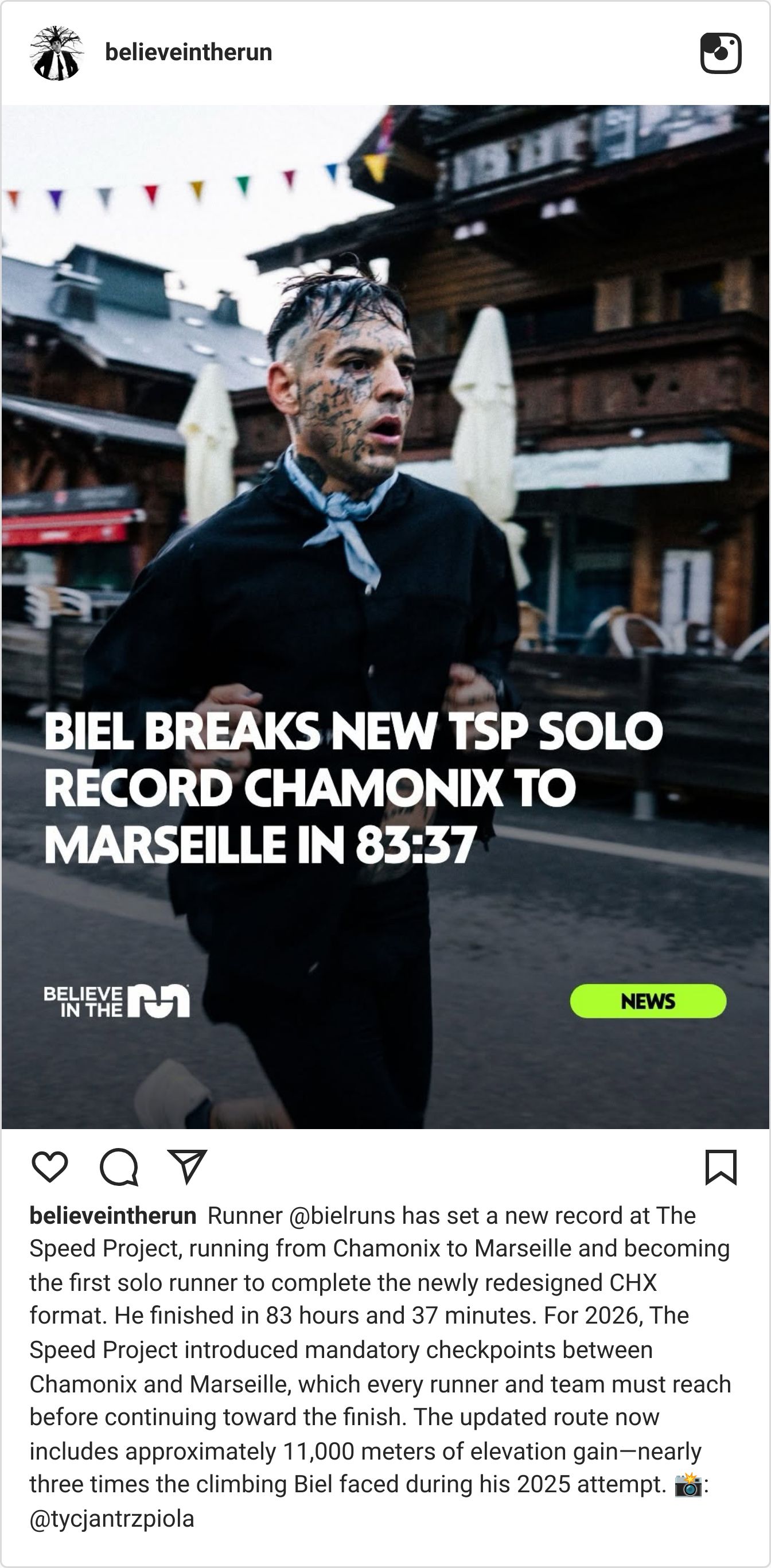
Brazilian ultrarunner Gabriel Barros – more commonly known as Biel – has set a new record time for the fastest solo run at The Speed Project’s Chamonix to Marseille endurance race.
Biel, who was taken to hospital after attempting the run last year, finished the newly redesigned CHX format in a time of 83 hours and 37 minutes.
This year’s TSP CHX>MRS saw mandatory checkpoints introduced on what is otherwise an unmarked trek from the French Alps to the Mediterranean Coast. The lack of a standard route means the distance can vary from 430km to 500km, but is generally accepted to be around the 450km mark.
The new checkpoints – which must be reached before athletes are allowed to move on to the next section of the race – mean the elevation is now around 11,000 metres, nearly three times what it was in 2025, when an under-prepared Biel required medical attention 72 hours into the race.
🏃🏼👏🏃🏼👏
What did you think of today's email?
That’s your Split. Until Next Time
Together, we go the distance. — @247_endurance 🏃♂️🚴♀️🏊♂️