


Presented by

Pool fine, but the lake falls apart by the first buoy? It’s rarely your fitness. It’s the breath you hold without noticing. Fresh Exit, with guest coach Lucas Tyler, fixes it in about six weeks of the pool sessions you already do. Fix my swim →
👋 Welcome back
Morning, endurance fans…
It has been almost a year since the announcement that a new Triathlon World Tour would be launched in 2027 – and with only a handful of races left in this season, our thoughts are naturally looking ahead to what this brave new dawn might bring to our sport.
The WTCS becomes the T50, the T100 gets a revamp, and Challenge Family joins the mix after the PTO bought a majority stake. Plenty to get your head around before anyone so much as looks at a trisuit.
Could Hayden Wilde really have a crack at both the new T50 and T100 world titles? How does a pro racer climb their way up from a Challenge start line onto the T100 Championship? And can the rest of us get a race bib? In this edition of The Daily Split, we get into what we know… and what we don’t know… about triathlon’s big shake-up.
Here’s what we have lined up for you today…
LATEST: The endurance news headlines
REPORTS: Action from the weekend’s races
ANALYSIS: We look at the Triathlon World Tour
TIPS: We debunk the myths of triathlon swimming
SPOTLIGHT: Why your swim falls apart by the first buoy
WARZONE: The man who swam the Strait of Hormuz
🏃🏼 Quick splits

Jelle Geens is lining up for another full-distance IRONMAN. [IRONMAN]
💪🏻 DETERMINED: Belgian Jelle Geens has signed up for another full-distance IRONMAN as he looks to fulfil his dreams of competing at Kona. Read HERE.
🤝🏻 CHALLENGE: Supertri is launching its Enduro format for age-groupers at six events in 2027 – and Jonny Brownlee could be racing. Read HERE.
🤕 RECOVERY: Mika Noodt has revealed the emotional strain of once again racing on his bike after he was badly injured at 70.3 Swansea. Read HERE.
❌ BANNED: Reigning world marathon champion Peres Jepchirchir has been banned for three years after admitting to EPO use. Read HERE.
🏁 Race news

Youri Keulen won his first full-distance IRONMAN at Cozumel on Sunday. [IRONMAN]
IRONMAN Cozumel
Lisa Perterer held off a late charge from Anna Bergsten to retain her IRONMAN Cozumel title in 8:21:56 on Sunday, while Youri Keulen overturned a deficit on the marathon to win the men’s race in 7:24:34.
Perterer did the damage on the bike, where she turned a deficit of more than a minute into a six-minute lead by the dismount. Keulen made his decisive move on foot, pulling away from full-distance debutant Lasse Nygaard Priester in the second half of the run.
IRONMAN Cozumel women’s results:
(Swim 3.8km - Bike 180km - Run 42.2km)
🥇 Lisa Perterer (AUT) 42:52 - 4:26:46 - 3:06:59 = 8:21:56
🥈 Anna Bergsten (SWE) 45:05 - 4:31:23 - 3:01:09 = 8:24:15
🥉 Loanne Duvoisin (SUI) 45:35 - 4:37:16 - 2:57:26 = 8:25:40
IRONMAN Cozumel men’s results:
(Swim 3.8km - Bike 180km - Run 42.2km)
🥇 Youri Keulen (NED) 38:29 - 4:01:41 - 2:40:05 = 7:24:34
🥈 Lasse Nygaard Priester (GER) 37:59 - 4:01:25 - 2:45:51 = 7:30:23
🥉 Michele Sarzilla (ITA) 38:01 - 4:08:18 - 2:39:36 = 7:30:33

Marjolaine Pierré won her third Long Distance Championship in four years. [World Triathlon]
Long Distance World Championship
French long-distance star Marjolaine Pierré earned her third world title in four years at the 2026 Multisport World Championships, shaking off the challenge of Caroline Pohle over the second half of the 30km run and pulling clear for the win on Sunday morning.
Germany’s Wilhelm Hirsch claimed the men’s crown, finishing five minutes ahead of Briton Will Draper, who put in an impressive bike display to take second place in a race that he won last year.
World Triathlon Long Distance Championships women’s results:
(Swim 3km - Bike 120km - Run 30km)
🥇 Marjolaine Pierré (FRA) 47:56 - 2:46:01 - 1:56:04 = 5:35:25
🥈 Caroline Pohle (GER) 46:22 - 2:47:44 - 1:59:12 = 5:38:38
🥉 Anne-Sophie Pierre (FRA) 55:54 - 2:54:41 - 2:02:56 = 5:58:22
World Triathlon Long Distance Championships men’s results:
(Swim 3km - Bike 120km - Run 30km)
🥇 Wilhelm Hirsch (GER) 38:29 - 4:01:41 - 2:40:05 = 7:24:34
🥈 Will Draper (GBR) 37:59 - 4:01:25 - 2:45:51 = 7:30:23
🥉 Wojciech Kopyciński (POL) 49:03 - 2:36:36 - 1:49:41 = 5:20:27
World Triathlon Cup
Carlotta Missaglia and Izan Edo Aguilar claimed their first World Triathlon Cup victories on Sunday as both races at the inaugural Tauranga event came down to sprint finishes at Pilot Bay.
Italy’s Missaglia broke clear of a seven-woman lead group to win in 57:33, with home favourite Nicole van der Kaay fifth after leading late on.
Spain’s Edo Aguilar went one better than his silver in Miyazaki the previous weekend, sprinting off the final bend to win the men’s race in 52:11.

The new-look Triathlon World Tour was announced in Qatar last year. [PTO]
🔍 The BIG issue: What we know (… and don’t) about 2027s World Tour
As the last rites are administered on what has been an enthralling triathlon year, thoughts and attention are very much starting to peek across into 2027 and a year which promises a great deal of change for our sport.
It was almost a year ago that the Professional Triathletes Organisation and World Triathlon announced they were to build on their T100 partnership by unveiling the all-new Triathlon World Tour.
The exciting rebrand was hailed as a ‘reimagining of the future’, with the hope being that it would ‘unlock triathlon’s untapped commercial and global opportunities’.
But what do we really know about the proposals? And what are we still waiting to find out? With more announcements expected in the run-up to the Qatar T100 finals in a couple of weeks, we’ve been busy crunching the data to give you an update on what we know… and what we don’t, ahead of the big switch.
What we do know…
One tour, two world titles: The Triathlon World Tour will launch in 2027, with the old World Triathlon Championship Series (WTCS) becoming the T50 World Championship Tour and the T100 Triathlon World Tour renamed the T100 World Championship Tour.
World Triathlon and the PTO will combine their race circuits under the one banner, with World Triathlon retaining governance of the sport overall.
The PTO has also bought a majority stake in Challenge Family: This deal was announced in February and brings an established network of races into the new tour. Fifteen Challenge events were named in the first T100 Challenger calendar, including Wanaka, Gran Canaria, Xiamen, and the flagship, The Championship, in Samorin. The races will take on Triathlon World Tour names but keep existing organisers and host cities. The Challenge Roth race was not included in the deal and remains as is.

The PTO has bought a majority stake in Challenge Family ahead of the 2027 season. [PTO]
There is a tier below the Championship: The T50 Cup will take over from the World Triathlon Cup, while the T100 Challenger gives middle-distance pros a route into the top tier.
Calendars have already been drawn up: The T50 Championship will kick off in Abu Dhabi over the weekend of March 27-28 with individual and mixed relay events, and there are nine races planned throughout the year. Venues include Samarkand, Yokohama, Rome, Quiberon, Los Angeles, London, Weihai and Tauranga, with the Finals held in Hamburg.
The T100 starts a week earlier, over the weekend of March 20-21, on Australia’s Gold Coast. There are eight races scheduled in Singapore, the French Riviera, San Francisco, Vancouver, Marbella, and Saudi Arabia, while the finals will be held in Qatar on December 10-11.
There are also 15 T50 Cup races and 15 T100 Challenger races lined up, with the prospect of more potentially being added to the calendar. The T50 Cup starts on March 6-7 in Lanzarote, while the T100 Challenger will first race on February 19-20 in Wanaka, New Zealand.

Short-course stars like Matt Hauser will compete in the T50 next year as the old WTCS branding will be replaced with the new Triathlon World Tour. [World Triathlon]
Getting involved as an amateur: Many of the venues for next year are already advertising opportunities for age-groupers to join in the fun, either on Championship or Challenger race days.
The T100 Championship opener on the Gold Coast is offering places for a 100km triathlon, a 10km run and an Olympic triathlon, while the T50 Championship event in London is taking bookings for the 100km, Olympic, sprint and super sprint triathlons.
A full list of the races and those distances which have been announced can be found by clicking the link HERE.
What we don’t know yet…
How do you race your way into the T100 Championship? Will a Challenger win earn an automatic championship start, or will athletes need to build up ranking points? How many places will be available to athletes coming through the Challengers once contracted athletes and wildcards are accounted for?
The PTO and World Triathlon have not yet published the exact 2027 qualification criteria or slot allocations for the T100 Championship Tour, though they have confirmed that the new Challenger tier will serve as an official feeder pathway.
Will there be any athlete contracts, and what will they commit to? How many contracts will be offered for 2027, how many starts will athletes owe the tour, and what flexibility will they have to chase Olympic qualification, race the IRONMAN Pro Series or target a one-off like Roth?
Contracts were removed from the T100 this season, but there has been no confirmation as to whether or not they will return for the World Tour.

Will athletes be able to not only compete in both the T50 and T100 next season, but can they hope to challenge for both titles? Hayden Wilde will certainly want to know. [PTO]
Can the biggest names seriously chase both titles? Hayden Wilde finished third at WTCS Abu Dhabi and won the Dubai T100 less than 24 hours later. Next year’s draft puts Yokohama and the French Riviera on the same weekend, and Rome and San Francisco on another. Which clashes will force athletes to choose, and will the two tours have a standing rule for athletes who want to double up? Will the chase for Olympic qualification end up tipping the balance when it comes to making a race choice?
How will the titles actually be won? How many results will count, and how heavily will the finals be weighted? Hamburg is billed as the T50 finale, yet Weihai and Tauranga appear later on the draft calendar. Which season will those two races count towards?
What will the prize money look like below the top tier? The launch promised an increase for the T50 Championship. How far down the field will it pay, and will T50 Cup and T100 Challenger athletes be able to cover the cost of travelling to enough races to progress?

How much of the Challenge Family will remain in the new World Tour? [Challenge Family]
How much of Challenge Family will still feel like Challenge Family? Will the new badge bring a standard 100km format to every Challenger, or will established races keep their own distances and courses? What happens to Challenge events outside the first 15, and how will qualification for Šamorín sit alongside any new route to Qatar?
Which races are still to be added? Does April’s Jeddah race replace the November Saudi slot, or could both go ahead? Dubai is already offering priority access for 2027 amateurs, but where will it sit on the pro calendar? And when will the T100 confirm which stops get the men, the women or both?
Where will we watch it all? The PTO has promised a unified broadcast offering. Will viewers be able to watch the T50 and T100 in the same place? What will be free to watch, and how much live coverage will the Cup and Challenger races get?
Are you excited for the new-look Triathlon World Tour in 2027?
👩💻 Trending in triathlon
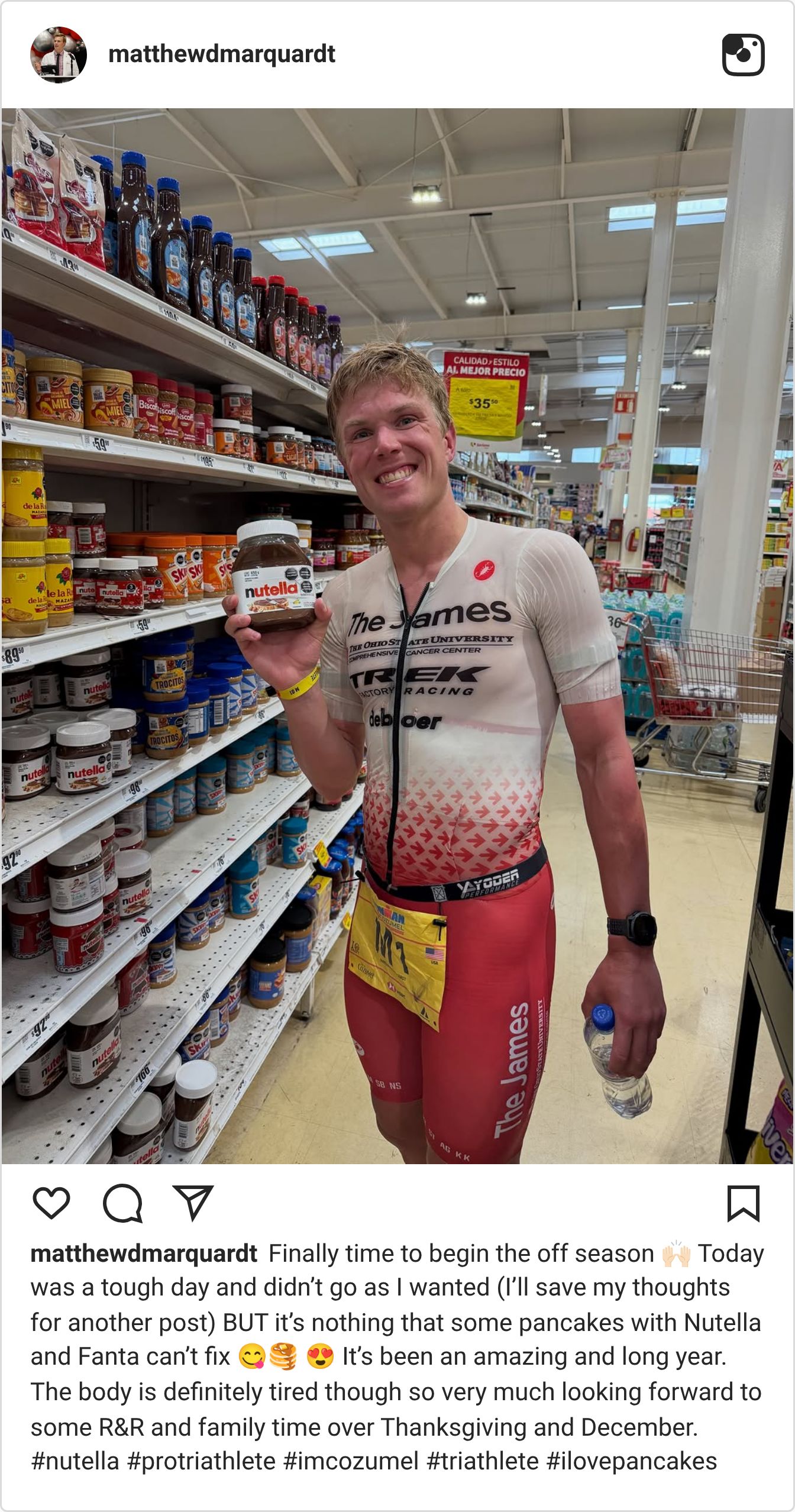
Nothing says it’s the off-season quite like pancakes with a big dollop of Nutella, washed down with a bottle of Fanta.
Well, that was certainly the case for American Matthew Marquardt this weekend after closing off his 2026 campaign with a battling fifth-placed finish at IRONMAN Cozumel.
Still wearing his signature red and white tri-suit, he made a quick pit stop on the way home to pick up some supplies… And judging by the size of his broad, beaming smile, he was pretty excited about his haul!!!
And we certainly won’t begrudge him his little treats, especially after a phenomenal season which saw him win IRONMAN South Africa, place second in Lake Placid and Sweden, and finish third on the Big Island.
Expect big things from him in 2027. 👏👏👏
⏱️ Coaches corner: Debunking the myths about triathlon swimming
Understanding the facts behind common swimming misconceptions helps triathletes train more effectively. Whether preparing for a sprint triathlon or a longer event, focusing on technique, safety, and consistent practice provides a more reliable foundation than following popular assumptions.
Here are eight of the most common myths that are simply NOT true…
MYTH 1 – To swim faster, you must pull harder: Many beginners assume that increasing arm effort automatically improves swimming speed. However, excessive force can create unnecessary fatigue without producing efficient forward movement. Swimming performance depends on several factors:
Body alignment.
Effective hand and forearm positioning.
Coordinated rotation.
Breathing control.
Reduced unnecessary drag.
MYTH 2 – You must have a perfect swimming technique: Some triathletes delay entering races because they believe their swimming technique must be flawless. In reality, swimming technique develops gradually through consistent practice. Beginners should prioritise:
Comfortable breathing.
Balanced body position.
Controlled arm movements.
Relaxed swimming.
Safe open water skills.

MYTH 3 – More swimming will always produce better results: Increasing training volume can improve endurance, but additional distance does not automatically produce better technique. Swimming repeatedly with inefficient movement may reinforce existing habits. Training quality matters alongside total distance, and a balanced swimming routine may include:
Technique practice.
Comfortable endurance swimming.
Controlled faster intervals.
Open water preparation.
Appropriate recovery.
MYTH 4 – Wetsuits make swimming easy: Wetsuits provide buoyancy and insulation, which can improve body position and reduce heat loss in suitable conditions. However, they do not eliminate the need for swimming ability or open water experience. A wetsuit cannot replace:
Breathing control.
Navigation skills.
Appropriate pacing.
Water confidence.
Safe swimming judgement.
MYTH 5 – Pool swimming fully prepares you for open water: Pool training is valuable for developing fitness and swimming technique. Open water practice should take place in suitable conditions with appropriate supervision or organised safety support. Never assume that strong pool swimming automatically guarantees safe open water performance.
MYTH 6 – You should hold your breath underwater: Some beginners hold their breath between strokes because they believe it helps maintain control. However, breath-holding can contribute to discomfort and an urgent need to inhale. A more effective approach generally involves exhaling steadily into the water and inhaling when the mouth clears the surface. There is no requirement to breathe every three strokes. Athletes should use a pattern that suits them – providing sufficient air and supporting efficient swimming.

MYTH 7 – Swimming straight happens naturally: Some triathletes assume they will maintain a straight swimming line simply by following their normal stroke. However, limited underwater visibility, uneven pulling and tricky environmental conditions can cause swimmers to drift off course.
Open water swimmers should also practice sighting, which involves briefly lifting the eyes to identify landmarks or course buoys. Effective navigation reduces unnecessary distance and improves race efficiency.
MYTH 8 – You should never stop during an open water swim: Some beginners believe stopping during a race means failure. However, pausing to regain control can be appropriate when breathing becomes uncomfortable or anxiety increases. Never push through severe breathing difficulty, chest pain, confusion, or other concerning symptoms.
If you become distressed:
Reduce your effort.
Float or tread water if safe.
Regain controlled breathing.
Signal race safety personnel when necessary.
Stop swimming if you cannot continue safely.
🏊 From the 247Endurance team
Myth 6, fixed: why your swim falls apart by the first buoy
If Myth 6 above sounded familiar, you’re in good company. Most triathletes hold their breath in the water without noticing. CO₂ builds, your head snaps up to breathe, your hips drop, and by the first buoy your heart rate is through the roof. The rest of the swim is recovery, and your bike pays for it.
More lengths won’t fix that. It’s a habit, and habits get trained.
That’s why we built The Fresh Exit System with guest swim coach Lucas Tyler, a multiple-time Canadian national champion. It’s a six-week programme on your phone that goes in order: calm breathing first, then body position, a catch that grips the water, a pace you can hold, open water and race day. Fifteen pool sessions, each one replacing a swim you’re already doing. Log a few numbers afterwards, and the next step opens when your numbers say the skill is there. Special winter price until 31 December
30-day guarantee: swim Modules 1 and 2 within 30 days. If you’re not calmer and more efficient in the water, email us and we’ll refund you in full.
Not sure yet? Take the 60-second Swim Start Profile and get the one drill that fits how your swim starts.
🚴♂️ News from the saddle
The Maryland Cycling Classic, a UCI-sanctioned pro race held in Baltimore, will not return to the calendar in 2027.
As first reported by Escape Collective, the race failed to secure funding after its backer, the Sport and Entertainment Corporation of Maryland, collapsed in late 2025.
The event was cancelled from its September slot this year amid doubts about its future. In July, the race’s executive director Steve Brunner told Escape he and the organising committee were “bullish” about bringing the race back for 2027. The same publication reported last week that efforts to revive the race have been abandoned.
Read the full story on Cycling Weekly HERE.
💪 Outside edge of endurance
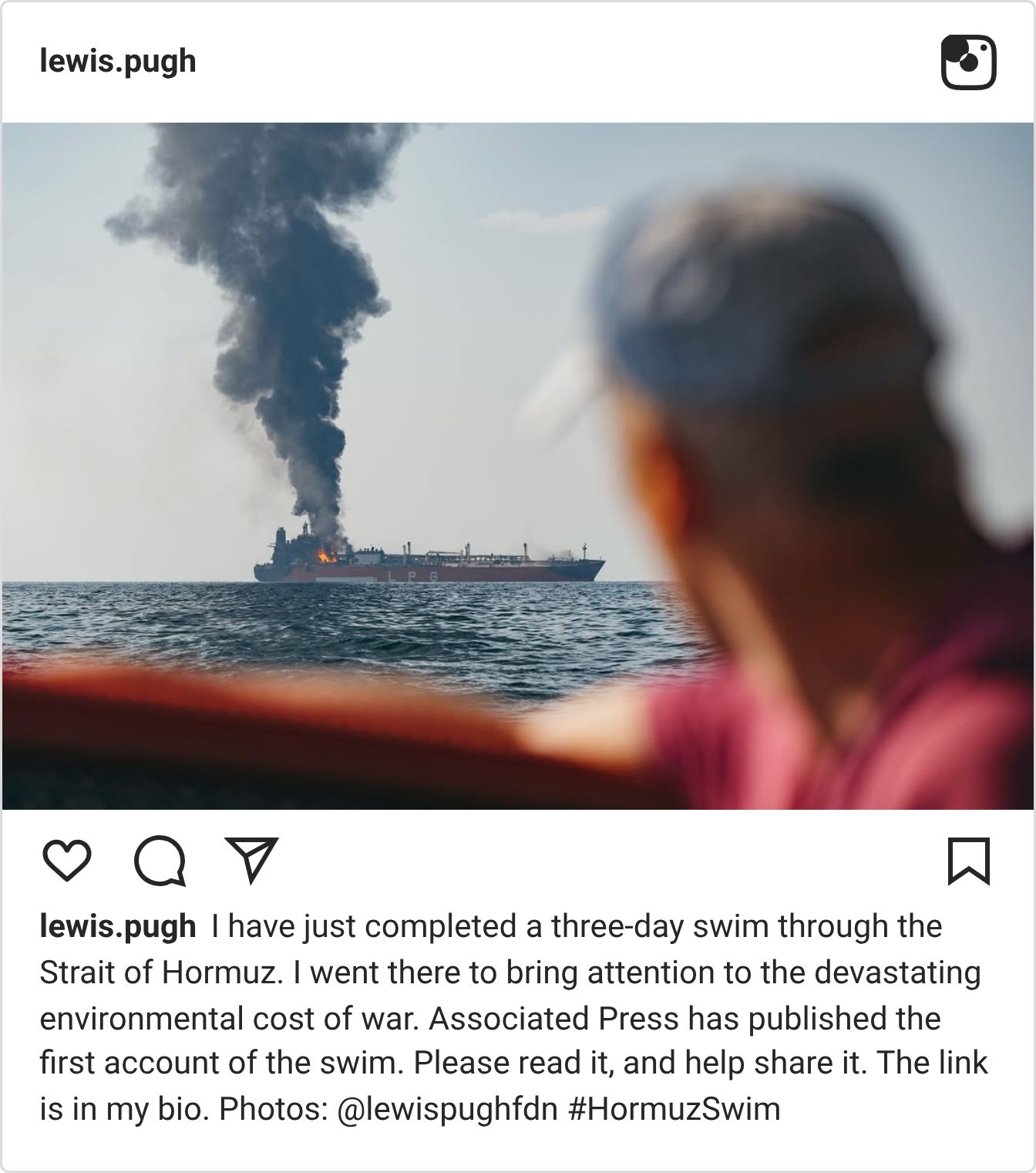
As open-water swims go, few come more treacherous than the one Lewis Pugh took on last week, when the British endurance athlete strapped on his goggles and dived headfirst into the war-torn Strait of Hormuz.
Barely half an hour later, he was back on dry land as an oil tanker was hit only a few kilometres away, and he rightly decided it was probably safer to wait a while before carrying on with his journey.
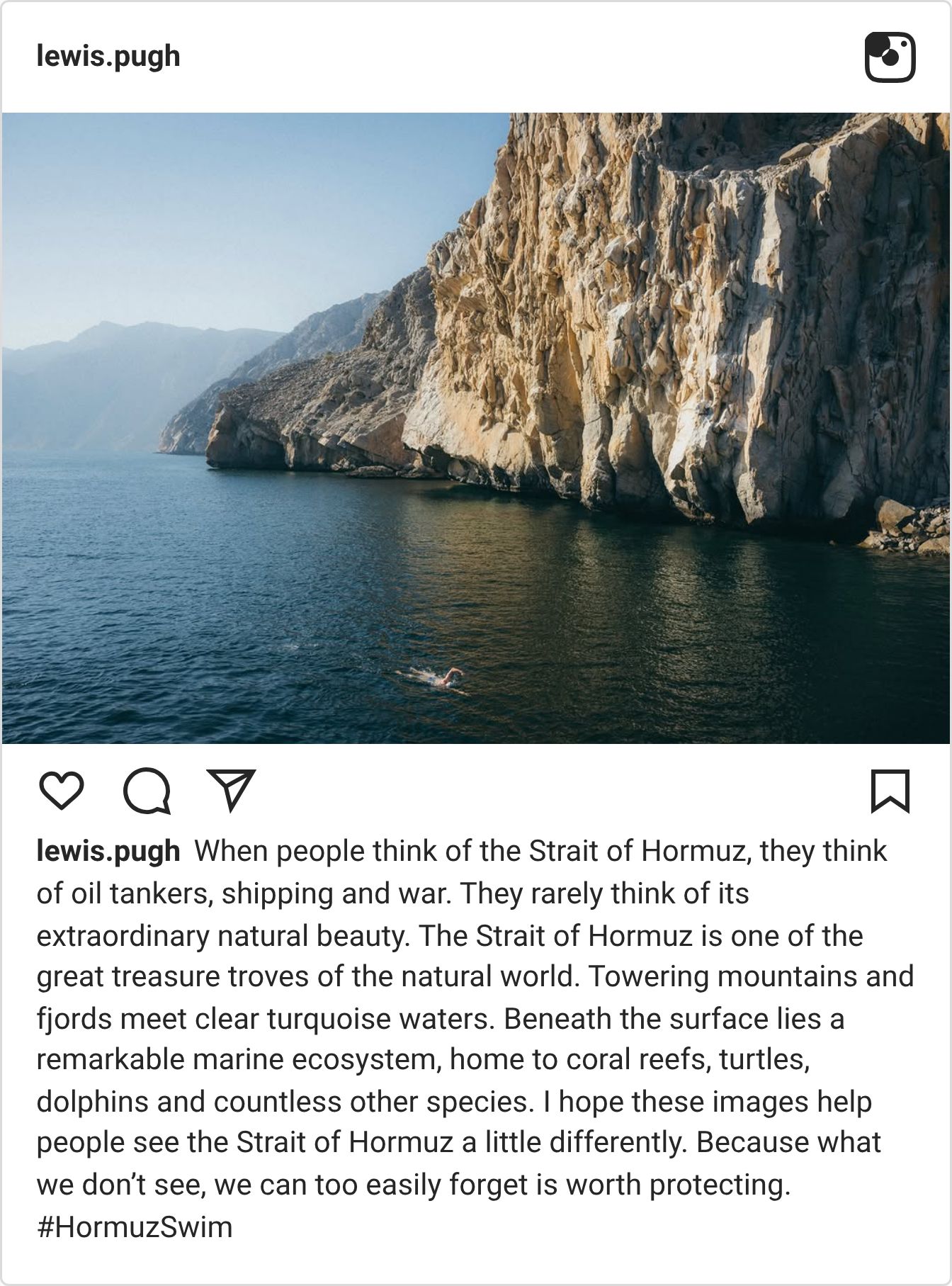
The challenge was aimed at drawing attention to the environmental damage caused by the war with Iran, with the 56-year-old covered about 15km (9.3 miles) in stages over three days, spending around six and a half hours in the water.
He set off from Oman’s Musandam peninsula and finished by rounding the Cape of Hormuz, wearing swimming trunks, goggles and a cap bearing the United Nations logo.
But it wasn’t only destruction that Pugh, a UN patron of the oceans, witnessed during his swim; he also described seeing green turtles, dolphins and ospreys along the route, a glimpse of the wildlife at risk when attacks on shipping send oil and chemicals into the water.
Read more about his extraordinary feat on his Instagram page HERE or by clicking the links below.
What did you think of today's email?
That’s your Split. Until Next Time
Together, we go the distance. — @247_endurance 🏃♂️🚴♀️🏊♂️