

👋 Welcome back
Morning endurance fans…
Two cities, five races and just over 18 hours between start lines… The upcoming UAE double-header has had a late shake-up, with the T100 men joining the women in Dubai after Jeddah’s switch to 2027.
In today’s Daily Split, we look at the big talking points surrounding what promises to be another thriller of a triathlon weekend, as Hayden Wilde is given the green light to race in both Friday’s WTCS and Saturday’s T100 races, and Julie Derron bids to take control of her own T100 title bid.
First, though, we celebrate two athletes who tore up the course records in Florida at the weekend. Magnus Ditlev and Alanis Siffert not only blew their rivals away, but they also rewrote history with incredible performances.
Buckle in and enjoy your Tuesday split…
Here’s what we have lined up for you today…
LATEST: The endurance news headlines
RACES: Magnus Ditlev sets new world record
ANALYSIS: UAE double-header explained in detail
SERIOUSLY? Clocking a 2:28:29 marathon wearing jeans?
TIPS: Expert safety advice on winter open-water swimming
🏃🏼 Quick splits

The UTMB World Series Majors will be expanded to six in 2027. [UTMB]
🥾 EXPANDING: Trail runners targeting a place at UTMB, CCC or OCC will have more opportunity in 2027 with an expansion of the ‘Majors’. Read HERE.
⏱️ RECORD: American Chris Myers has become the first-ever runner to break 20 hours at Australia’s Grampians Peaks Trail 100 Miler. Read HERE.
❌ SWITCH: Triathlon legend Lionel Sanders pulled out of last weekend’s Challenge Xiamen as he now focuses on IRONMAN Cozumel. Read HERE.
🎽 TOUGHEST: Cameron Main has revealed that running the 228km Red On Backyard Ultra was the ‘hardest thing’ he has ever done. Read HERE.
Today’s Split is Presented By

World of Triathlon LIVE returns to ExCeL London on 10–11 April 2027, powered by TriDot and promising a bigger second edition after its debut. The weekend brings more than 100 brands (including HUUB, Zone3, FORM and ROUVY), a Multisport Academy for technique and training advice, and the Beyond the Finish Line stage with Alistair Brownlee, Jess Learmonth, Kieran Lindars and Nikki Bartlett, hosted by Annie Emmerson.
New for 2027 is a Sunday-morning community 10 km run led by Brownlee. Weekend tickets start at £10, making it a practical stop for anyone wanting kit, insight and community in one place. Learn more here
🏁 Race news

Magnus Ditlev set a new full-distance world record in Florida. [IRONMAN]
IRONMAN Florida:
MEN’S RACE: Four weeks after his race fell apart while leading the IRONMAN World Championship in Kona, Magnus Ditlev went faster than anyone ever has over the full distance. The Dane won IRONMAN Florida in 7:19:17 on Saturday, taking 1:47 off the world best Sam Laidlow set at Challenge Roth in July.
Ditlev was out of the water in 47:52 and took the lead inside the first 10.2 miles of the bike. A 3:51:16 ride put him more than 11 minutes clear heading into T2. He then ran a 2:33:31 marathon to beat runner-up Rudy von Berg by 14:08. Only third-placed Matt Hanson ran faster (2:28:07).
His 7:19:17 is now the new fastest full-distance race finish, while the incredible nature of this season is highlighted by the fact that four of the top five best times have actually been set this season.
CURRENT TOP FIVE MEN’S FULL-DISTANCE RACE TIMES:
🇩🇰 Magnus Ditlev: IRONMAN Florida, 2026 = 7:19:17
🇫🇷 Sam Laidlow: Challenge Roth, 2026 = 7:21:04
🇳🇴 Kristian Blummenfelt: IRONMAN Cozumel, 2021 = 7:21:12
🇳🇴 Kristian Blummenfelt: IRONMAN Texas, 2026 = 7:21:24
🇧🇪 Marten Van Riel: IRONMAN Texas, 2026 = 7:22:56
TOP FIVE MEN’S FULL-DISTANCE RACE TIMES PRE-2026:
🇳🇴 Kristian Blummenfelt: IRONMAN Cozumel, 2021 = 7:21:12
🇩🇰 Magnus Ditlev: Challenge Roth, 2024 = 7:23:24
🇳🇴 Kristian Blummenfelt: IRONMAN Texas, 2025 = 7:24:20
🇩🇰 Magnus Ditlev: Challenge Roth, 2023 = 7:24:40
🇫🇷 Denis Chevrot: IRONMAN Hamburg, 2023 = 7:26:21

Alanis Siffert completed a stunning 2026 season with victory at Florida. (IRONMAN)
WOMEN’S RACE: Alanis Siffert capped a breakthrough season by winning IRONMAN Florida in 8:07:37, running down Britain’s Holly Lawrence and pulling away to win by more than 16 minutes in Panama City Beach.
The Swiss athlete had already won Challenge Roth and taken bronze at the IRONMAN 70.3 World Championship in Nice. She chose to sit out Kona this year, and her victory in Florida, her first in an IRONMAN, gives her the option to race at the 2027 IRONMAN World Championship.
Siffert’s 2:45:03 marathon took her way inside Skye Moench’s (USA) previous Florida best of 8:22:28. Indeed, it was one of the quickest times ever on what was a record-breaking day – placing her fourth in the women’s all-time table of quickest full-distance finishes.
CURRENT TOP FIVE WOMEN’S FULL-DISTANCE RACE TIMES:
🇩🇪 Anne Haug: Challenge Roth, 2024 = 8:02:38
🇩🇪 Laura Philipp: IRONMAN Hamburg, 2025 = 8:03:13
🇬🇧 Kat Matthews: IRONMAN Hamburg, 2025 = 8:05:13
🇨🇭 Alanis Siffert: IRONMAN Florida, 2026 = 8:07:37
🇨🇭 Daniela Ryf: Challenge Roth, 2023 = 8:08:21
Challenge Xiamen:
Zachary Bernier-Michaud (CAN) started the half marathon nearly five minutes behind Dorian Horsten (NED) but caught him in the closing metres to win a dramatic Challenge Xiamen in China on Saturday.
Norwegian stars Kristian Blummenfelt and Gustav Iden had headlined the men’s field, but they finished 13th and 16th, respectively, as Bernier-Michaud ran 1:11:45 to claim his first professional middle-distance win.
Sara Pérez Sala had a very different race in the pro women’s event. The Spaniard led from the gun and rode a 2:02:35 bike split on her way to a successful title defence by almost 15 minutes in hot and windy conditions.

Taylor Knibb took silver in Chile at the weekend. (World Triathlon)
World Triathlon Cup, Chile:
Taylor Knibb lasted four days in off-season mode before deciding she wanted to race again! Less than a month after winning the IRONMAN World Championship, the American came within a sprint finish of landing a World Triathlon Cup in Chile.
Colombia’s Maria Carolina Velasquez Soto pipped Knibb to win the inaugural World Cup in Iquique on Sunday, with both women clocking 55:47. Spain’s David Cantero Del Campo won the men’s race, while the Hong Kong World Cup races delivered two tight individual finishes and a Swiss comeback in the mixed relay.

Will Hayden Wilde race in both the WTCS and T100 this weekend? [PTO]
🔍 The BIG issue: Wilde looks to do the double after huge Dubai switch
Hayden Wilde could spend Friday afternoon defending his WTCS Abu Dhabi title and then line up on Saturday morning at the rearranged T100 in Dubai after being given permission by World Triathlon to compete in both.
The prospect of him – and indeed any other athlete wishing to take on the double header – racing two start lines in two cities, just 18 hours and three minutes apart, was given the green light on Monday evening by the World Triathlon Technical Committee.
With the men’s T100 in Saudi Arabia cancelled due to the ongoing unrest in the Middle East, the male athletes will now join the women in Dubai on Saturday for the final regular-season stop in their respective titles.
Meanwhile, Friday’s sprints in Abu Dhabi – themselves rearranged from the start of the season due to the war in Iran – will carry Olympic qualification points… it promises to be another thrilling weekend in a season which just keeps on giving!!!
Here are seven things you need to know before the racing starts…
1: Why are the men now racing in Dubai?
Dubai was always on the calendar for the women. The men were due to race in Jeddah on 27 November, but the inaugural Saudi Arabia T100 and its accompanying World Triathlon Cup have both moved to 16-17 April 2027. Organisers cited a joint review of the organisational and technical preparations for the event.
That left the men a race short before December’s Qatar final. The PTO wanted to preserve a fourth regular-season round, and Dubai already had the course and a pro race in place at Al Mamzar. The men will now start five minutes ahead of the women on Saturday morning. Dubai becomes the only regular-season stop this year to stage both pro fields.

The T100 in Saudi Arabia has been postponed until April 2027. [PTO]
2: Why is WTCS Abu Dhabi after the Grand Final?
Abu Dhabi was supposed to open the WTCS season in March. The elite races were postponed amid the conflict in the Middle East and rearranged for November alongside the World Triathlon Multisport Championships on Hudayriyat Island. The individual sprints are on Friday, followed by the mixed relay on Saturday.
The 2026 series titles were settled in Pontevedra, but Friday still matters. There are Olympic qualification points, World Triathlon ranking points and regular WTCS prize money on offer. Wilde and Lisa Tertsch won here last year, while the initial men’s field also included newly crowned world champion Vasco Vilaça, Matt Hauser and Alex Yee.
3: Can Wilde really race in both?
The World Triathlon Technical Committee has granted athletes permission to race both WTCS Abu Dhabi and the Dubai T100. That clears the way for Wilde, who is on both start lists, and any other athlete entered in both events to attempt the double.
The decision matters because World Triathlon’s rules normally require at least 24 hours between starts when an athlete contests two triathlon or multisport races, and at least one is a standard distance or longer. Friday’s WTCS race is a sprint, but Saturday’s T100, with its 2km swim, 80km bike and 18km run, takes the double beyond that threshold. Wilde’s starts are at 16:00 on Friday and 10:03 on Saturday, almost six hours inside the usual minimum.
Now comes the hard part. Wilde has to finish an all-out sprint on Hudayriyat Island, get himself and his kit to Al Mamzar, then refuel, sleep and be ready to race 100km the next morning. He raced both formats on the same weekend on the French Riviera and in Wollongong last year, with little more than 24 hours between starts each time. This is a tighter turnaround with a trip between cities thrown in.

Mikka Noodt returns to action this weekend after his Swansea crash. [PTO]
4: Why does Wilde need to race in Dubai?
The reigning T100 champion leads the standings with 96 points, with wins in Singapore and on the French Riviera and a third place in San Francisco. Only his best three regular-season scores count, so even a win in Dubai would add just nine points to his total, replacing the 26 he earned in San Francisco with 35. A second place would add three.
The race has a different value for the men chasing him. Jake Birtwhistle and Lasse Nygaard Priester sit second and third in the standings, while Kyle Smith was third on the French Riviera. There’s also a comeback to watch. Mika Noodt is on the Dubai start list after his serious bike crash at IRONMAN 70.3 Swansea in July.
So in many ways, the main benefit of Wilde competing would be to block his closest rivals from securing wins and podium places, which could see them gain on his handy lead at the top of the rankings.

Julie Derron won in Dubai last season. [PTO]
5: Let’s not forget the women are in Dubai also
The late addition of the men’s race has grabbed the headlines, but the women arrive in Dubai with just three points covering the top three in the Race to Qatar. Julie Derron leads on 64, with fellow Swiss Imogen Simmonds on 62 and Britain’s Georgia Taylor-Brown on 61. Simmonds was absent from the announced Dubai field, leaving Taylor-Brown, who won in Spain in May, as the closest challenger to Derron on Saturday.
6: What does it all mean for Qatar?
Dubai is the last chance for both fields to improve their regular-season scores before the 10-12 December final in Doha. The title goes to the athlete with the highest total from their best three regular-season results plus the final. A win in Dubai is worth 35 points. A win in Qatar is worth 55. That extra weight means the standings on Saturday will tell us who has the advantage heading to Doha, with plenty still to race for.
7: When do they race and how can we watch?
13/11/26: WTCS Abu Dhabi women’s sprint (14:00 local time)
13/11/26: WTCS Abu Dhabi men’s sprint (16:00 local time)
14/11/26: T100 Dubai Pro Men (10:03 local time)
14/11/26: T100 Dubai Pro Women (10:08 local time)
14/11/26: Abu Dhabi mixed relay (16:15 local time)
TriathlonLive has live coverage of the women’s and men’s races at WTCS Abu Dhabi on Friday, with the mixed relay also being shown on Saturday. The T100 Dubai races will be streamed for free on the T100 YouTube page.

Kate Waugh and Hayden Wilde won the T100 titles last year. [PTO]
👩💻 Trending in triathlon
His dreams of winning another World Championship may have come crashing down on the Kona roadside, but Sam Laidlow says he has (just about) come to terms with his feelings of bitter disappointment.
The Frenchman pulled up shortly after exiting T2, struggling with the vascular condition iliac artery endofibrosis – a problem caused by repetitive hip flexion, which leads to arterial wall thickening and reduced blood flow.
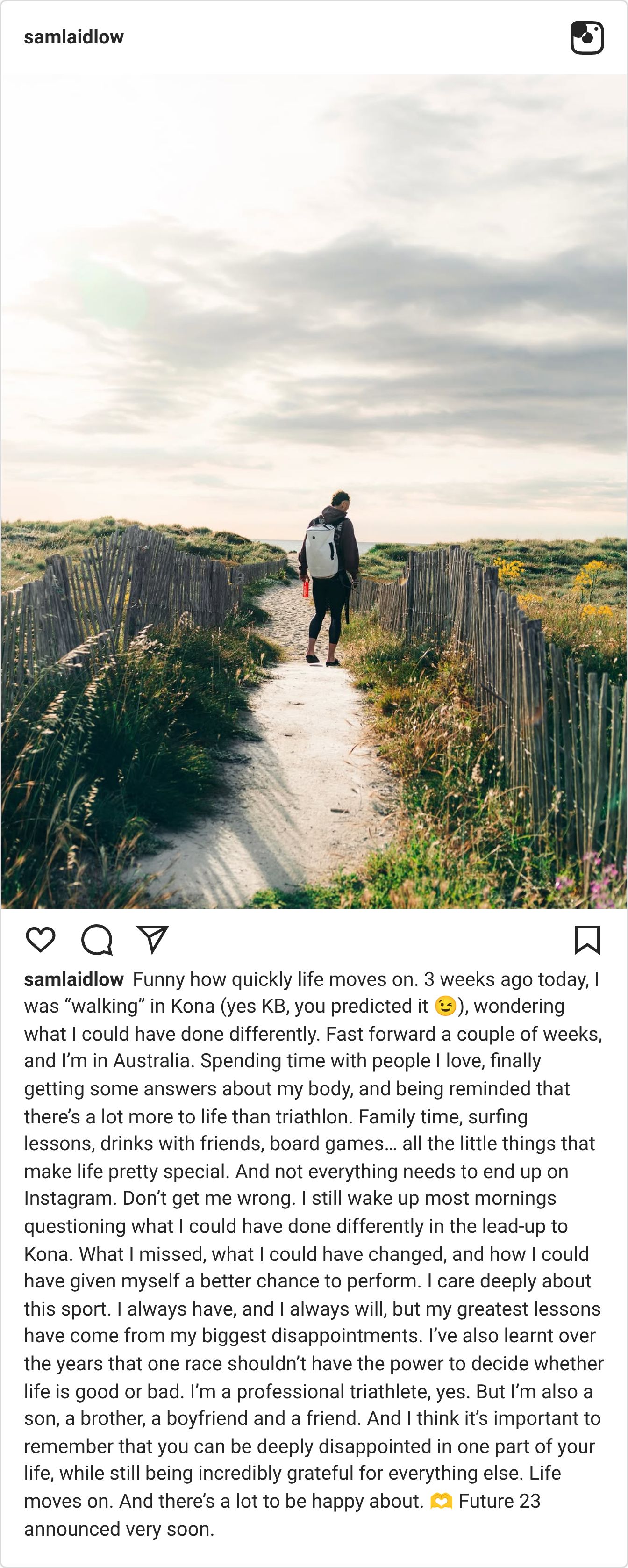
It is an issue which is likely to require surgery before he competes again next season… But until then, he is focusing more on a mental kind of recovery, as he explained in a recent post on Instagram.
Together with images of him enjoying some downtime at the seaside, he wrote: “Funny how quickly life moves on. 3 weeks ago today, I was “walking” in Kona (yes KB, you predicted it 😉), wondering what I could have done differently.
“Fast forward a couple of weeks, and I’m in Australia. Spending time with people I love, finally getting some answers about my body, and being reminded that there’s a lot more to life than triathlon.
“Family time, surfing lessons, drinks with friends, board games… all the little things that make life pretty special.”
But don’t mistake his need for downtime as a sign that he is growing tired of the triathlon grind… far from it.
“Don’t get me wrong,” he insists. “I still wake up most mornings questioning what I could have done differently in the lead-up to Kona. What I missed, what I could have changed, and how I could have given myself a better chance to perform.
“I care deeply about this sport. I always have, and I always will, but my greatest lessons have come from my biggest disappointments… one race shouldn’t have the power to decide whether life is good or bad.
“And I think it’s important to remember that you can be deeply disappointed in one part of your life while still being incredibly grateful for everything else. Life moves on. And there’s a lot to be happy about. 🫶”
Here, here, Sam… We can’t wait to see you out there competing again in 2027.
⏱️ Coaches corner: How to continue open-water swimming in the winter
Continuing open-water swimming in winter can help triathletes maintain outdoor swimming skills, confidence, and familiarity with changing water conditions. However, cold temperatures make winter swimming significantly different from training in warmer months.
UNDERSTAND THE RISKS: Cold water creates immediate physiological responses that can affect swimming safety. Risks include:
Rapid loss of hand coordination.
Reduced swimming efficiency.
Muscle weakness.
Difficulty maintaining body position.
Progressive cooling.
Impaired judgement.
Hypothermia.
CHOOSE A SAFE SWIMMING LOCATION: Not every open water location is suitable for winter swimming. Cold temperatures, reduced daylight, changing currents, and limited emergency access can increase risks.
Avoid unfamiliar lakes, rivers, and coastal areas without appropriate local safety information. Check weather forecasts and local warnings before every session. Choose locations with:
Supervised swimming sessions.
Lifeguards or qualified safety personnel.
Clearly marked swimming areas.
Reliable entry and exit points.
Accessible changing facilities.
Established emergency procedures.
USE APPROPRIATE EQUIPMENT: Suitable equipment can improve comfort and help reduce heat loss, although it cannot eliminate cold water risks. Important equipment includes:
Wetsuit: Provides insulation and buoyancy.
Neoprene swim cap or hood: Helps reduce heat loss.
Neoprene gloves: May improve hand comfort in cold conditions.
Neoprene socks or booties: Help protect feet from cold.
Bright swim cap: Improves visibility.
Tow float: Improves visibility.
ACCLIMATISE TO COLD WATER GRADUALLY: Cold water acclimatisation involves becoming more familiar with the physical sensations and responses associated with colder water. However, acclimatisation does not eliminate cold shock, swimming impairment, or hypothermia risk. A cautious approach includes:
Beginning with supervised sessions in manageable conditions.
Keeping initial exposure brief.
Entering the water slowly where safe.
Allowing breathing to settle before swimming.
Increasing exposure only when conditions and individual tolerance permit.
Stopping immediately if symptoms become concerning.
CONTROL BREATHING BEFORE SWIMMING: Cold water immersion can cause sudden gasping and rapid breathing. Trying to swim immediately during this response increases the risk of inhaling water.

KEEP YOUR SESSIONS SHORT: Winter swimming should not follow the same distance targets as summer endurance sessions. Cold exposure can reduce muscular coordination and swimming ability even when athletes initially feel comfortable. A safer approach is to focus on brief, supervised exposure rather than achieving a specific distance.
MAINTAIN SWIMMING FITNESS INDOORS: Winter open water swimming does not need to provide most of a triathlete’s swimming training volume. Indoor pools offer a more controlled environment for endurance, technique, and structured workouts.
PREPARE FOR RECOVERY: Leaving cold water does not immediately stop body cooling. Core temperature can continue falling after exiting, a phenomenon commonly called afterdrop. Swimmers should prepare their recovery equipment before entering the water. Important steps include:
Leaving the water through a safe exit.
Drying off promptly.
Removing wet clothing.
Putting on warm, dry layers.
Moving into a sheltered environment.
Consuming a warm nonalcoholic drink if fully alert and able to swallow.
Remaining with another person until recovered.
KNOW WHEN TO STOP: Knowing when to leave the water is one of the most important winter swimming skills. Warning signs include:
Uncontrolled breathing.
Loss of hand coordination.
Increasing muscle weakness.
Difficulty swimming normally.
Confusion or unusual behaviour.
Dizziness.
Extreme fatigue.
Difficulty reaching the exit.
Cold incapacitation can develop before a swimmer recognises how seriously their ability has deteriorated.
🚴♂️ News from the saddle
Luxembourg's cycling federation has filed a complaint after its rider, Marie Schreiber, was relegated from first to second at the UEC European Cyclo-cross Championships on Sunday.
The 23-year-old crossed the line first ahead of Dutchwoman Lucinda Brand in Zeddam but was judged to have sprinted irregularly by the UCI commissaires, and therefore Brand was awarded the European title. In the aftermath, Schreiber refused to attend the podium ceremony, describing the decision as ‘disrespectful’.
On Monday, the Fédération du Sport Cycliste Luxembourgeois (FSCL) revealed that it had complained to the race organiser, the Union Européenne de Cyclisme (UEC). A statement said: “The FSCL is calling for the race standings to be determined based on the order in which the riders crossed the finish line.”
The decision lies with cycling's governing body, the UCI, however.
Read the full story at Cycling Weekly HERE.
💪 Outside edge of endurance
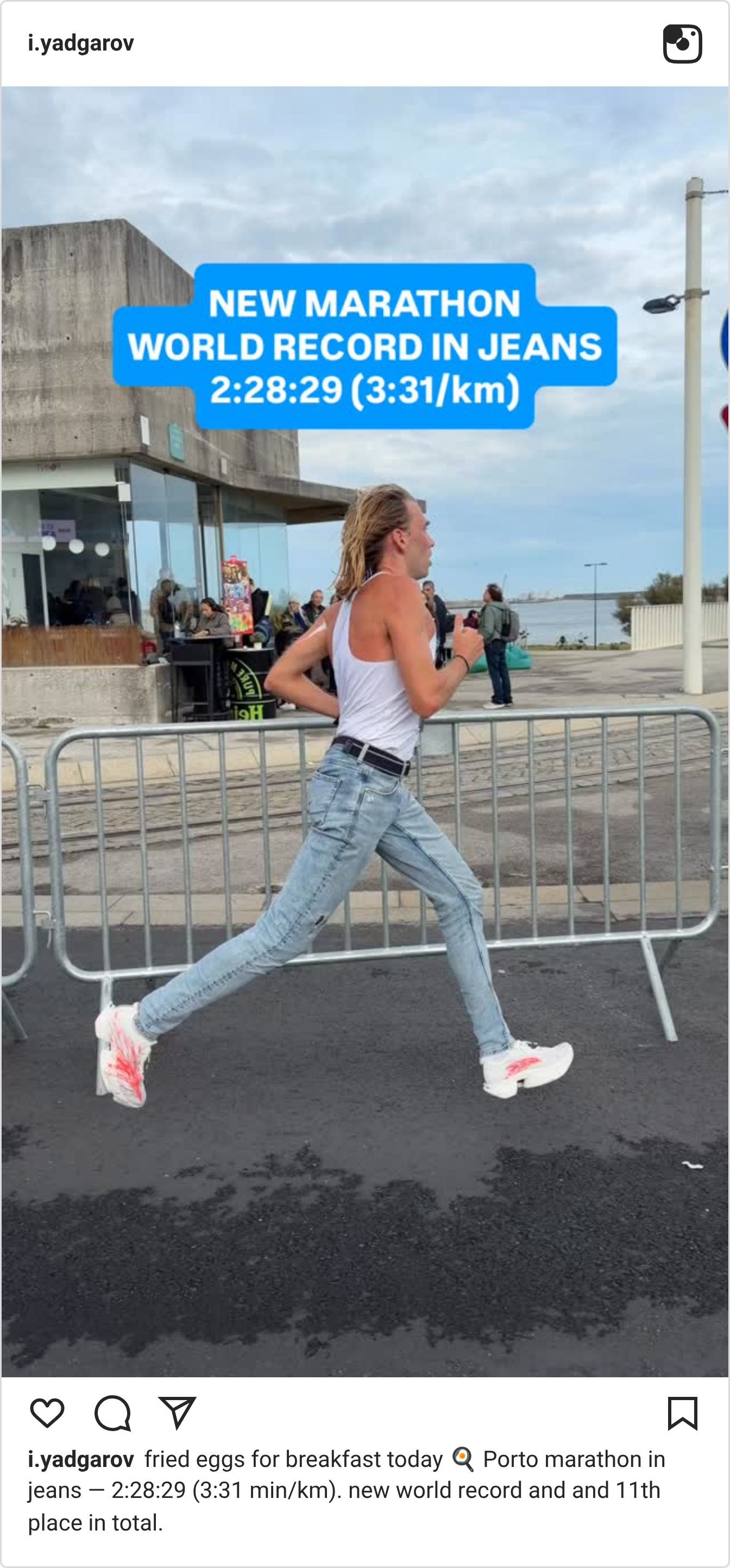
Six weeks after running the Berlin Marathon in bright yellow Crocs, Iskander Yadgarov found another way to make 26.2 miles look even less comfortable. The Russian pulled on a pair of jeans for Sunday’s Porto Marathon and finished 11th overall in 2:28:29. That’s 3:31 per kilometre in denim.
And yes, you read that right: he wore the Crocs in Berlin, where he clocked 2:30:03 on September 27, meaning he went 94 seconds quicker in Porto. Two marathons, two very questionable wardrobe choices and a pair of times that most runners would take in their best race kit.
What attire will he try next? The mind boggles…
What did you think of today's email?
That’s your Split. Until Next Time
Together, we go the distance. — @247_endurance 🏃♂️🚴♀️🏊♂️